Why Bitcoin's Difficulty Adjustment Isn't Perfectly Smooth (And Why That's OK)
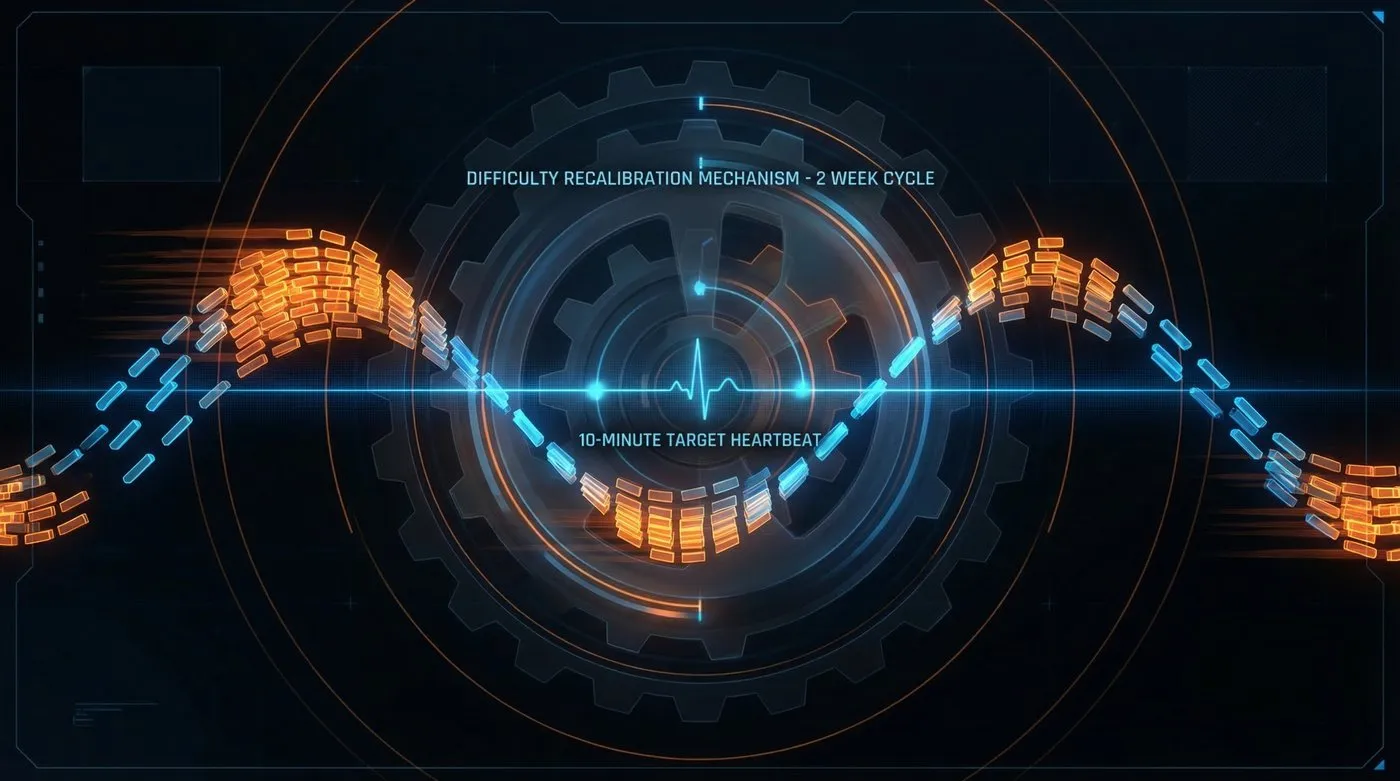
If you’ve ever watched Bitcoin’s block times, you’ve noticed something odd: they’re all over the place. One block arrives in 30 seconds, the next takes 25 minutes. Over a few hours, things average out to the famous 10-minute target. But zoom in on a single difficulty period, and you’ll see blocks speed up and slow down in waves.
This isn’t a bug. It’s the price Bitcoin pays for a difficulty adjustment algorithm that’s stable, secure, and impossible to game. The network could theoretically adjust difficulty after every block, smoothing out variance to near perfection. But that would open the door to manipulation, wild oscillations, and attacks that could destabilize the entire chain.
Here’s why Bitcoin’s difficulty adjustment is intentionally “lumpy,” and why that lumpiness is a feature.
How difficulty adjustment actually works
Bitcoin’s difficulty algorithm is deceptively simple. Every 2,016 blocks (roughly two weeks at the 10-minute target), the network calculates how long those blocks actually took and adjusts difficulty accordingly:
new_difficulty = old_difficulty × (expected_time / actual_time)Where expected_time is 20,160 minutes (2,016 blocks × 10 minutes) and actual_time is the timestamp difference between the first and last block of the period.
If miners found blocks faster than 10 minutes on average, difficulty goes up. If they were slower, it goes down. The adjustment is capped at 4× in either direction to prevent abrupt swings.
As of March 2026, difficulty sits at 145.04 trillion. The next adjustment on March 20 is expected to drop it to around 135.13 trillion, a roughly 6.8% decrease. That’s because hashrate has been slightly lower than the previous period, stretching average block times a bit past 10 minutes.
Why not adjust every block?
On the surface, continuous adjustment sounds elegant. If a block comes in 5 minutes after the last one, bump difficulty up slightly. If it takes 20 minutes, nudge it down. Over time, you’d converge on a perfect 10-minute average with minimal variance.
Here’s the problem: block discovery is random.
Mining is a lottery. Miners generate trillions of hashes per second, hoping to find one that falls below the current target. The time between blocks follows an exponential distribution with a mean and standard deviation both equal to 10 minutes. That means:
- 63% of blocks are found in under 10 minutes
- 37% take longer than 10 minutes
- Some blocks take seconds, others take over an hour
If you adjust difficulty based on every block or every few blocks, you’re reacting to noise, not signal. You’d get a feedback loop:
- Fast block → difficulty increases
- Higher difficulty → slow block (just random variance)
- Slow block → difficulty decreases
- Lower difficulty → fast block
- Repeat forever
This isn’t theoretical. Many altcoins tried faster adjustments and suffered exactly this fate: wildly oscillating difficulty and unstable block times that miners could exploit.
Bitcoin’s 2,016-block window smooths out the randomness. By the law of large numbers, the average block time over 2,016 blocks converges toward the true mean (10 minutes, if hashrate is constant). The adjustment is accurate without overreacting to variance.
The 2-week oscillation pattern
Here’s where things get interesting. Difficulty is locked in for the entire 2,016-block period, but hashrate is not.
Scenario 1: Hashrate increases mid-period
- Difficulty was set based on the previous two weeks
- New miners join (or existing miners deploy more hardware)
- With more hashrate but the same difficulty, blocks arrive faster than 10 minutes
- The period ends early (say, 12 days instead of 14)
- Next adjustment: difficulty jumps to compensate
Scenario 2: Hashrate decreases mid-period
- Miners shut down due to low prices, regulation, or energy costs
- With less hashrate but the same difficulty, blocks slow down
- The period drags on (maybe 16 days instead of 14)
- Next adjustment: difficulty drops
If hashrate is constantly changing, you get a perpetual back-and-forth: difficulty playing catch-up with reality. This is exactly what we’ve seen in recent years.
Real-world examples
February 2026: Winter Storm Fern
Bitcoin mining difficulty fell 11.16% at block height 935,424, the largest single negative adjustment since China’s 2021 mining ban. Winter Storm Fern drove mass miner curtailments across US power grids. Marathon Digital alone shut down 770 MW of capacity. Network hashrate dropped roughly 20% in two weeks. Blocks slowed to 12-14 minutes on average until the adjustment kicked in and restored the 10-minute target.
June 2025: Post-halving hashrate slump
Difficulty dropped 7.5% after hashrate fell about 30% in two weeks to under 700 EH/s. This was attributed to miner capitulation following the April 2024 halving, which cut block rewards in half and squeezed margins.
May-July 2021: China mining ban
When China banned crypto mining in May 2021, Bitcoin’s hashrate collapsed. Difficulty saw multiple massive drops: -27.94% on July 3 (the largest negative adjustment in Bitcoin’s history), -15.97% in June, and several more adjustments of -12% to -16%. Block times stretched to 14-20 minutes during the worst periods as the remaining miners struggled to keep up.
The pattern is consistent: major hashrate shocks cause block time disruption for up to two weeks, then the adjustment kicks in and restores equilibrium. The system self-heals, but not instantly.
Can miners exploit this?
In theory, yes. In practice, not really.
The most serious theoretical attack is the time warp attack. A majority-hashrate miner could manipulate block timestamps to artificially lower difficulty. By setting timestamps at the minimum allowed (median time past + 1 second) for 2,015 blocks, then jumping to the current time at block 2,016, they could make it appear blocks took twice as long as they actually did. Over multiple periods, this could eventually let them mine blocks at 6/second instead of 1 every 10 minutes.
Why hasn’t this happened? It requires 51%+ hashrate, is publicly visible for about a month before it accelerates, and would destroy Bitcoin’s value, killing the attacker’s mining revenue. A proposed fix in the Consensus Cleanup soft fork would tighten timestamp rules to make this impossible.
Other forms of “exploitation” (strategic hashrate deployment, selective block withholding) are either impractical due to randomness or don’t actually benefit from the 2-week period specifically.
Why this trade-off was chosen
Satoshi Nakamoto never explicitly documented why 2,016 blocks was chosen. The Bitcoin whitepaper doesn’t mention the adjustment period at all. But the design reflects several elegant trade-offs:
1. Stability over responsiveness
A two-week delay is acceptable for a monetary system with a 140-year emission schedule. Perfect real-time tracking isn’t necessary.
2. Statistical soundness
2,016 samples is enough for the law of large numbers to dominate random variance. Jameson Lopp’s analysis shows actual block time distributions match theoretical exponential distributions remarkably well.
3. Security
Discrete adjustment periods prevent timestamp manipulation attacks that continuous adjustments would enable. More frequent adjustments would create more opportunities to game timestamps for infinitesimal advantages in block races, as discussed on Bitcoin StackExchange.
4. Simplicity
The algorithm is trivial to implement and audit. Every node can independently verify it. No complex moving averages or weighted factors.
5. Predictability
Miners, users, and protocol developers know exactly when the next adjustment will hit. The 21 million cap and roughly 140-year emission schedule depend on this algorithm working consistently.
Why “not perfectly smooth” is fine
Bitcoin doesn’t need microsecond precision. It needs:
- Long-term predictability: The 10-minute average holds over years ✓
- Resistance to manipulation: The 2-week window is too large to game profitably ✓
- Robustness to shocks: Even a 50% hashrate drop self-corrects in 2-4 weeks ✓
The “lumpiness” is a real-time signal of market dynamics: miner profitability, regulatory shifts, hardware deployments. The difficulty adjustment acts as a stabilizing flywheel that kicks in every two weeks, absorbing the chaos and keeping the network on track.
Users waiting for confirmations might notice variance (a block could take 30 seconds or 30 minutes), but over 6 confirmations (roughly one hour on average), the variance washes out. For Lightning Network users, on-chain settlement speed is already abstracted away.
Bitcoin’s difficulty adjustment isn’t perfectly smooth because perfect smoothness would require:
- Continuous adjustment → unstable oscillations and manipulation risks
- Omniscient hashrate prediction → impossible
- Centralized control → defeats the purpose
The 2,016-block window is a Goldilocks solution: long enough to average out randomness, short enough to respond to real hashrate changes, simple enough to be verifiable by anyone, and secure enough to resist manipulation.
When people say “Bitcoin’s difficulty adjustment is its most important feature,” they’re not exaggerating. It’s what makes the 21 million cap enforceable, the 10-minute block time stable, and the network antifragile to miner churn. The occasional 12-day or 16-day period is the price of that stability. And it’s a price worth paying.
- Blockchain.info
- CoinWarz
- Learn Me a Bitcoin
- Bitcoin StackExchange - Standard deviation
- Bitcoin StackExchange - Why 2 weeks
- The Block - Feb 2026
- The Block - June 2025
- ZyCrypto - China ban
- Bitcoin Optech - Time warp
- Bitcoin Optech - Consensus Cleanup
- Lopp - Block time variance
Data/status as of March 14, 2026.