Bitcoin Miners as Grid Stabilizers — Until the Weather Turns
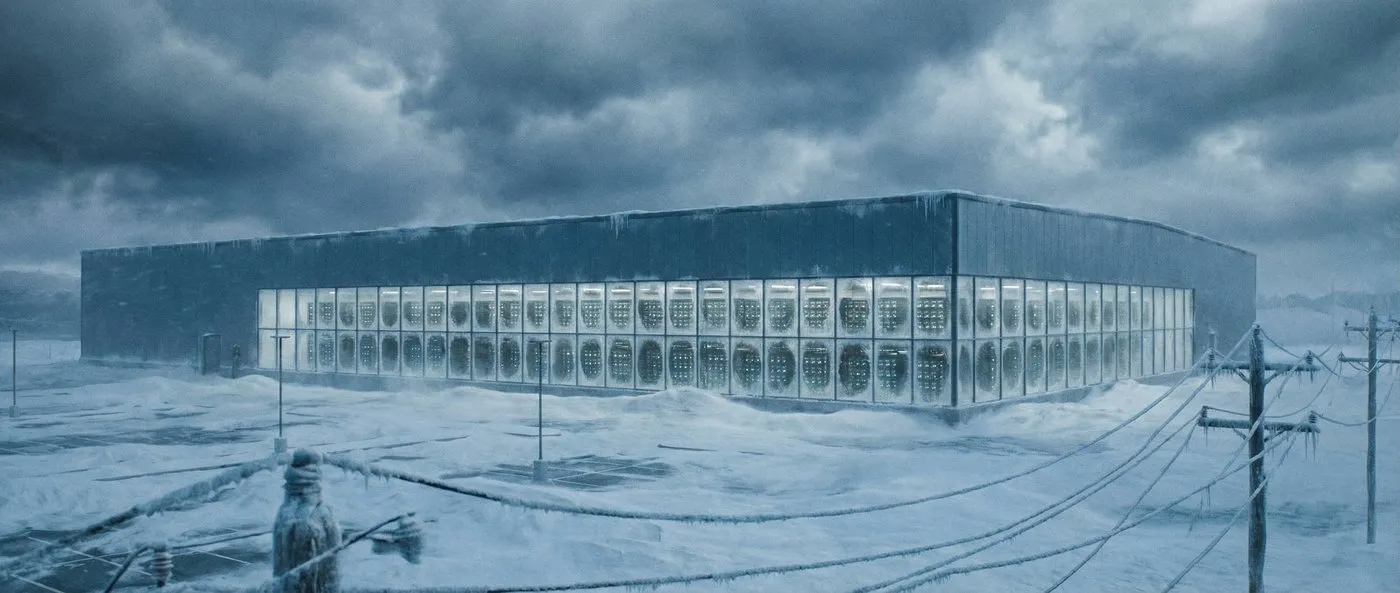
When Winter Storm Fern swept across the United States in late January 2026, the world’s largest Bitcoin mining pool lost 60% of its hash rate in a matter of days. Miners shut down operations as electricity prices spiked, freeing up power for homes and businesses. Two weeks later, crypto advocacy group Paradigm published a report calling Bitcoin miners a “quiet savior” for the grid. The juxtaposition raised an uncomfortable question: Are miners reliable infrastructure, or fair-weather friends who only show up when it’s profitable?
The storm hits
Late January brought subfreezing temperatures across large parts of the U.S., straining power grids and disrupting infrastructure nationwide.
Bitcoin miners felt it harder than most. FoundryUSA, which controls roughly 22-23% of global hash rate, saw its mining power collapse from around 340 EH/s to 242 EH/s. That’s a 60% drop. Luxor, another major pool, fell from 45 EH/s to 26 EH/s (42% decline). Network-wide, Bitcoin’s hash rate dropped 30-40%, hitting a seven-month low of 663-826 EH/s.
Block production slowed to around 12 minutes per block instead of the usual 10. Miner reserves hit their lowest level since 2010, according to CryptoQuant. An estimated 1.3 million mining rigs shut down.
The reason was simple: when heating demand spikes, wholesale electricity prices can jump from $30-50 per megawatt-hour to $100 or more. Most miners operate with a break-even price around $100-150/MWh. Once prices cross that threshold, every hour of mining loses money. So they shut down.
Paradigm makes its case
On February 13, two weeks after the storm, Paradigm released a report titled “Green Mining, Stable Grids: Clarifying Misconceptions about Bitcoin Mining.” The timing was not coincidental. The storm had triggered a fresh wave of political pressure on the industry, with Senate Democrats and environmental groups calling for tighter regulation or outright bans.
Paradigm’s report made four key arguments.
First, Bitcoin’s energy use is overstated. Mining consumes only 0.23% of global energy and is responsible for 0.08% of the world’s carbon emissions. Past studies wildly exaggerated the impact, including a 2017 World Economic Forum claim that Bitcoin would consume more energy in 2020 than the entire planet did in 2017. Reality: 0.046%.
Second, miners are driven toward cheap electricity, which is often during off-peak hours or when renewable generation exceeds demand. They follow the “duck curve,” the daily rhythm of high demand in the morning and evening, low demand at midday. When prices spike, miners shut down.
Third, because they seek out cheap power, miners often gravitate toward renewable or otherwise wasted energy: flared gas, curtailed wind and solar, stranded hydro in places like Iceland and Bhutan.
Fourth, large miners like Riot Platforms participate in demand response programs, where they’re paid to shut down during peak demand. Riot earned $13.9 million in curtailment credits in Q2 2024 alone. During Winter Storm Fern, Riot curtailed over 95% of its operations and sold pre-purchased power back to the grid at premium prices.
The conclusion: Bitcoin miners stabilize the grid by acting as flexible demand. They absorb surplus energy when it’s abundant and step aside when the grid is stressed. They should be rewarded, not penalized.
The contradiction
Here’s the problem: Winter Storm Fern demonstrated both halves of the argument at once.
Yes, miners curtailed during the storm. FoundryUSA and Luxor alone freed up 110+ EH/s worth of electricity. That’s real flexibility. It probably helped prevent blackouts in some regions.
But a 60% hash rate drop at the world’s largest pool isn’t “grid stabilization.” It’s mass shutdown. If the goal is reliability, miners failed. If the goal is flexible demand that disappears when conditions tighten, they succeeded. But you can’t claim to be foundational infrastructure if you only work when it’s convenient.
The debate comes down to framing. Paradigm argues that miners are opportunistic load that happens to stabilize the grid, which is a net positive. Critics argue that unreliable participants who vanish during stress events are a net negative. Both can be true. The policy question is: Should the U.S. incentivize mining via tax breaks and curtailment credits, or regulate it with caps and reporting requirements?
Who wins when the grid breaks?
The storm also exposed a bifurcated mining economy. Large, sophisticated miners like Riot and Marathon came out ahead. They had demand response contracts with grid operators. When they shut down, they got paid. When they sold pre-purchased power back to the grid at peak prices, they made money. Riot’s curtailment credits can offset lost mining revenue. In some cases, they can even turn a profit during downtime.
Small and medium miners without those contracts just bled cash. They shut down because they had to, not because they were compensated for it. They lost revenue, burned through reserves, and some probably won’t turn back on.
This divergence matters. If only giant corporations with sophisticated energy contracts can afford to mine, Bitcoin’s decentralization suffers. The network becomes more centralized by geography (mostly U.S., mostly Texas) and by operator (mostly large public companies).
The storm also revealed concentration risk. FoundryUSA alone controls 22-23% of global hash rate. When a single pool drops 60%, it’s a meaningful hit to network security, even if only temporary. Bitcoin survived fine. Difficulty adjusted. Hash rate recovered. But the event showed how much of Bitcoin’s global computational power is now concentrated in regions vulnerable to weather events.
The recovery and what it means
By mid-February, hash rate had fully recovered to around 1 ZH/s (1,000 EH/s). On February 19-20, Bitcoin’s mining difficulty jumped 14.73% to 144.4 trillion. That’s the largest absolute increase in network history and the biggest percentage jump since China’s 2021 mining ban.
The rapid recovery shows Bitcoin’s resilience. Even a 60% drop at a major pool didn’t break the network. Difficulty adjusted. Miners turned back on. Blocks kept getting mined.
But the context matters. Bitcoin’s price was down from an October 2025 all-time high of $126,500 to around $60,000-70,000 in early February. Hashprice (revenue per unit of hash rate) hit a record low below $32/PH/s. U.S. electricity costs hit a record 18.07 cents per kilowatt-hour in September 2025, up 10.5% year-over-year. Miners were already under extreme financial stress. The storm was just the final blow.
Some miners are pivoting. Bitfarms, a mid-sized operator, announced it’s reallocating resources toward AI and high-performance computing to diversify revenue. This is becoming a trend: miners are hedging against Bitcoin price volatility and energy cost spikes by turning into hybrid AI/crypto data centers.
The political context
The storm and Paradigm’s response landed in the middle of a bipartisan political fight over high-energy industries.
Senate Democrats have introduced multiple bills to curb crypto mining emissions and energy use. Senator Markey urged FERC to address potential energy cost hikes from data centers and mining. The focus is on consumer electricity costs and climate impact.
Republicans are mixed. Some support mining as economic development, especially in Texas and Wyoming. The Trump administration announced a $15 billion emergency power auction to add generation capacity for tech, including mining and AI data centers. Others worry that high-demand users are driving up residential electricity costs.
State-level actions vary. Texas is the major mining hub, with cheap wind energy and a deregulated market. Riot and others participate in ERCOT demand response programs. The storm tested the model. Miners curtailed, but questions remain about long-term grid impact. New York environmental groups claim the “vast majority” of mining in the state is fossil-fuel-powered, and the state is considering stricter regulations.
Internationally, Kuwait and Angola have banned mining due to energy shortages. China’s 2021 ban remains in effect. On the other hand, the UAE has embraced sovereign mining. As of February 2026, the country had accumulated 6,782 BTC (around $455 million) through a state-owned partnership with Citadel Mining. Total UAE Bitcoin exposure is over $900 million. The country is positioning itself as a major national Bitcoin holder, treating mining as state infrastructure rather than a private-sector gamble.
What this means for the future
This won’t be the last storm. Climate change is making extreme weather more frequent. The U.S. power grid is aging. Data centers and AI are pushing electricity demand to new highs. Miners will face more curtailment events, not fewer.
The question is whether the demand response model can scale. Right now, it works for large, sophisticated operators with grid contracts. But if the goal is to make Bitcoin mining a pillar of U.S. energy infrastructure, the model needs to include smaller players too. Otherwise, the industry consolidates into a handful of giant corporations, and decentralization suffers.
There’s also the open question of whether miners should be rewarded for curtailment or simply allowed to exist. Paradigm argues that miners provide a grid service by acting as flexible demand, and they should be compensated for it. Critics argue that miners are opportunistic load that only helps the grid when it’s profitable, and they shouldn’t receive subsidies or special treatment.
The truth is probably somewhere in between. Miners do provide flexibility. That has value. But calling them “critical infrastructure” is a stretch when they disappear during the events that test infrastructure the most.
Winter Storm Fern was a stress test. The system worked in the narrow sense that miners curtailed and power stayed on for most people. But the 60% hash rate drop at the world’s largest mining pool raised a bigger question: If miners only show up when it’s profitable, are they partners in the energy transition, or just another variable-load customer?
The answer will shape U.S. energy policy for the next decade. And the next storm is already forming.
Sources: Paradigm, TheMinerMag, BeInCrypto, Cointelegraph, CoinDesk, Phemex, TheMinerMag, Riot Platforms SEC filing, Blockworks, PRNewswire, FinanceFeeds, CoinGenius, CoinDesk. Data/status as of February 23, 2026.