Bitcoin's MEV Problem: How Ordinals and Layer 2s Are Creating Ethereum-Style Frontrunning
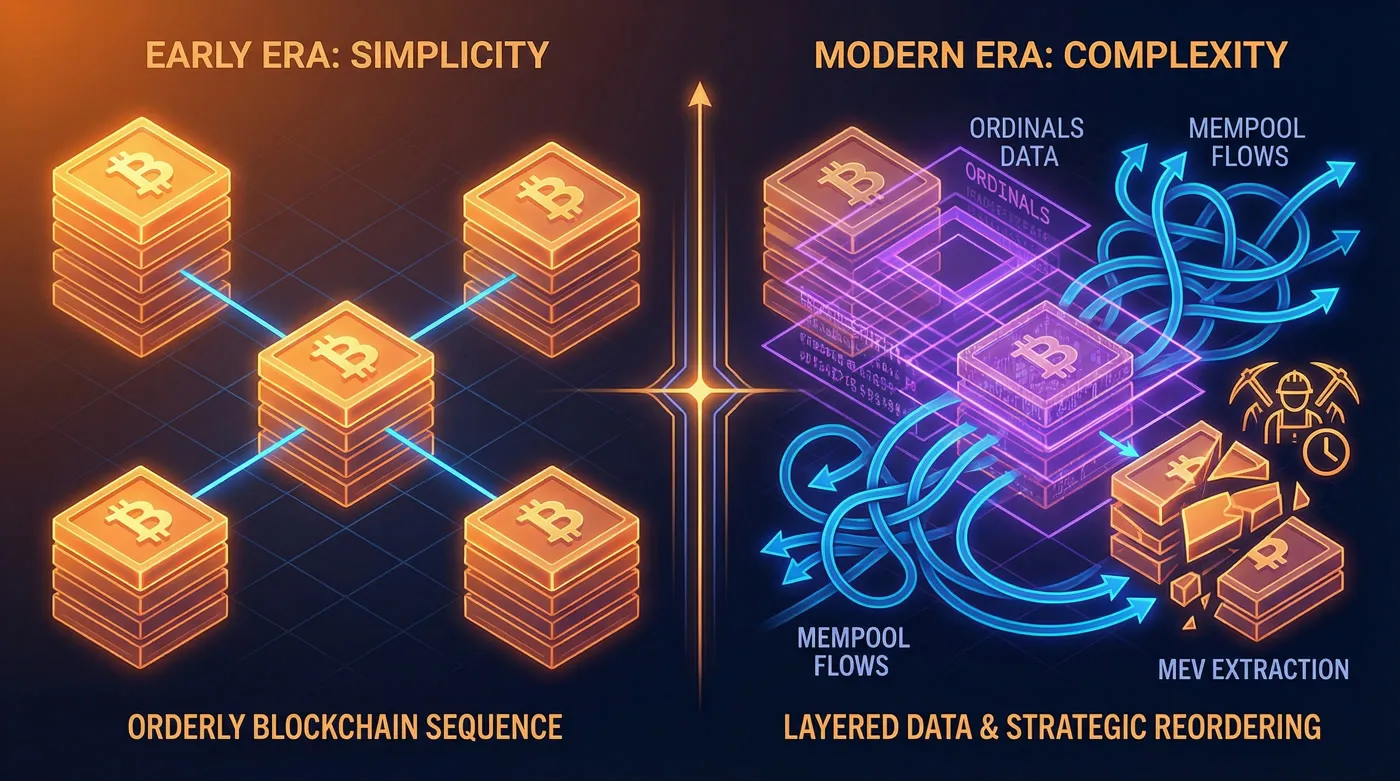
In 2013, Bitcoin developer Peter Todd posted a warning on BitcoinTalk that most people ignored. He was running a bounty program for hash collision attacks, and he noticed something troubling: miners could see his bounty transactions in the mempool, destroy the blocks containing legitimate solutions, and claim the rewards themselves.
That was 13 years ago. The warning went mostly unheeded because Bitcoin’s simplicity seemed like natural protection. Simple value transfers between addresses don’t create much opportunity for miner manipulation. MEV (Maximal Extractable Value) was Ethereum’s problem, not Bitcoin’s.
Then came Ordinals.
What is MEV, anyway?
MEV is profit extracted by controlling transaction ordering in a block. It’s separate from normal block rewards or transaction fees. Miners (or validators, depending on the consensus mechanism) can include, exclude, or reorder transactions to benefit themselves financially.
On Ethereum, this became an art form. Arbitrage bots spot price differences across DEXes and race to exploit them. Liquidation hunters compete to claim DeFi bounties. Sandwich attacks surround victim transactions with buys and sells, extracting value from the price movement they create.
By 2026, a significant portion of Ethereum’s MEV has been “enshrined” into protocol-level auctions rather than just third-party extraction. The game became so sophisticated that frontrunning evolved into an infrastructure layer.
Bitcoin was supposed to be different. The UTXO model is simpler. Smart contracts are limited. Most transactions are just person-to-person transfers.
But that assumption depended on Bitcoin staying simple. It didn’t.
Ordinals broke the simplicity assumption
In January 2023, developer Casey Rodarmor introduced Bitcoin Ordinals, a protocol that lets individual satoshis carry unique data. Built on the 2021 Taproot upgrade, Ordinals effectively created NFTs on Bitcoin.
The numbers are staggering. By September 2024:
- 69.6 million inscriptions had been created (up 31.89% in nine months)
- $656.65 million market capitalization
- 6,901.34 BTC in total fees (worth roughly $405 million)
- Over 40% of daily blockspace consumed during peak periods
That last stat is the one that matters for MEV. When inscription transactions account for nearly half of Bitcoin’s blockspace, transaction ordering suddenly becomes profitable.
And miners noticed. At peak activity, Bitcoin miners were earning $63 million daily from fees, totaling approximately $23 billion annually. Fidelity Digital Assets explicitly warned that miners may exploit “MEV-like opportunities, where additional revenue can be gained by efficiently building blocks” with Ordinals.
How Ordinals create MEV surfaces
Unlike simple payment transactions, Ordinals introduce complexity that miners can exploit:
Inscription competition. During high-demand drops or rare satoshi minting events, users compete to get their inscriptions confirmed quickly. Miners see these pending transactions in the mempool and can prioritize their own identical inscriptions, frontrunning users who thought they were first.
Rare sat trading. Certain satoshis have special significance (first sat of a block, first after a halving, etc.). Miners can identify valuable sats before they’re claimed and inscribe them first, using their privileged position to claim scarcity before the market.
Fee market manipulation. When inscriptions consume 40%+ of blockspace, miners can strategically delay inscription-heavy blocks to inflate fee markets, then release their own inscriptions with perfect timing.
Block building optimization. Inscription transactions vary wildly in size and fee-per-byte. Miners who intelligently reorder inscriptions extract more value than naive first-come-first-served ordering. This is exactly the kind of optimization that created Ethereum’s MEV ecosystem.
Peter Todd’s 2013 warning was about bounties. But the mechanism is identical: miners see valuable transactions before confirmation and can manipulate ordering for profit.
Layer 2s open another front
While Ordinals created on-chain MEV opportunities, Bitcoin’s growing Layer 2 ecosystem introduced off-chain risks.
The major Bitcoin L2s (Lightning Network, Stacks, Rootstock, Liquid, RGB) each create their own MEV surfaces:
Rootstock’s vulnerability. According to Nervos research, “If the activity on the sidechain were to drop, the incentives for merge-mining would diminish, leaving Rootstock vulnerable to relatively low-cost 51% attacks and MEV or double-spend-motivated chain reorganizations.”
Cross-layer arbitrage. L2s create price discrepancies between on-chain and off-chain markets. As CoinCryptoRank notes, “L2 MEV auctions typically have lower costs and faster execution but require understanding of cross-layer arbitrage and bridge-based MEV extraction opportunities.”
Sequencer control. Many L2s use centralized sequencers that order transactions. Optimism uses first-come-first-served but is transitioning to auction-based systems. Arbitrum’s Timeboost combines time priority with fee auctions, creating “express lanes” for priority transaction ordering. These are MEV infrastructure by design.
Bridge MEV. Moving assets between L1 and L2 creates arbitrage opportunities and potential for sandwich attacks during cross-chain swaps.
The L2 landscape is expanding rapidly. The Block’s 2026 Layer 2 Outlook highlights enterprise rollups and growing smart contract functionality. Each new layer adds complexity. Complexity creates MEV.
The academic evidence is mounting
While Bitcoin-specific MEV research is still emerging, academic studies confirm that Ordinals fundamentally changed Bitcoin’s transaction dynamics:
The Journal of British Blockchain Association found that “inscriptions have significantly increased network activity, created additional [revenue opportunities].”
A 2025 ScienceDirect study noted that Ordinals overcome Bitcoin’s UTXO model limitations by “allowing extensive data and information embedding within Bitcoin transactions,” creating new transaction types with different fee dynamics.
Another ScienceDirect paper from March 2024 examined how different Bitcoin applications create “significant differences in terms of transaction fees,” similar to MEV-driven fee markets on Ethereum.
IEEE research in 2025 was “the first to demonstrate that Bitcoin Ordinals-related data are crucial features for predicting Bitcoin transaction fee rates and prices.”
These studies establish what miners already knew: Ordinals changed the game. Fee prediction now requires understanding transaction complexity, not just network congestion. That’s MEV territory.
The mempool transparency problem
Bitcoin’s mempool (the pool of unconfirmed transactions) has always been visible to miners. But when transactions were simple value transfers, this transparency mattered less. Now it’s a frontrunning tool.
With mempool visibility, miners can:
- See pending high-value inscription transactions
- Identify rare satoshi claims before confirmation
- Reorder transactions for financial advantage
- Exclude competing transactions entirely
In February 2026, Bitcoin Core introduced the Cluster Mempool upgrade, grouping related unconfirmed transactions into “clusters” and subdividing them into “chunks” sorted by feerate. This improves efficiency but also makes transaction relationships more transparent to miners, potentially making MEV extraction more systematic.
WooMiner’s analysis of mempool dynamics notes how miners can optimize profits by understanding transaction flows. When transactions become complex, optimization becomes extraction.
Can Bitcoin avoid Ethereum’s fate?
Here’s where I genuinely don’t know what to make of this.
On one hand, Bitcoin has structural advantages. The UTXO model is simpler than Ethereum’s account-based system. Bitcoin’s scripting is far more restricted than Ethereum’s Turing-complete EVM. The Lightning Network could absorb most complex transactions, keeping on-chain activity simple. Bitcoin’s community might culturally resist MEV-enabling features.
On the other hand, the trends point the wrong way. Ordinals aren’t fading (31.89% growth in nine months). Layer 2s are proliferating. Miners are earning billions from complex transactions. The Cluster Mempool makes relationships more visible, not less.
Ethereum developed solutions after MEV became a crisis: private mempools (Flashbots Protect, MEV Blocker), commit-reveal schemes, and eventually enshrined protocol-level auctions. Bitcoin could adopt some of these (private mempools could work; commit-reveal schemes could protect Ordinals marketplaces), but others conflict with Bitcoin’s design or would require controversial hard forks.
The real question is whether Bitcoin’s community will act before MEV becomes entrenched. Ethereum learned the hard way. Bitcoin has the advantage of watching that lesson play out.
But the 2013 warning is coming true. Peter Todd knew that complex, high-value transactions would tempt miners to manipulate ordering. Ordinals are those transactions. The $405 million in inscription fees proves the incentive exists.
The simplicity era is ending
Bitcoin’s immunity to MEV depended on staying simple. That era is over.
Ordinals aren’t going away. Layer 2s are expanding. Academic research confirms that transaction complexity has fundamentally changed Bitcoin’s dynamics. Miner revenue shows behavioral shifts. The mempool is more transparent than ever.
The question isn’t whether MEV exists on Bitcoin anymore. It’s whether the community will address it before it becomes infrastructure.
Last updated: February 28, 2026
Sources: River Learn: What Is MEV? Does It Apply to Bitcoin Mining?, Peter Todd (2013): BitcoinTalk forum post on MEV risks, Social Capital Markets: Bitcoin Ordinals Statistics 2026, Intel Market Research: Bitcoin Ordinals Market Outlook 2026-2032, Arkham Intelligence: MEV: A Guide to Maximal Extractable Value in Crypto (Sept 2024), Nervos: The Ultimate Guide to Bitcoin Layer 2s (Part 1), CoinCryptoRank: MEV Auction Strategy (Nov 2025), The Block: 2026 Layer 2 Outlook (Dec 2025), JBBA: Bitcoin Ordinals and Inscriptions: An Analysis, ScienceDirect: Bitcoin reimagined (Sept 2025), ScienceDirect: Bitcoin Ordinals: Determinants and impact on total transaction fees (March 2024), IEEE: Bitcoin Ordinals: Bitcoin Price and Transaction Fee Rate Predictions, CoinCryptoRank: Front-running Protection: Complete MEV Defense Guide (Nov 2025), Hacken: Front-Running In Blockchain: Real-Life Examples & Prevention, CryptoJobs News: Bitcoin Core’s Cluster Mempool Upgrade (Feb 2026), WooMiner: Mempool Explained (Jan 2026), Fidelity Digital Assets: Q&A: Bitcoin Ordinals, Inscriptions, and Digital Artifacts, Decrypt: Bitcoin Miners Made $184 Million Last Quarter Thanks to Ordinals, CoinDesk: Bitcoin Fees Spike to 2-Year High as Ordinals Bonanza Gives Windfall Profit to BTC Miners. Data/status as of February 28, 2026.