Taproot's Quiet Failure: Why Bitcoin's 2021 Upgrade Peaked at 42% and Is Now Fading
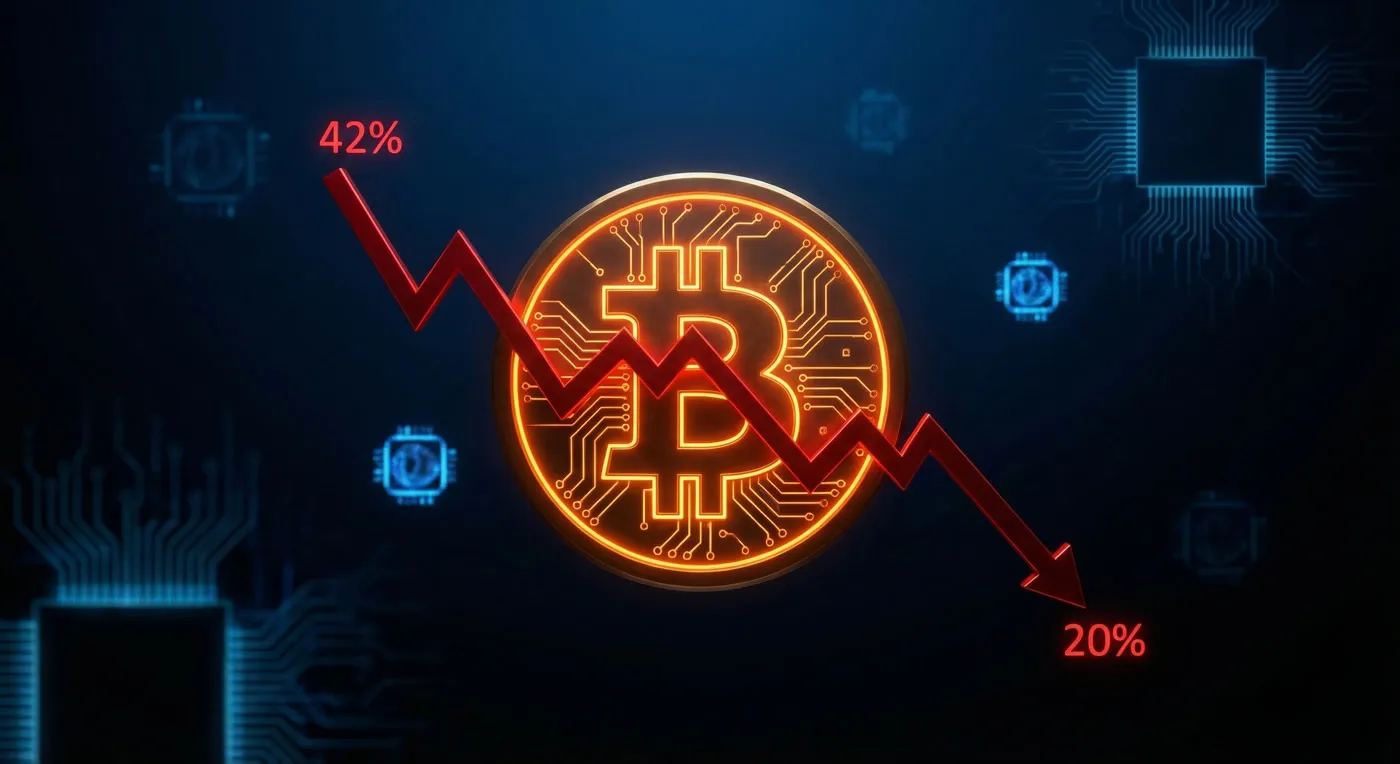
Something strange is happening in Bitcoin land. For the first time in the network’s history, a newer address format is losing ground. Taproot adoption has dropped from 42% of transactions in 2024 to just 20% in 2025, and the decline is accelerating.
This isn’t supposed to happen. Previous upgrades like SegWit took years to gain traction, sure, but once they reached critical mass they kept climbing. Taproot hit its peak and fell off a cliff.
The story of what went wrong is equal parts irony, industry inertia, and quantum panic. Taproot was supposed to enhance Bitcoin’s privacy and efficiency. Instead, it became associated with controversial NFT-like spam, failed to win support from major exchanges for years, and is now seen as a security liability in the age of quantum computing.
The numbers are stark
According to on-chain analyst Willy Woo, citing Glassnode data from December 2025:
- 42% peak Taproot adoption in 2024
- 20% current adoption as of late 2025
- 22 percentage points dropped in roughly one year
“I’ve never seen the latest format losing adoption before,” Woo wrote. “Taproot is quantum vulnerable, while older SegWit and Legacy are not.”
The Bitcoin Wiki confirms the trend: roughly 15-20% of network transactions now use Taproot, down from a 2024 peak above 40% that was driven largely by inscriptions (the Ordinals boom).
This is unprecedented. SegWit took four years to reach 80% adoption, but it never went backward. Taproot climbed to 42%, then collapsed. What happened?
What Taproot was supposed to achieve
Activated in November 2021 at block 709,632 with 90% miner approval, Taproot was Bitcoin’s biggest protocol upgrade since SegWit in 2017. It bundled three Bitcoin Improvement Proposals (BIPs 340, 341, and 342) and promised three main benefits:
Enhanced privacy via Schnorr signatures
Schnorr signatures made complex multi-signature transactions indistinguishable from simple single-signature payments. By aggregating multiple signatures into one, they obscured transaction details and improved fungibility. Different transaction types would look identical on-chain.
Lower fees
Schnorr signatures are 64 bytes compared to ECDSA’s 71-72 bytes. Signature aggregation reduces data size for complex transactions. MAST (Merkleized Alternative Script Trees) allows complex scripts without bloating transaction size. For users running Lightning channels or multisig setups, this meant cheaper, more efficient operations.
Better smart contracts
Tapscript enabled more flexible scripting. It made Lightning Network operations more efficient and created a foundation for more sophisticated Bitcoin applications.
On paper, this sounded great. In practice, none of these benefits proved compelling enough for mass adoption.
Timeline: from hype to collapse
November 2021: Activation
Taproot goes live with widespread developer enthusiasm. Initial adoption: near zero. Exchanges announce “support” but don’t actually implement sending to Taproot addresses.
2022: Stagnation
One year after activation, adoption is still near-zero. Reddit users complain: “Not a good sign for Bitcoin when a year after the Taproot soft fork, Binance, Coinbase, Gemini, Strike, and most of the other exchanges still don’t support sending to Bech32m addresses.”
Kraken becomes an early adopter in December 2022, but most infrastructure providers drag their feet.
Early 2023: The Ordinals inflection
The Bitcoin Ordinals protocol launches, exploiting Taproot’s expanded script capabilities. Inscriptions (NFT-like data embedded on-chain) create sudden demand for Taproot transactions. Adoption spikes to around 10% by February 2023, a reported 1,000% increase from the near-zero baseline.
This wasn’t the intended use case. It was controversial “spam” that bloated blocks and drove up fees.
2024: The artificial peak
Ordinals and Runes (fungible tokens on Bitcoin) drive Taproot usage to 42%. Coinbase finally adds Taproot support in October 2024, nearly three years after activation.
But the peak is hollow. It’s built on inscription mania, not organic demand for privacy or efficiency.
2025: The collapse
Ordinals and Runes activity cools. Quantum computing concerns accelerate. Adoption drops to 20% and keeps falling. Users are actively migrating away from Taproot back to SegWit.
Why adoption failed
Three distinct failures converged to kill Taproot’s momentum.
1. Industry inertia: Exchanges took three years
The single biggest barrier was wallet and exchange support. Without infrastructure providers implementing Taproot, ordinary users couldn’t adopt it even if they wanted to.
Support timeline:
- November 2021: Activation
- December 2022: Kraken adds support (1 year delay)
- October 2024: Coinbase adds support (3 years delay)
- Still lacking: Many smaller exchanges and wallets
Chainalysis noted in November 2021: “The main reason for this slow rate of adoption is that cryptocurrency wallets and service providers choose to opt-in on their own schedule.” They predicted Taproot would follow SegWit’s pattern, taking two to four years to reach majority adoption.
It never got that far.
2. The wrong use case: Ordinals, not privacy
Taproot’s 2024 peak was driven by Ordinals and Runes, not by users seeking privacy or efficiency. This had three consequences.
Controversy and backlash: Bitcoin Core developer Jimmy Song argued that Taproot “failed to deliver the promised privacy and security gains” and “expanded the social attack surface.” Inscriptions were seen as spam by many Bitcoin purists. The upgrade became associated with NFT speculation, not sound money principles.
Unsustainable demand: Ordinals activity generated over $500 million in cumulative fees, with daily inscription fees ranging from $3,000 to $537,000 in 2025. But when the fad cooled, so did Taproot usage.
Policy fights: In June 2025, Bitcoin Core removed the 80-byte OP_RETURN limit, enabling larger inscriptions. This sparked migration to Bitcoin Knots (a more restrictive fork) by users opposed to Ordinals. Bitcoin Knots node count rose from 67 in March 2024 to over 7,112 by mid-2025, nearly 28% of visible nodes.
3. Quantum vulnerability: The ultimate irony
The final nail in the coffin: Taproot is now seen as a security liability.
The technical problem: Taproot uses Schnorr signatures, which are based on elliptic curve cryptography (like ECDSA). Quantum computers running Shor’s algorithm can efficiently solve the discrete logarithm problem that secures these signatures. Older formats (SegWit, Legacy) use hash-based approaches that expose public keys only when spending, which is considered more quantum-resistant.
The timeline debate:
- Optimists (Adam Back, Samson Mow): “Decades away” (quantum computers can’t even factor the number 21 yet).
- Urgency camp (Charles Edwards, Willy Woo): Implementation must happen by 2026 to prevent market panic.
Charles Edwards, founder of Capriole Investments: “Without migration to standards like BIP-360, up to 20-30% of Bitcoin holdings could be at risk from quantum hackers in the coming years.”
User response: The mere perception of quantum risk is driving behavior right now. Woo’s data shows a 3% decline in Taproot supply since January 2024, with users proactively moving funds back to SegWit.
The proposed fix: BIP-360 and the 2026 deadline
BIP-360: Pay-to-Merkle-Root (P2MR)
Recently merged into the official Bitcoin Improvement Proposals repository, BIP-360 proposes a quantum-resistant alternative to Taproot.
How it works: Functions like Taproot but removes the “key-path spend” option. Key-path spending exposes a tweaked public key on-chain, which is the quantum vulnerability. BIP-360 forces all transactions through script-path spending (Merkle tree verification). The trade-off: slightly higher fees and less privacy, but quantum resistance.
Timeline pressure: Edwards and others are pushing for 2026 implementation, arguing that Bitcoin needs to move before quantum computers become viable threats, or before market fear of quantum risk becomes self-fulfilling.
Hash-based signatures: The long-term solution
Blockstream Research published a December 2025 paper proposing hash-based signature schemes as Bitcoin’s post-quantum future.
Advantages: They rely on hash functions already integral to Bitcoin (SHA-256). Quantum computers offer no advantage against hash functions. Grover’s algorithm only provides quadratic speedup, which can be mitigated by increasing hash length. No need to overhaul Bitcoin’s core cryptographic assumptions.
Challenge: Coordination. As one developer put it: “Bitcoin’s real constraint is coordination, not cryptography.”
What this means for Bitcoin’s ability to evolve
Taproot’s failure reveals a fundamental challenge: Bitcoin’s conservative, slow-moving governance makes even widely supported upgrades difficult to deploy, and impossible to reverse when they underperform.
Five lessons
Protocol upgrades need compelling use cases for ordinary users, not just developers. Taproot’s benefits were theoretical for most people. Lower fees for multisig? Great if you run a Lightning node. Privacy for complex scripts? Useful if you’re building DeFi on Bitcoin. But for someone sending a simple payment, the value proposition was invisible.
Infrastructure adoption is the real bottleneck. Coinbase took three years to add Taproot support. Without exchanges and wallets implementing the upgrade, protocol-level changes sit idle.
Unintended consequences matter. Taproot enabled Ordinals, which drove adoption for the wrong reasons and created lasting controversy. The 2024 peak wasn’t a victory. It was a side effect of a speculative fad.
Perception can override reality. Even if quantum computers are “decades away,” fear of quantum risk is already changing user behavior. Woo’s data shows a measurable migration away from Taproot. Markets move on perception, not just facts.
Reversibility is impossible. Bitcoin can’t “undo” Taproot. It can only build around it (BIP-360) or wait for natural attrition.
I keep coming back to the irony
Taproot was supposed to make Bitcoin more private, more efficient, more capable. Instead, it became a vehicle for NFT-like spam that divided the community, a quantum liability that scared users back to older formats, and a case study in how difficult it is to upgrade a $2 trillion network when coordination moves at geological speed.
The 42% peak in 2024 looked like success. It wasn’t. It was Ordinals mania propping up an upgrade that most of the ecosystem hadn’t actually embraced.
Now Taproot is fading. Users are moving their funds back to SegWit. And Bitcoin developers are scrambling to patch the quantum vulnerability before it becomes a bigger problem.
The question is whether Bitcoin can move fast enough to fix this before the next crisis hits. Because if Taproot’s story teaches us anything, it’s that Bitcoin’s ability to evolve is constrained less by technology than by the sheer difficulty of getting thousands of independent actors to coordinate on change.
And that’s a problem no soft fork can solve.
Last updated: February 28, 2026
Sources
- Willy Woo on Taproot adoption decline (X/Twitter)
- Bitcoin.it Wiki: Taproot adoption
- Decrypt: Bitcoin Taproot upgrade activated
- River Financial: What is Taproot?
- CoinDesk: Bitcoin Taproot upgrade explained
- Chainalysis: Bitcoin Taproot adoption
- Reddit: Not a good sign for Bitcoin…
- Kraken: Taproot deposits and withdrawals
- LinkedIn: Bitcoin Ordinals and Taproot adoption
- Unchained: Bitcoin Taproot two years later
- CoinDesk: Coinbase to support Bitcoin Taproot sends
- JBBA: Ordinals past, present, and future
- BitcoinEthereumNews: Bitcoin faces quantum computing threat
- CoinTelegraph: Bitcoin quantum computing threat
- Phemex: Is Bitcoin quantum resistant?
- Forbes: New Bitcoin quantum resistance upgrade
- Bitcoin Magazine: BIP-360 post-quantum Bitcoin addresses
- Blockstream: Quantum resistance in Bitcoin