BIP-110 Ignites Bitcoin's Governance War: Ocean Mines First Signal Block
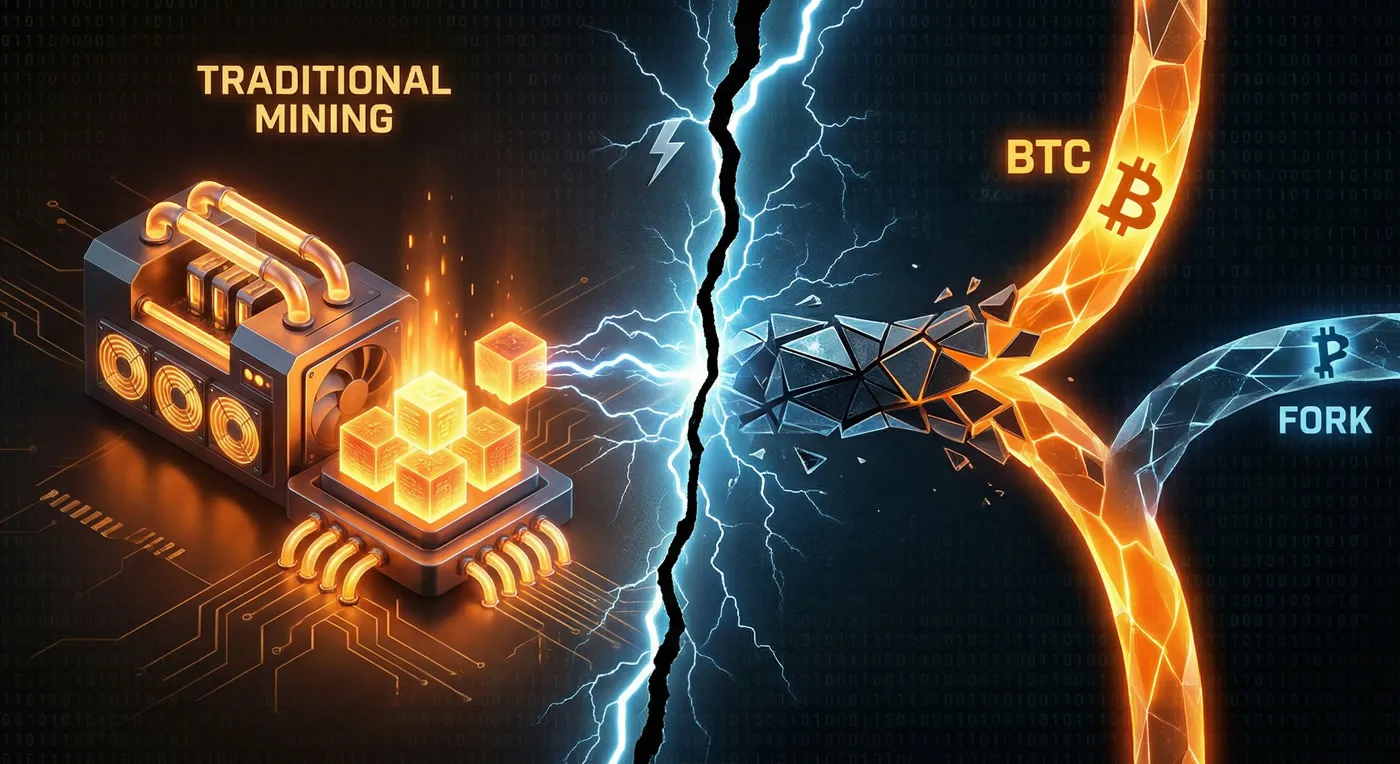
On March 2, 2026, Ocean mining pool mined the first block signaling support for BIP-110, a soft fork proposal that would restrict arbitrary data on Bitcoin’s blockchain. It’s a single block from a pool controlling roughly 2% of Bitcoin’s hashrate. But it’s also the opening shot in what might become Bitcoin’s ugliest governance battle since the block size wars.
BIP-110 wants to curtail NFTs, inscriptions, and other non-financial data cluttering Bitcoin’s base layer. Supporters say it protects Bitcoin’s purpose as sound money. Critics call it censorship that violates Bitcoin’s core principle: transaction neutrality. Adam Back, Blockstream CEO and Bitcoin cypherpunk icon, has emerged as one of its fiercest opponents, warning that consensus-layer discrimination sets a dangerous precedent.
The proposal has a 55% miner activation threshold (far below Bitcoin’s traditional 95% supermajority) and a mandatory lock-in date in September 2026 whether miners like it or not. If major exchanges and businesses enforce it, miners will be forced to comply or mine a worthless minority fork. If they don’t, BIP-110 dies.
Either way, this is a referendum on what Bitcoin is for. And the answer is not obvious.
What BIP-110 actually does
BIP-110 is a one-year temporary soft fork that imposes strict limits on non-financial data:
- OP_RETURN capped at 83 bytes (down from unlimited in Bitcoin Core v30)
- Data pushes limited to 256 bytes in witness elements and scripts
- New transaction outputs capped at 34 bytes (except OP_RETURN)
- Taproot restrictions on annexes, large control blocks (257+ bytes), and certain opcodes like OP_IF in specific contexts
The restrictions would lift automatically after one year. Any coins created before activation are permanently exempt, so no one is forced to move existing funds.
The activation mechanism is where things get spicy. BIP-110 locks in early if 55% of blocks in a difficulty period (1,109 out of 2,016) signal support using bit 4. If that doesn’t happen by roughly August 2026, mandatory activation kicks in at block 965,664 (around September 1). After that, blocks that don’t signal for BIP-110 get rejected as invalid by enforcing nodes.
This is a forced choice: upgrade or mine on a minority fork.
The 66 KB middle finger
Days before Ocean’s signaling block, Slovak developer Martin Habovštiak inscribed a 66 KB TIFF image directly onto Bitcoin’s blockchain without using OP_RETURN, Taproot, or OP_IF. The image reportedly depicts Luke Dashjr (a Bitcoin Core developer and key BIP-110 advocate) crying.
This wasn’t just trolling. It was a technical rebuttal.
BIP-110 proponents claim that restricting OP_RETURN and Taproot data will curtail large inscriptions. Habovštiak’s proof-of-concept shows that determined developers can route around these restrictions by encoding data in other transaction structures BIP-110 doesn’t touch. The inscription was mined and validated by the network, proving that consensus-layer data restrictions are whack-a-mole. Restrict one method, and clever developers find another.
The message: BIP-110 won’t stop inscriptions. It will just force them to evolve.
Adam Back calls it dangerous
Adam Back’s opposition is the biggest signal that BIP-110 is not a slam dunk for Bitcoin’s “sound money” camp. Back is a cypherpunk legend, inventor of Hashcash (Bitcoin’s proof-of-work predecessor), and CEO of Blockstream. He typically aligns with Bitcoin maximalists. His public break from the pro-BIP-110 coalition tells you something.
Back’s objections center on three points:
Credibility damage. Consensus rules should validate transactions based on whether they follow protocol rules, not what they contain. Once you start filtering based on content, Bitcoin loses its claim to neutrality. Where does it stop? Today it’s NFTs. Tomorrow it could be privacy tools or transactions from addresses governments don’t like.
Chain split risk. Bitcoin soft forks have historically required 95% miner support to minimize the risk of the network fragmenting into competing chains. BIP-110’s 55% threshold is dangerously low. If activation happens with slim majority support, the network could fracture.
Censorship precedent. BIP-110 sets a template for using consensus changes to ban transaction types for political reasons. That door, once opened, is hard to close.
Back has also criticized what he calls “lynch mob tactics” behind the proposal, warning that governance-by-pressure threatens Bitcoin’s stability.
The irony here is thick. Back is arguing against people who share his “Bitcoin is money, not a data layer” worldview. That he’s willing to break ranks over this shows how foundational the neutrality principle is for Bitcoin’s original architects.
How we got here: Ordinals broke the truce
None of this happens without Casey Rodarmor launching the Ordinals protocol on January 20, 2023. Ordinals uses Taproot to inscribe arbitrary data (images, text, entire videos) onto individual satoshis, creating what are effectively NFTs on Bitcoin’s base layer.
By mid-2023, millions of inscriptions flooded Bitcoin blocks. BRC-20 tokens (a token standard built on Ordinals) emerged, generating what even Rodarmor himself called “garbage.” Inscription activity periodically spiked transaction fees, pricing out smaller financial transactions. Ordinals advocates argued they were proving demand for Bitcoin block space and contributing to miner fee revenue. Critics called it spam that imposed permanent storage costs on every node operator.
In October 2025, Bitcoin Core v30 removed the 80-byte OP_RETURN limit, arguing that encouraging OP_RETURN use for arbitrary data would reduce UTXO bloat (since OP_RETURN outputs are provably unspendable). This enraged inscription critics, who saw it as Bitcoin Core endorsing spam. Bitcoin Knots adoption surged 49% as users migrated to Luke Dashjr’s alternative client, which maintained the 80-byte limit.
BIP-110 is the counterattack. It’s an attempt to codify inscription restrictions at the consensus layer so that no single development team can reverse them with a policy change.
The philosophical split
This is really a fight about Bitcoin’s identity.
Vision A: Sound money only. Bitcoin’s purpose is to be the world’s best money. Anything that burdens node operators or distracts from this mission should be restricted, even at the consensus layer. Inscriptions impose storage costs on everyone and “unfairly compete” with monetary transactions. Data storage belongs on sidechains or other blockchains designed for it.
Vision B: Neutral protocol. Bitcoin is a neutral, permissionless protocol. Users pay fees, miners decide what to include, nodes validate according to consensus rules. The protocol should not discriminate based on transaction content. The moment developers pick “good” vs. “bad” transactions at the consensus layer, Bitcoin loses its most important property: censorship resistance.
Both visions claim to defend Bitcoin’s core values. Both have merit. And they are fundamentally incompatible.
Miners have no reason to comply
Here’s the awkward part: miners have no rational economic incentive to support BIP-110.
Transaction fees currently represent only 0.64% of total miner revenue (90-day average as of early 2026). The block subsidy (currently 3.125 BTC per block) dominates income. BIP-110 would reduce fee revenue by excluding certain transactions. Why would miners voluntarily take a pay cut?
BIP-110 proponents argue that inscription fees are minimal relative to block space consumed, and that protecting Bitcoin’s long-term monetary adoption matters more than short-term inscription revenue. They also argue that if economic nodes (exchanges, businesses) run BIP-110-enforcing software, miners who resist will be mining a worthless minority fork.
Critics counter that the market should decide block space allocation, and that restricting transaction types reduces Bitcoin’s utility and adoption.
The real tension is this: As block rewards halve every four years, miners will increasingly depend on transaction fees. What happens when the subsidy goes to zero around 2140? Bitcoin’s security model requires miners to be compensated for honest behavior. If fees must sustain that, can Bitcoin afford to arbitrarily restrict transaction types?
BIP-110 supporters say inscriptions are parasitic and that real monetary adoption will generate sustainable fees. Opponents say any transaction willing to pay fees contributes to network security, and that limiting the fee market is shortsighted.
Collateral damage: BitVM and advanced contracts
BIP-110’s 257-byte control block limit would temporarily break BitVM (Bitcoin Virtual Machine), an experimental framework for running complex computations on Bitcoin using large Taproot script trees. BitVM contracts often require control blocks exceeding 256 bytes.
It would also affect some Bitcoin wallets (like Nunchuk) that allow users to create arbitrary Miniscript policies, which can include OP_IF in Taproot leaves. BIP-110 would make these UTXOs unspendable if created after activation.
Proponents argue that BitVM is experimental and not widely deployed yet, and that wallets have months to update. Pre-activation UTXOs are permanently exempt, so no existing funds are at risk.
But the precedent matters. Developers building on Bitcoin face existential uncertainty if their tools can be consensus-banned for political reasons. This chills innovation on the base layer.
What happens in September
The mandatory activation height (block 965,664, roughly September 1, 2026) is the point of no return. Here are the scenarios:
1. Early lock-in (unlikely). If 55% of miners signal support before August, BIP-110 locks in early. Given that no major pools have signaled and economic incentives favor rejection, this seems improbable.
2. Mandatory activation showdown (likely). Mandatory lock-in arrives with miner support still below 55%. Non-signaling blocks get rejected by BIP-110-enforcing nodes. The network fractures based on which software economic nodes choose. If major exchanges and payment processors run BIP-110 nodes, miners are forced to comply or mine a worthless minority fork. If economic actors refuse to enforce it, BIP-110 dies regardless of node count.
3. Economic node rejection (also possible). If most exchanges, merchants, and payment processors view BIP-110 as too risky, they simply don’t upgrade. BIP-110 nodes reject blocks, but the market moves on without them. This would mirror Bitcoin Cash’s fate in 2017: a minority fork with ideological supporters but no economic weight.
4. Community compromise (optimistic). Before mandatory activation, developers propose a narrower approach with higher activation thresholds and fewer restrictions on advanced contracts. Voluntary measures (updated mempool policies, wallet defaults) replace consensus changes.
My gut says scenario 3. Major pools won’t signal, exchanges won’t risk a chain split, and the mandatory lock-in height passes as a non-event. But the debate itself is clarifying. It forces the Bitcoin community to articulate what Bitcoin is for, which is a conversation that’s been deferred too long.
Why this matters
Bitcoin has survived crises before. The 2017 block size wars. The Mt. Gox collapse. Nation-state mining bans. But those were fights about scaling or external threats. BIP-110 is different. It’s an internal identity crisis.
If BIP-110 activates over significant opposition, it sets a precedent that consensus changes can discriminate based on transaction content. If it fails, it establishes that Bitcoin’s neutrality principle is untouchable, even when inscriptions annoy a vocal faction.
Either outcome shapes Bitcoin’s culture for decades. And right now, the only certainty is that Ocean’s single signaling block is just the beginning.
Sources
- BIP-110 Official Site
- CoinDesk: Bitcoin BIP-110 battles begin
- Bitcoin Core v30 Release Notes
- Bitcoin Knots
- Ordinals Protocol
- Jameson Lopp: A Layman’s Guide to BIP-110
Last updated: March 3, 2026