Stratum V2 in 2026: How Far Has Mining Decentralization Actually Come?
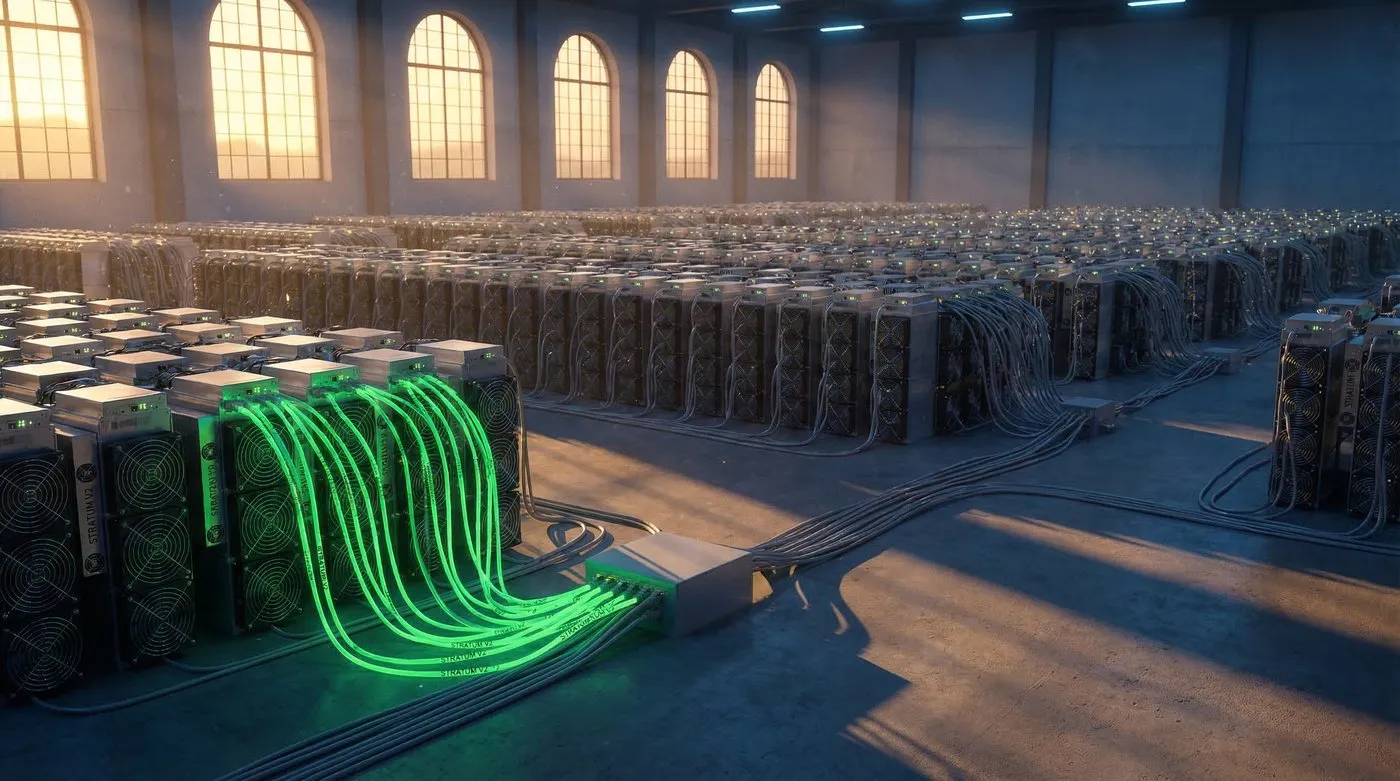
For years, Stratum V2 has been talked about as the solution to Bitcoin mining’s centralization problem. The pitch was compelling: give miners back control over which transactions go into blocks, prevent pool-level censorship, and make Bitcoin more resilient against regulatory pressure.
In 2026, the protocol is real, deployed, and working. But the revolution? Still pending.
Here’s what’s actually happening on the network: 15-20% of Bitcoin’s hashrate runs some version of Stratum V2. That sounds promising until you realize most of that adoption is the basic version (encryption, faster job delivery, bandwidth savings), not the feature that matters most for decentralization. Job negotiation, the part that lets miners choose their own transactions, is live on maybe 5% of the network. The rest? Still following orders from pool operators.
Meanwhile, the top five pools control 72% of hashrate. Foundry USA alone sits at 30.1%. Two pool operators coordinating gives you 51%. That’s not a hypothetical threat. That’s Tuesday.
So what’s the gap between promise and reality? Let’s dig in.
The censorship problem is real
In May 2021, Marathon Digital Holdings launched an “OFAC-compliant” mining pool that filtered transactions from addresses on the U.S. Treasury’s sanctions list. Block 682170, the first one they mined, had 178 transactions (compared to over 1,000 in adjacent blocks). They weren’t just leaving money on the table. They were actively choosing which transactions belonged in Bitcoin.
Community backlash was swift. Marathon shut down the OFAC pool a month later, claiming they’d no longer filter transactions.
But the problem didn’t go away.
In November 2023, a developer running the miningpool-observer project detected that F2Pool, ViaBTC, and Foundry USA were excluding transactions from OFAC-sanctioned addresses. These weren’t edge cases or low-fee spam. These were higher-fee transactions the pools chose to skip.
This is the threat Stratum V2 was designed to solve. When miners control transaction selection, pools can’t censor on their behalf. But in 2026, almost no miners are using that feature.
What Stratum V2 actually does
Stratum V2 isn’t one thing. It’s a bundle of upgrades, and they don’t all deliver the same benefits.
Basic Stratum V2 gives you:
- Encryption between miners and pools
- Reduced latency when new blocks are found (228x faster in one study)
- Bandwidth savings from more efficient data structures
These are real improvements. They make mining more efficient, reduce stale shares, and marginally boost profitability. A benchmarking study by Hashlabs in June 2025 found miners running Stratum V2 could see up to a 7.4% net profit increase from lower latency, fewer stale shares, and protection against hashrate hijacking.
Job negotiation (also called Job Declaration) is different. It’s the feature that gives miners transaction selection. Instead of the pool handing you a pre-built block template, you construct your own from your local Bitcoin node and submit it to the pool. The pool can’t censor transactions you’ve included because they never see the template until you’ve already committed to mining it.
Here’s the catch: job negotiation requires running a full Bitcoin node. That means syncing hundreds of gigabytes of blockchain data, maintaining ongoing bandwidth, and managing the technical overhead. For industrial miners in bandwidth-constrained regions or small operators without the expertise, that’s a non-starter.
And even if you’re willing to run a node, most pools don’t offer job negotiation anyway.
Who’s actually using it?
As of early 2026, here’s the breakdown:
Pools with basic Stratum V2 support:
- Braiins Pool: 100% Stratum V2, pioneered the protocol
- F2Pool, Foundry USA: Testing or partial support
Pools offering job negotiation:
- DEMAND Pool: Launched March 2025 as the first production pool with full job negotiation
- OCEAN: Offers DATUM, their own protocol for miner-side block templates (not standard Stratum V2, but functionally similar)
- Braiins Pool: Protocol support exists, but unclear how many miners actually use it
DEMAND and OCEAN combined represent less than 5% of network hashrate. The other pools running Stratum V2 are using the basic version, which does nothing for censorship resistance.
Translation: The vast majority of Bitcoin mining (including Foundry’s 30.1%, AntPool’s 18.3%, and ViaBTC’s 13.0%) is still mining on Stratum V1 or basic V2 without transaction selection.
The profitability angle
If decentralization isn’t motivating miners, profitability might.
The Hashlabs study compared two identical Antminer S19k Pro machines running Stratum V1 vs. V2 in a controlled environment. The results:
- Reduced stale shares: +2.0% net profit gain
- Lower job latency: +0.4% profit gain from capturing higher-fee transactions faster
- Hashrate hijacking prevention: +5.0% security gain (industry estimate)
- Total potential gain: up to 7.4%
The block change latency improvement is dramatic: 325ms on V1 vs. 1.42ms on V2. That’s 228x faster. When a new block is found, V2 miners waste almost no time on stale work.
There’s also a competitive edge. Transaction fee jobs are delivered every ~30 seconds. V1’s 228ms latency means miners miss the highest-fee transactions in that window. V2 cuts this to 2.44ms, capturing an estimated 0.00141 BTC per block in additional revenue (a 0.75% gain on fees alone).
Over a year (52,560 blocks), early Stratum V2 adopters could claim ~74 BTC (~$8.17 million at $110k BTC) before V1 competitors even receive the job. This is a zero-sum advantage that shrinks as adoption increases.
But here’s the problem: these gains come from basic Stratum V2, not job negotiation. Miners can get the profitability boost without running a full node or taking on the complexity of transaction selection. So most do exactly that.
Firmware, hardware, and other friction
Even if miners wanted to switch, it’s not always easy.
ASIC compatibility as of March 2026:
- Antminer S21 series: Native Stratum V2 support out of the box
- Antminer S19 series: Requires custom firmware (Braiins OS, LuxOS, or vnish)
- Older models (S17, S9): Limited or no support
Most ASICs ship with stock firmware that only supports Stratum V1. Upgrading to custom firmware voids warranties, requires technical knowledge, and can brick the machine if done wrong. Industrial miners managing thousands of ASICs aren’t eager to take that risk unless the pool requires it.
And most pools don’t require it.
Bitcoin Core integration: Getting there
Bitcoin Core v30, released in October 2025, introduced an experimental IPC (Inter-Process Communication) mining interface designed to work with Stratum V2 software. This allows mining pool software to interact directly with Bitcoin Core’s block template logic without relying on the older JSON-RPC interface.
What this enables:
- Pool operators can run a Stratum V2 Job Declaration Server that pulls templates from Bitcoin Core
- Miners running a Job Declaration Client can fetch templates directly from their own Bitcoin node
What it doesn’t do yet:
- Full template provider integration is still in progress
- Job negotiation still requires miners to run a full node, which is a high bar
The infrastructure is getting better, but the user experience gap remains.
Why pools don’t want this
Let’s be blunt: job negotiation reduces pool control over block templates. Pools earn fees by packaging high-fee transactions and, in some cases, extracting MEV-like revenue (sandwich attacks, front-running). Giving miners transaction selection means giving up that control.
Pools also face regulatory pressure. Marathon’s OFAC pool in 2021 wasn’t a rogue experiment. It was a compliance test. If governments pressure pools to filter transactions (and they have), pools have two choices: comply or resist. Job negotiation makes compliance impossible because the pool doesn’t control the template. But it also makes the pool less attractive to miners who just want simple, reliable payouts.
The incentives are misaligned. Pools want control. Regulators want compliance. Miners want profitability and simplicity. Decentralization loses.
What happens next
For Stratum V2 to deliver on its censorship-resistance promise, a few things need to happen:
- More pools must offer job negotiation. Foundry, F2Pool, and AntPool should enable it and make it easy to use.
- Bitcoin Core template provider integration must ship. The IPC interface is a start, but full support will make it easier for pools to delegate transaction selection to miners.
- Firmware support must improve. Bitmain and other manufacturers should ship ASICs with Stratum V2 enabled by default.
- Miners need incentives. If job negotiation doesn’t increase profitability or reduce pool fees, most miners won’t bother.
The hard truth: Most miners won’t run their own Bitcoin nodes. It’s expensive, bandwidth-heavy, and operationally complex. Until that changes, censorship resistance will remain aspirational.
But here’s the optimistic take: the infrastructure exists. When a major pool is forced by regulators to filter transactions (and that day is coming), miners who want to resist will have the tools to do it. Whether they’ll actually use them is the open question.
Stratum V2 in 2026 is a slow burn, not a revolution. The efficiency gains are real and adoption will continue. But the decentralization promise? Still waiting for its moment.
Sources
- Stratum Protocol
- Bitcoin Magazine - DMND Launch
- OCEAN - DATUM
- ECOS - Stratum V2 Overview
- Hashrate Index - Top 10 Pools
- The Block - Marathon OFAC Pool
- The Block - Censorship Risk
- Hashlabs Study
- Braiins OS
- D-Central - LuxOS Guide
- Bitcoin Core 30.0 Release Notes
- Bitcoin Optech #385
Data/status as of March 16, 2026.