The 46% Problem: Why Bitcoin's Top Two Mining Pools Are a Bigger Threat Than You Think
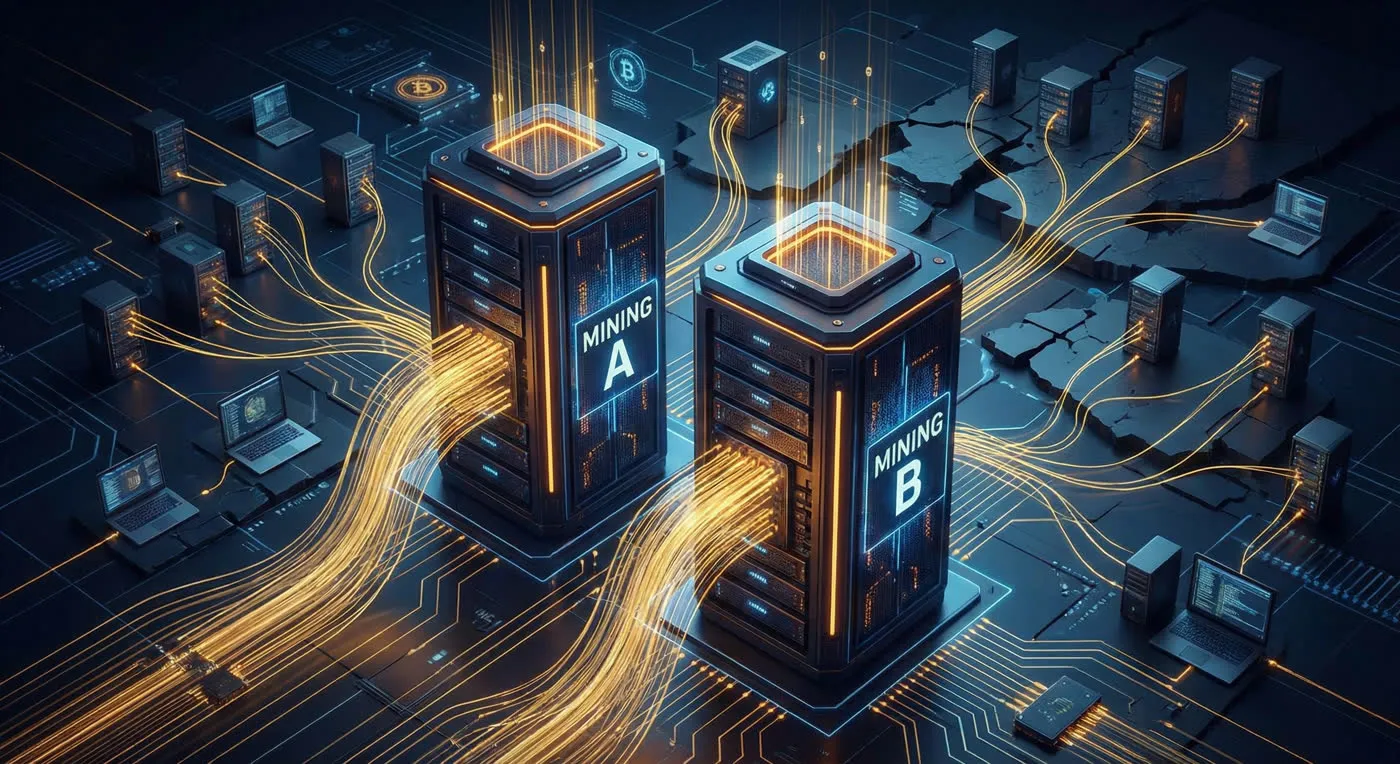
Two mining pools control 46% of Bitcoin’s network hashrate. If that doesn’t alarm you, it should.
Foundry USA sits at 29% of total hashrate. AntPool holds another 17%. Together, they mine nearly half of all Bitcoin blocks. Add in suspected “proxy pools” (smaller operations that relay AntPool’s block templates while appearing independent) and the real concentration might be closer to 40% for AntPool alone.
This isn’t a 51% attack scenario. Not yet. But it’s close enough to break the security assumptions that make Bitcoin work.
Why 46% is more dangerous than it sounds
A 51% attack requires majority control to rewrite the blockchain. But threats emerge well before that threshold.
With 40% of hashrate, a pool has roughly a 50% chance of mining six consecutive blocks. That’s enough to fool most exchanges into accepting a deposit that gets reversed later. It’s not guaranteed, but it’s disturbingly plausible.
More realistic than a double-spend? Censorship.
Mining pools are legal entities. They have physical locations, bank accounts, and regulatory obligations. If a government orders Foundry to exclude transactions from sanctioned Bitcoin addresses, Foundry complies or shuts down. If Foundry and AntPool both comply, those transactions face systematic confirmation delays. The network doesn’t break, but its neutrality does.
According to b10c’s analysis, Bitcoin mining has never been this concentrated. In 2017, the top two pools controlled less than 30% of hashrate. By 2023, that figure hit 55-60%. Today, six pools produce 96-99% of all blocks. The oligopoly is real.
How we got here
Mining used to be decentralized by default. In Bitcoin’s early days, anyone with a laptop could mine blocks solo. As difficulty increased, miners joined pools to smooth out rewards. Pools introduced efficiency. They also introduced trust.
Modern mining is industrial. ASIC warehouses require capital, electricity contracts, and logistics. Solo mining is economically irrational for all but the largest operations. Pools provide predictable payouts, which miners need to cover fixed costs.
But predictability came at a cost. Pooled mining centralizes block template construction: the decision of which transactions to include. Most miners don’t run full nodes. They accept whatever template their pool provides, effectively outsourcing censorship decisions to pool operators.
Mempool.space data from the past three months shows just how concentrated this has become:
- Foundry USA: 3,846 blocks (29.2%)
- AntPool: 2,284 blocks (17.4%)
- ViaBTC: 1,461 blocks (11.1%)
- F2Pool: 1,457 blocks (11.1%)
- SpiderPool: 1,153 blocks (8.8%)
- MARA Pool: 664 blocks (5.0%)
The top six pools mine 84% of blocks. Everyone else fights over the scraps.
The technical fix: Stratum V2 and DATUM
Two protocols are challenging this centralization: Stratum V2 and DATUM.
Stratum V2: evolution of the mining protocol
Stratum V2 is the next-generation mining protocol, replacing the 2012-era Stratum V1. It brings three major improvements:
- Encrypted connections: prevents ISPs and attackers from surveilling mining activity
- Improved efficiency: reduces bandwidth and latency between miners and pools
- Job Declaration (optional): allows miners to build their own block templates instead of accepting pool-provided ones
That third feature is the game-changer. With Job Declaration enabled, miners run their own Bitcoin full nodes, construct their own templates, and submit proof-of-work to the pool. The pool coordinates payouts but never decides which transactions get mined.
As of late 2025, 15-20% of network hashrate uses Stratum V2. Braiins Pool runs 100% V2. F2Pool and Foundry USA are testing support. Bitmain’s S21 ASIC series ships with V2 compatibility out of the box.
But there’s a catch: not all Stratum V2 adoption improves decentralization. Miners can use V2 for encryption and efficiency without enabling Job Declaration. The exact percentage using miner-built templates is unknown, but it’s lower than the 15-20% headline figure.
DATUM: built for decentralization from day one
DATUM (Decentralized Alternative Templates for Universal Mining) takes a different approach. Built by OCEAN, a Bitcoin-only mining pool, DATUM was designed from the ground up for miner-controlled templates.
Here’s how it works:
- Miner runs a DATUM Gateway (software that talks to mining hardware)
- Miner runs a Bitcoin full node (validates transactions, builds templates)
- OCEAN pool tracks hashrate contributions and coordinates payouts
- Miner decides which transactions to include
Unlike Stratum V2 (which retrofits decentralization onto the existing protocol), DATUM is purpose-built for low-bandwidth, miner-sovereign mining. It works in rural and African deployments where internet is spotty. Payouts are non-custodial: the coinbase transaction pays miners directly, so OCEAN never holds funds.
OCEAN currently holds 1.4% of network hashrate (about 190 blocks in the past three months). That’s small, but it’s growing. It got a major credibility boost in April 2025 when Tether announced it would deploy its global mining operations on DATUM.
That was the first institutional endorsement of decentralized mining infrastructure. Tether’s CEO Paolo Ardoino said: “As a company committed to financial freedom and open access, we see supporting decentralization in Bitcoin mining as essential to the network’s long-term integrity.”
The real question: will miners choose decentralization?
The technology exists. Stratum V2 works at scale. DATUM proves miner-sovereign templates are viable in production. The question is whether miners will use them.
Running your own full node and building your own templates is harder than pointing your ASIC at Foundry and collecting payouts. It requires more bandwidth, more hardware, and more technical knowledge. For large mining operations, the efficiency gains from centralized pools are real.
But every hash pointed at a decentralized pool is a vote for censorship resistance. Every hash pointed at Foundry or AntPool is a vote for convenience.
Bitcoin’s security model depends on which vote wins.
If regulators start pressuring pools to censor transactions (and they will), miners running their own templates become the last line of defense. A censorship-resistant Bitcoin isn’t just a technical feature. It’s the entire point.
What happens if centralization wins
Imagine a scenario:
- The U.S. Treasury sanctions a list of Bitcoin addresses linked to privacy tools like Whirlpool or JoinMarket.
- Foundry USA (29% hashrate) and AntPool (17%+) comply, refusing to include transactions from those addresses.
- Transactions from sanctioned addresses face 46% longer confirmation times on average.
- Other pools, fearing regulatory pressure, follow suit.
- Bitcoin becomes effectively censored for certain users, even though the network still “works.”
This isn’t hypothetical fear-mongering. OCEAN itself faced controversy in early 2024 when it filtered Ordinals inscriptions from its blocks, calling them spam. Critics called it censorship. The line between “spam filtering” and “transaction censorship” is thinner than most people admit.
The difference? With DATUM and Stratum V2 Job Declaration, individual miners make that call. With centralized pools, pool operators make it for everyone.
The path forward
Bitcoin mining centralization is fixable, but it requires miners to care.
If you’re a miner:
- Run a full node
- Enable Stratum V2 Job Declaration if your pool supports it
- Consider switching to a pool that prioritizes decentralization (OCEAN, Braiins, or any pool with miner-built templates)
If you’re an investor:
- Understand that Bitcoin’s censorship resistance depends on mining decentralization
- Support miners and pools that prioritize sovereignty over convenience
If you’re just watching:
- Monitor mempool.space/mining to track pool concentration
- Ask questions when hashrate gets too concentrated
- Push back against narratives that treat pool centralization as “fine because miners can switch pools” (true in theory, sticky in practice)
Bitcoin’s value proposition is neutrality. A neutral network doesn’t censor transactions based on who sent them. But neutrality isn’t automatic. It’s a choice that miners make every time they point their hashrate somewhere.
Right now, 46% of that hashrate is pointed at two pools. That’s not decentralization. That’s a security flaw waiting to be exploited.
The tools to fix it exist. The question is whether we’ll use them.
Sources
- Mempool.space mining pool statistics: 3-month hashrate data (Feb 2026)
- b10c Bitcoin Mining Centralization analysis: April 15, 2025
- OCEAN DATUM documentation: Technical specification
- Tether press release: April 14, 2025
- Stratum V2 official site: Protocol specification
- Braiins “Past and future of bitcoin mining protocols”: April 10, 2024
- ECOS “Stratum V2: Next-Generation Mining Protocol”: Oct 17, 2025
- The Block “Tether backs OCEAN mining pool”: April 14, 2025
- CoinTelegraph “Tether partners with Ocean mining pool”: April 15, 2025
- D-Central Bitcoin Mining Pool Comparison 2026
Last updated: February 28, 2026