Five months in: has Bitcoin Core's Stratum V2 support changed anything?
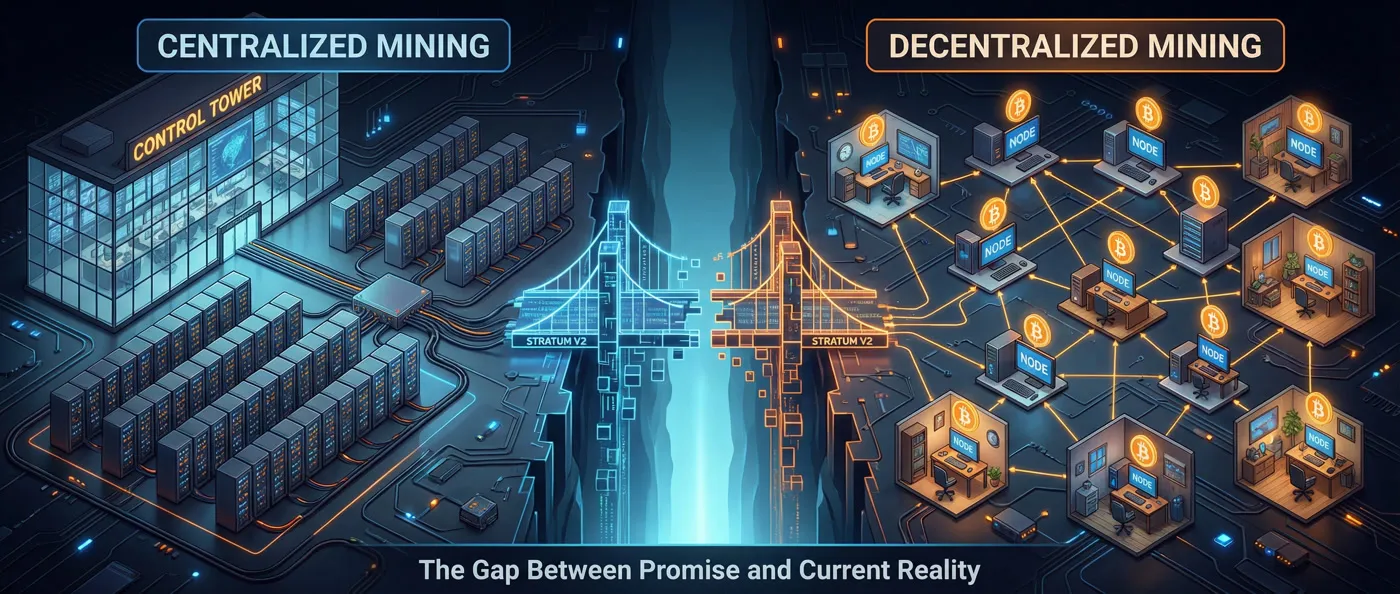
Bitcoin Core v30.0 quietly introduced something significant last October: an experimental interface for Stratum V2, the next-generation mining protocol that’s supposed to make Bitcoin mining more decentralized and censorship-resistant.
Five months later, I keep coming back to the same question: is anyone actually using it?
The short answer is yes, but not many. And the reasons why tell us a lot about the gap between Bitcoin’s ideals and the economic realities of industrial mining.
What Bitcoin Core v30.0 actually added
Let’s start with what changed. Bitcoin Core v30.0, released October 8, 2025, introduced an IPC (Inter-Process Communication) Mining Interface that allows external mining software to integrate with Bitcoin Core’s block template engine.
This isn’t a complete Stratum V2 server. It’s more like plumbing. The IPC interface lets mining clients request block templates and submit mined blocks without having to constantly poll Bitcoin Core’s old JSON-RPC interface, which is slow and clunky.
To actually mine with Stratum V2, you still need additional software like the Stratum Reference Implementation components. Bitcoin Core provides the foundation; someone else has to build the house.
The feature is experimental. The GitHub tracking issue shows active development, with PR #33229 simplifying the command-line arguments needed to enable it. But this is not production-ready for most miners.
Why Stratum V2 matters (in theory)
Stratum V1 has been the industry standard since 2012. It works, but it has problems.
The biggest one is centralization. In Stratum V1, pool operators control which transactions get included in blocks. Miners are just hashers. They have no say in the actual content of the blockchain they’re building.
Stratum V2’s “Job Negotiation” feature flips this. Miners can run their own Bitcoin Core nodes, construct their own block templates, and choose which transactions to include. The pool still coordinates share distribution and payouts, but it doesn’t control transaction selection anymore.
This matters for censorship resistance. If a government pressures a pool operator to blacklist certain transactions, miners using V2 with Job Negotiation can ignore those instructions and include whatever they want.
There are other benefits too. V2 uses binary encoding instead of verbose JSON, cutting bandwidth usage by about 30%. It includes native encryption and authentication, protecting against man-in-the-middle attacks. These are real improvements, not just theoretical.
But here’s the thing: most of these benefits don’t translate into immediate profit for miners. And in an industry with razor-thin margins, that’s a problem.
Who’s actually using Stratum V2?
As of March 2026, a handful of pools support Stratum V2:
Braiins Pool was the first mover. They developed the protocol and run 100% V2-native infrastructure. They control about 3% of network hashrate.
DMND Pool launched in March 2025 as the first pool built entirely on the Stratum Reference Implementation. They went fully public in November 2025 with SOC 2 compliance. Still relatively small in terms of hashrate.
OCEAN Mining offers V2 support with a focus on privacy and non-custodial mining.
And that’s about it for meaningful adoption.
Foundry USA, which controls roughly 32% of network hashrate, has no Stratum V2 support. Neither do AntPool (~20%), F2Pool, or ViaBTC. These are the pools most miners actually use.
According to ECOS mining analysis from October 2025, Stratum V2 adoption stands at 15-20% of global hashrate. That’s not nothing, but it’s not a revolution either.
The adoption problem
Why is uptake so slow? A few reasons stand out.
Inertia is powerful. Stratum V1 works. Most miners don’t see an immediate economic benefit from switching. If you’re a large mining farm optimizing for uptime and simplicity, rewriting your infrastructure for a protocol that doesn’t directly increase revenue is a tough sell.
Pools have to rebuild everything. Stratum V2 isn’t backward-compatible with V1. Supporting it means new backend systems, new tooling, new operational complexity. For established pools, that’s a significant cost with uncertain payoff.
Full Job Negotiation requires running a node. The censorship-resistance benefits only work if miners run their own Bitcoin Core nodes and construct block templates locally. That’s not realistic for small home miners who want plug-and-play simplicity, and it’s often not worth the overhead for large farms that prefer pools to handle template construction.
Hardware support is patchy. Bitmain and MicroBT ASICs don’t support V2 on stock firmware. You need third-party firmware like Braiins OS+ on compatible Antminer models. Auradine ships with native V2 support, but they’re a smaller player.
Most miners don’t understand the benefits. Decentralization and censorship resistance are abstract concepts. Hashrate and electricity costs are concrete. If you can’t explain why V2 increases profitability, most miners won’t care.
The censorship question
The censorship-resistance argument is compelling but still mostly theoretical.
There have been incidents. In December 2023, researcher 0xB10C documented six Bitcoin transactions that appeared to be deliberately ignored by three major pools. Some pools have voluntarily implemented transaction filtering, likely as preemptive compliance with anticipated regulations.
But we haven’t seen a large-scale government crackdown forcing pools to censor transactions. Until that happens, most miners treat censorship resistance as a nice-to-have, not a critical feature.
And even among pools that support V2, many haven’t fully enabled Job Negotiation. They offer the protocol’s efficiency and encryption benefits but still control transaction selection themselves. It’s V2 in name, not in spirit.
What happens next?
Bitcoin Core’s IPC interface is a step forward, but it’s just infrastructure. The real work is convincing miners and pools that switching is worth the effort.
Short-term, we’ll probably see a few more pools announce V2 support in 2026. Hardware manufacturers might start shipping V2-capable firmware by default. Bitcoin Core will continue refining the IPC interface.
Medium-term, if regulatory pressure increases and governments start leaning on pools to censor transactions, Job Negotiation adoption could accelerate. Miners who want sovereignty over transaction selection will have a concrete reason to switch.
Long-term, Stratum V2 will likely become the default. But “likely” and “long-term” are doing a lot of work in that sentence. We’re talking about a multi-year migration, not a sudden flip.
For now, five months after Bitcoin Core v30.0’s release, Stratum V2 remains a niche protocol with compelling benefits and frustratingly slow adoption. The infrastructure is being built. Whether miners actually use it depends on whether the benefits ever become urgent enough to outweigh the costs.
I genuinely don’t know if we’ll look back at this moment as the beginning of a major shift in mining decentralization, or just another incremental improvement that most of the industry ignored. Check back in another five months.
Sources
- Bitcoin Core 30.0 Release Notes
- Bitcoin Core GitHub Issue #31098: IPC Mining Interface
- Stratum V2 Official Documentation
- Braiins: Past and Future of Bitcoin Mining Protocols - Stratum V2 Overview (April 10, 2024)
- Bitcoin Magazine: What is Stratum V2? (December 6, 2024)
- Bitcoin Magazine: DMND Pool Now Open to All Miners (November 28, 2025)
- D-Central: Bitcoin Mining Pool Comparison 2026
- The Block: Bitcoin Faces Risk of Protocol-Level Censorship (December 26, 2023)
- Bitcoin Magazine: Is Mining Censorship a Threat to Bitcoin? (September 28, 2025)
- Solo Satoshi: Understanding Mining Pools (February 2026)
Published March 3, 2026 by bitcoinindex.net