SEC drops crypto from 2026 examination priorities
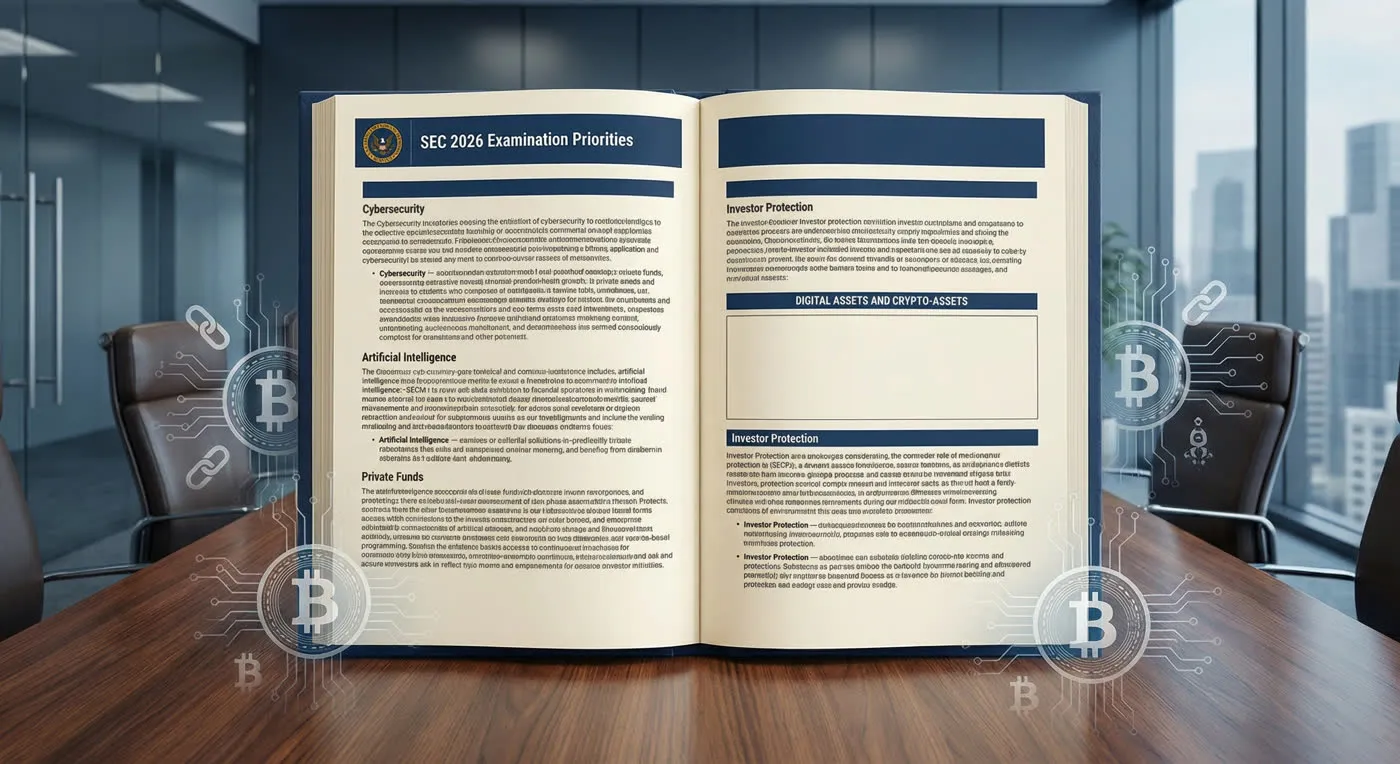
On November 17, 2025, the SEC published its 2026 Examination Priorities. Seventeen pages outlining where the agency plans to focus its compliance scrutiny for the year ahead. Crypto got exactly zero mentions.
Not a single reference to “crypto,” “digital assets,” “virtual currency,” or “blockchain” anywhere in the document. This is the first time since 2021 that cryptocurrency has been entirely absent from the SEC’s annual examination roadmap.
If you’ve been following crypto regulation over the past four years, this is a big deal.
What are examination priorities, and why do they matter?
The SEC’s Division of Examinations publishes these priorities every year to signal which firms and which risks will get heightened scrutiny. They’re not an exhaustive list of everything the SEC can examine, but they forecast where examiners will spend their time.
Here’s why that matters: examinations can lead to enforcement referrals. If examiners find material rule violations or deficiencies, those cases get kicked to the Division of Enforcement. Being on the priorities list means you’re flagged for routine compliance sweeps. Being off the list means you’re no longer in the crosshairs by default.
Crypto has been on that list every year since 2021. Until now.
The before and after
Let’s look at what changed:
2024 priorities: Crypto had a dedicated section titled “Crypto Assets and Emerging Financial Technology.” The SEC explicitly stated it would prioritize firms active in crypto assets, with specific focus on spot Bitcoin and Ether ETFs.
2025 priorities: Crypto assets were listed alongside AI, cybersecurity, and anti-money laundering as key risk areas. Multiple references throughout the document.
2026 priorities: Zero mentions. Crypto is nowhere.
The shift is stark. CryptoSlate put together a comparison table that shows the trend:
| Year | Crypto as distinct risk | Mentions in text |
|---|---|---|
| 2024 | Yes, dedicated section | Multiple |
| 2025 | Yes, listed among risks | Multiple |
| 2026 | No | Zero |
The Gensler era
To understand why this matters, you need to understand what came before.
Gary Gensler served as SEC Chair from April 2021 to January 2025. His tenure was defined by aggressive crypto enforcement. The numbers tell the story:
- 125 crypto enforcement actions in less than four years
- $6.05 billion in penalties (nearly four times the previous administration)
- 2023 peak: 46 enforcement actions, the highest on record
- 2024: 33 actions (a 30% drop from 2023) but $4.98 billion in penalties, driven largely by Binance’s $4.3 billion settlement
Gensler’s approach was widely criticized as “regulation by enforcement.” Instead of writing new rules, the SEC applied existing securities laws through enforcement actions, arguing that most crypto tokens were unregistered securities. The Blockchain Association estimated this cost the crypto industry more than $400 million in legal fees.
It was a strategy that created legal uncertainty and pushed much of the industry offshore or underground.
The Atkins shift
Paul Atkins was confirmed as SEC Chair on April 9, 2025, and sworn in on April 21. A former SEC Commissioner from 2002 to 2008, Atkins is known for favoring lighter regulation and emphasizing capital formation. His appointment signaled a pro-crypto shift.
Seven months later, crypto is off the examination priorities entirely.
But Atkins hasn’t ignored crypto. In July 2025, he launched “Project Crypto,” a Commission-wide initiative to create a comprehensive regulatory framework for digital assets. The project includes roundtables with industry participants and aims to produce two proposed rules in 2026: one for a broad crypto asset framework, and another to amend the Securities Exchange Act to accommodate crypto trading on exchanges and alternative trading systems.
Several high-profile enforcement cases were dismissed or settled:
- The Ripple case ended with a $125 million penalty and a limited injunction covering only institutional sales.
- Robinhood’s crypto investigation was closed with no charges.
- The SEC moved to dismiss its lawsuit against Coinbase.
Enforcement activity has collapsed. The shift is real.
What this does and doesn’t mean
Let’s be clear about what’s actually happening here.
What it means:
- Crypto firms are no longer flagged as a high-risk category for compliance sweeps. Broker-dealers, investment advisers, and exchanges offering crypto services won’t face heightened scrutiny solely because they touch crypto.
- The SEC is shifting from enforcement to rule-making. Atkins is pursuing regulation through Project Crypto rather than through enforcement actions.
- Crypto-related risks will now be addressed through technology-neutral frameworks. Custody, AML, marketing, and suitability rules still apply to crypto firms, but crypto isn’t being singled out.
What it doesn’t mean:
- Crypto is not exempt from SEC oversight. The priorities document explicitly states it’s “not an exhaustive list.” Crypto firms can still be examined, and enforcement actions can still be brought.
- The SEC hasn’t abandoned crypto. Project Crypto is a top priority, and Atkins has held multiple roundtables with industry. The focus has shifted from examinations and enforcement to regulatory clarity.
- There’s no immunity from fraud or securities law violations. The SEC can still pursue enforcement for fraud, unregistered securities offerings, or violations of custody and AML rules. What’s changed is routine compliance examinations, not enforcement authority.
The global context
While the U.S. pulls back from crypto-specific oversight, other jurisdictions are moving in the opposite direction:
- European Union: The Markets in Crypto-Assets (MiCA) framework is fully in effect. Stablecoin rules went live June 30, 2024; broader regulations for crypto-asset service providers took effect December 30, 2024.
- United Kingdom: Draft regulations to create new regulated activities for crypto assets, with consultations on trading platforms, intermediation, staking, and DeFi.
- Hong Kong: Licensing regime for virtual asset trading platforms; 12-initiative roadmap in 2025, including steps to allow licensed platforms to share global order books.
- Singapore: Stablecoin framework finalized in 2023, effective 2024, for single-currency stablecoins pegged to SGD or G10 currencies.
The U.S. is taking a different path. Whether that’s better or worse depends on execution.
Looking ahead: three scenarios
Legal analysts have outlined three plausible paths for 2026-2027:
1. Benign neglect (most likely) The SEC keeps crypto out of examination priorities and handles crypto exposure through custody, AML, cyber, and marketing rules. Enforcement drifts toward single-digit case counts focused on fraud. Absent external shocks, this is the baseline scenario.
2. Realignment (requires Congress) Legislation on market structure pushes most spot tokens to the CFTC and reserves the SEC for tokenized securities and fund shares. The exam program could then reintroduce a narrow crypto scope limited to securities products. Bills have been proposed, but prospects are uncertain.
3. Snap-back (high-impact failure) A high-profile failure triggers hearings and a re-insertion of crypto into 2027 or 2028 priorities with new specialist resources. A stablecoin breakdown, exchange incident, or ETF product shock could reverse the current policy overnight.
Is this overdue normalization or a temporary pause?
I genuinely don’t know.
On one hand, the Gensler-era enforcement approach was widely seen as heavy-handed and counterproductive. The fact that enforcement dropped 30% in Gensler’s final year (before Atkins even took over) suggests the shift began earlier. Moving to rule-making through Project Crypto seems like a more sensible approach than regulation by enforcement.
On the other hand, the crypto market is volatile. Bitcoin is down nearly 30% from its October 2025 peak above $126,000, trading below $90,000 in early 2026. The broader crypto market shed roughly $1 trillion in six weeks. If there’s a high-profile failure, this policy could reverse quickly.
The removal of crypto from the priorities was fast. Seven months from Atkins taking office to publication on November 17, 2025. That’s unusual for a bureaucracy. It suggests this was a priority for the new chair.
Interestingly, private fund advisers were also dropped from the 2026 priorities for the first time since 2019. Unlike crypto, private fund topics were absorbed into other sections rather than removed entirely. But the parallel removal suggests a broader shift toward a more cooperative, business-supportive examination approach.
Whether this is the right call depends on what happens next. If the market remains stable and Project Crypto delivers clear rules, this could be remembered as the moment U.S. crypto regulation matured. If there’s a major failure, it will look reckless in hindsight.
For now, the SEC is betting on rule-making over enforcement. We’ll see if that bet pays off.
Sources
- SEC Division of Examinations, “Fiscal Year 2026 Examination Priorities” (November 17, 2025)
- SEC Division of Examinations, “Fiscal Year 2025 Examination Priorities”
- SEC Press Release, “SEC Division of Examinations Announces 2026 Priorities” (November 17, 2025)
- Katten Muchin Rosenman LLP, “SEC Division of Examinations Releases Its 2026 Examination Priorities”
- CryptoSlate, “SEC is done with crypto: Removes all mention from its agenda for 2026” (November 18, 2025)
- Georgetown Law Center on Transnational Business and the Law, “Beyond Enforcement: The SEC’s Shifting Playbook on Crypto Regulation”
- Cornerstone Research, “SEC Enforcement of Cryptocurrency Dropped 30% in the Last Year of the Gensler Administration” (January 23, 2025)
Last updated: March 2, 2026