SEC Drops Crypto from 2026 Enforcement Priorities
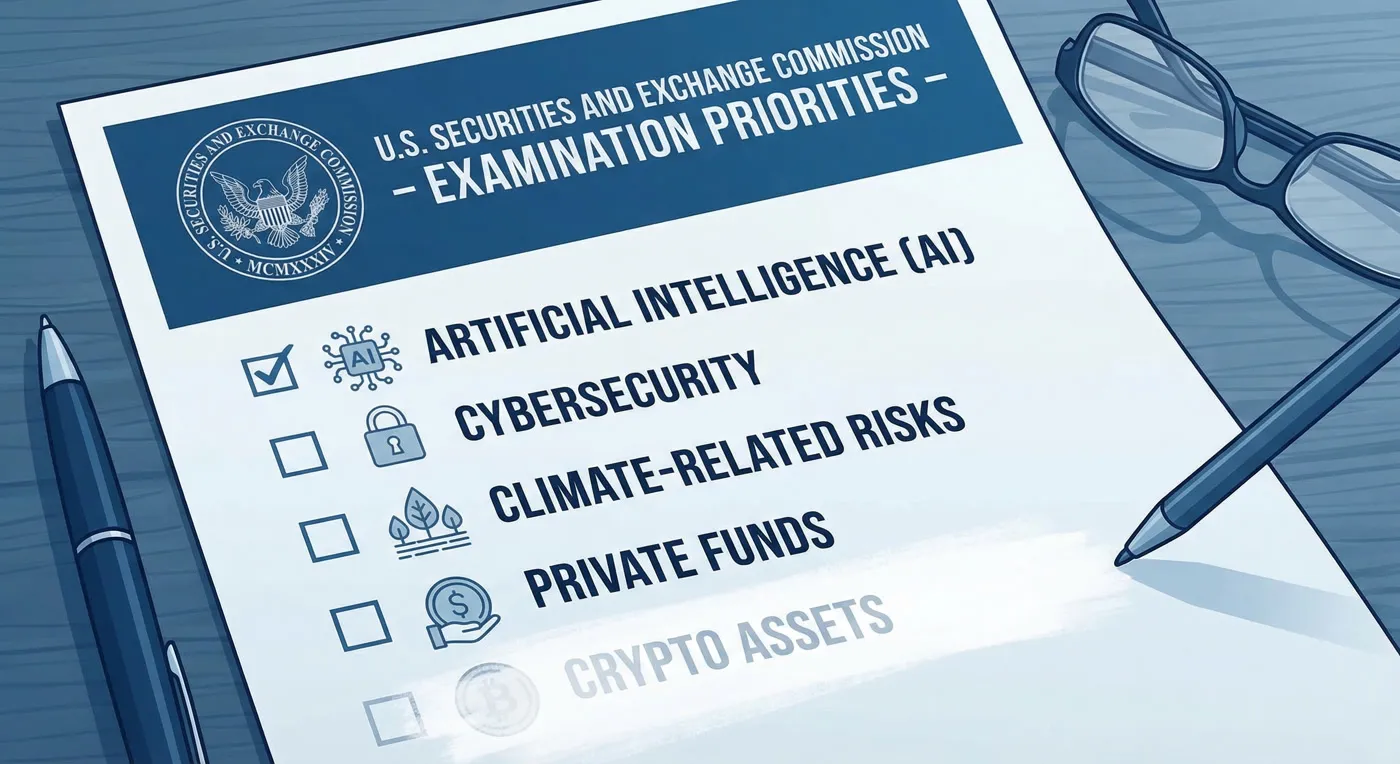
For the first time since approximately 2019, crypto is nowhere to be found in the SEC’s annual examination priorities.
On November 17, 2025, the SEC’s Division of Examinations released its 2026 Examination Priorities, and the document contains zero mentions of crypto assets, digital assets, blockchain, or virtual currencies. The dedicated “Crypto Assets and Emerging Financial Technology” section that appeared in every priorities document from 2021 through 2025 is gone entirely.
This isn’t subtle. It’s a deliberate removal that marks a fundamental shift in how the SEC approaches digital assets.
What disappeared
The 2025 priorities, published just over a year earlier under the prior administration, contained a full section on crypto. That document explicitly stated the Division would “prioritize firms active in crypto assets and related products” and would examine custody arrangements, trading activities, and advisory services related to digital assets.
The 2026 version? Nothing. Instead, the SEC now prioritizes artificial intelligence and automated investment tools, cybersecurity, data privacy compliance, and extended-hours trading. Crypto didn’t migrate to a different section. It was removed from the document entirely.
This is the first year in roughly half a decade that crypto hasn’t been flagged as a distinct examination priority requiring specialized scrutiny.
Why examination priorities matter
The SEC’s examination priorities aren’t just a policy wish list. They drive resource allocation within the Division of Examinations and signal where the agency will focus its compliance checks and enforcement referrals for the coming year.
When crypto was on the list, it meant examiners were specifically tasked with reviewing crypto-related activities at registered firms. It meant surprise examinations, document requests, and a higher likelihood that deviations from compliance would result in enforcement actions.
Removing crypto from the priorities doesn’t mean the SEC has lost the authority to examine crypto firms. The document itself notes that the priorities are “not an exhaustive list.” But it does mean the Division is no longer dedicating specialized examination teams to crypto as a category requiring heightened scrutiny.
In practical terms, this reduces the likelihood that crypto firms will face proactive examinations focused specifically on their digital asset activities. The shift is from targeted oversight to general oversight, where crypto falls under the same fiduciary duty, custody, and retail protection standards as any other asset class.
The Atkins factor
The 2026 priorities were released under SEC Chairman Paul Atkins, appointed by President Trump in his second term. Atkins has made no secret of his intention to move the SEC away from what he calls “regulation by enforcement.”
In his statement accompanying the priorities release, Atkins wrote: “Examinations are an important component to accomplishing the agency’s mission, but they should not be a ‘gotcha’ exercise.”
That quote is revealing. It suggests the prior approach, which leaned heavily on surprise examinations and enforcement actions against crypto firms operating in regulatory gray zones, is being replaced by a model that emphasizes clarity and predictability.
This isn’t happening in a vacuum. On July 31, 2025, Chairman Atkins launched “Project Crypto,” an SEC-wide initiative to modernize securities regulations for blockchain-based markets. In his speech announcing the project, Atkins stated: “To achieve President Trump’s vision of making America the crypto capital of the world, the SEC must holistically consider the potential benefits and risks of moving our markets from an off-chain environment to an on-chain one.”
The removal of crypto from examination priorities is consistent with this broader strategy. Instead of examining crypto firms for violations of rules that were never written for digital assets, the SEC is focusing on writing those rules.
What the SEC is actually doing
If you’re thinking this means the SEC has stopped caring about crypto, look at what happened in 2025 alone.
The agency issued seven major staff statements clarifying how existing securities laws apply to various crypto activities:
- Meme coins typically don’t meet investment contract criteria (February 27)
- Proof-of-work mining isn’t a securities offering (March 20)
- Payment stablecoins aren’t securities when designed for payments or value storage (April 4)
- Tokenized securities require proper disclosure and registration (April 10)
- Broker-dealer crypto custody follows existing financial responsibility rules (May 15)
- Protocol staking isn’t a securities offering (May 29)
- Liquid staking isn’t a security under certain conditions (August 5)
The SEC also issued two no-action letters in September 2025, providing safe harbor for decentralized physical infrastructure network token distributions and confirming that state-chartered trust companies can serve as crypto custodians for registered investment advisers and investment companies.
On the market structure front, the SEC approved in-kind creations and redemptions for crypto ETPs on July 29, issued a joint statement with the CFTC on spot crypto trading on exchanges on September 2, and approved generic listing standards for commodity-based trust shares including crypto on September 17.
This is not an agency that has abandoned crypto oversight. It’s an agency that’s shifted from enforcement-first to guidance-first.
The enforcement wind-down
Alongside these policy moves, the SEC moved to dismiss its lawsuit against Coinbase, which had alleged the exchange was operating as an unregistered securities platform and offering unregistered staking services. Approximately a dozen other crypto enforcement cases were halted or settled throughout 2025.
The combination of dropping enforcement actions and removing crypto from examination priorities sends a clear message: the “regulation by enforcement” era is over.
Whether what replaces it will be better or worse depends entirely on what rules the SEC actually writes.
The caveat no one should ignore
Multiple securities law firms published analyses of the 2026 priorities, and they all made the same point: the absence of crypto from the document doesn’t mean crypto firms are off the hook.
Katten Muchin Rosenman noted that “Chairman Atkins has made clear that crypto and digital assets are a top priority” for the SEC’s overall policy agenda, even if they’re not listed as an examination priority. The distinction is between proactive examinations (looking for violations) and rulemaking (setting clear standards).
Crypto firms can still be examined under general categories like fiduciary duties, custody obligations, conflicts of interest, and retail investor protection. If a crypto firm blatantly violates existing rules or commits fraud, the SEC isn’t going to shrug and walk away.
The removal from priorities means the SEC is no longer treating crypto as a discrete “special risk” category requiring dedicated examination teams. It doesn’t mean crypto firms are exempt from securities laws.
What comes next
The real test of this regulatory shift will come in 2026, when the SEC is expected to propose “Regulation Crypto,” a comprehensive rulemaking that would establish:
- A token taxonomy distinguishing digital commodities, network tokens, digital collectibles, and digital tools
- Clarity on when tokens transition from securities to non-securities
- Tailored disclosure requirements and safe harbor frameworks
- Rules for tokenized securities trading and custody
- A path for “super-apps” offering both securities and non-securities with unified oversight
- An “innovation exemption” for testing novel business models under principles-based safeguards
If the SEC delivers on these promises, the removal of crypto from examination priorities will look like a sensible transition from ad-hoc enforcement to systematic regulation. If Regulation Crypto stalls or proves unworkable, the removal will look premature.
Congress could also act. The FIT21 bill, which would establish a clear jurisdictional split between the SEC and CFTC for digital assets, passed the House and is pending in the Senate. If it becomes law, it could supersede or reshape whatever the SEC proposes.
What this actually means
The SEC’s 2026 examination priorities represent a meaningful policy shift, not just a symbolic one.
For the first time in years, crypto firms registered with the SEC won’t wake up wondering if this is the day an examination letter arrives asking them to explain their compliance with rules that were never clearly defined for digital assets. That’s progress.
But it’s conditional progress. The shift from enforcement-heavy to guidance-driven regulation only works if the guidance actually arrives. If Project Crypto produces clear, workable rules, this will be remembered as the year US crypto regulation matured. If it produces vague principles or stalls in political gridlock, the industry may end up nostalgic for the clarity that enforcement actions at least provided.
The removal of crypto from examination priorities isn’t the end of SEC oversight. It’s a bet that oversight works better when the rules are written down first and enforced second, rather than the other way around.
Whether that bet pays off depends on what happens in 2026.
Sources: SEC Division of Examinations 2026 Priorities (PDF), SEC Press Release - 2026 Priorities Announcement, Chairman Atkins Speech - American Leadership in the Digital Finance Revolution, Chairman Atkins Remarks - Project Crypto Update, Katten Muchin Rosenman - SEC 2026 Examination Priorities Analysis, Reuters - Wall Street regulator drops emphasis on crypto sector exams, Sidley Austin - Breaking Down Project Crypto. Data/status as of March 4, 2026.