SEC and CFTC Issue Joint Crypto Token Taxonomy: 'Most Crypto Assets Are Not Securities'
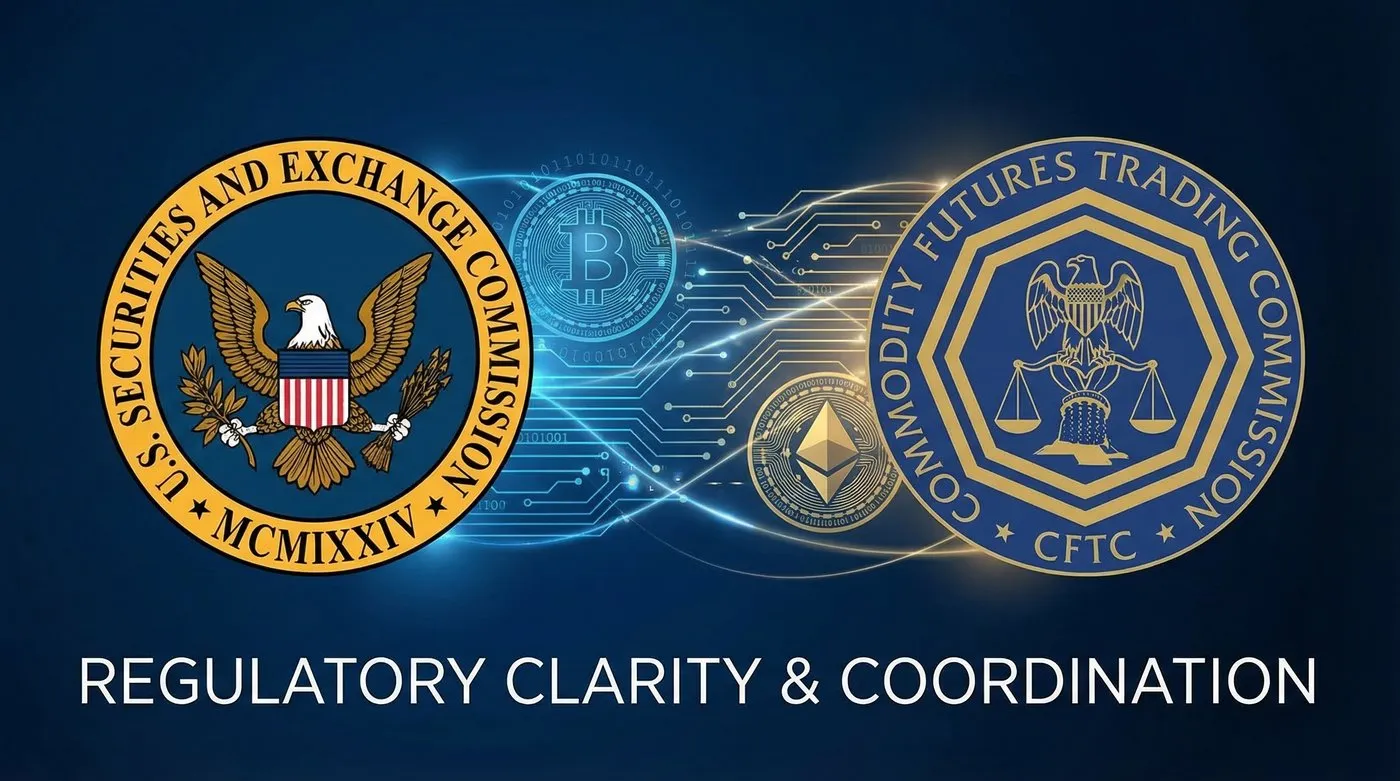
After more than a decade of regulatory fog, the SEC and CFTC just drew a map.
On March 17, 2026, the two agencies issued joint interpretive guidance establishing the first formal federal token taxonomy. The 68-page document names 16 assets as digital commodities, carves out categories for collectibles and stablecoins, and includes a line that would have been unthinkable two years ago: “most crypto assets are not themselves securities.”
SEC Chairman Paul Atkins put it bluntly at the Digital Chamber’s DC Blockchain Summit: “We’re not the securities and everything commission anymore.”
Five categories, one framework
The guidance creates five distinct classifications:
Digital commodities are the headliners. The SEC and CFTC explicitly named 16 assets that fall under CFTC jurisdiction, not securities law: Bitcoin (BTC), Ethereum (ETH), Solana (SOL), XRP, Cardano (ADA), Chainlink (LINK), Avalanche (AVAX), Polkadot (DOT), Stellar (XLM), Hedera (HBAR), Litecoin (LTC), Dogecoin (DOGE), Shiba Inu (SHIB), Tezos (XTZ), Bitcoin Cash (BCH), Aptos (APT), and Algorand (ALGO).
Digital collectibles cover NFTs and memecoins that derive value from community sentiment and culture rather than investment contracts.
Digital tools are utility tokens and assets like ENS (Ethereum Name Service) domains that function as software tools or services.
Payment stablecoins are those meeting the requirements of the GENIUS Act, which became law on July 18, 2025. The Act explicitly states that permitted payment stablecoins are not securities.
Digital securities are traditional securities represented as tokens, like tokenized stocks or bonds.
Investment contracts can end
Here’s the conceptual shift that matters: the guidance establishes that a digital asset can enter and exit investment contract status. An investment contract ends when “either the issuer has fulfilled its representations or promises or the issuer has failed to satisfy its representations or promises.”
This acknowledges what anyone who’s watched a crypto project mature already knows: decentralization changes things. A token tied to founder promises at launch may evolve into something else entirely as the network grows. The law can now follow that arc.
What you can actually do
The guidance clarifies specific activities that have lived in legal limbo:
Protocol mining (like Bitcoin mining) is not subject to securities laws when users independently participate in network validation.
Protocol staking treatment depends on structure. Independent wallet-based staking is treated differently from participation in a managed pool with profit promises.
Airdrops get securities law treatment based on the token’s nature and distribution structure.
Token wrapping doesn’t automatically convert a non-security into a security. Wrapped Bitcoin (WBTC) remains a non-security when wrapped onto other chains.
Why this matters for Bitcoin
Bitcoin’s status as a digital commodity is now formally confirmed in joint SEC-CFTC guidance. This clarifies that Bitcoin mining is not subject to securities laws, that Bitcoin itself is a commodity under CFTC jurisdiction, and that wrapped Bitcoin remains a non-security.
The guidance reinforces Bitcoin’s unique regulatory position and provides legal certainty for Bitcoin-related financial products, mining operations, and infrastructure development.
From Gensler to Atkins
This represents a complete reversal from the Gary Gensler SEC era (2021-January 2025), which brought over 100 enforcement actions against crypto companies and refused to provide tailored crypto regulations.
Atkins, appointed by President Trump, stated the guidance “acknowledges what the former administration refused to recognize – that most crypto assets are not themselves securities.”
The joint guidance follows a formal Memorandum of Understanding between the SEC and CFTC signed days earlier, establishing coordinated regulation across industries. CFTC Chairman Michael S. Selig said: “For far too long, American builders, innovators, and entrepreneurs have awaited clear guidance on the status of crypto assets under the federal securities and commodity laws. With today’s interpretation, the wait is over.”
What comes next
Atkins announced that formal rulemaking “in a week or two” will include more than 400 pages of crypto proposals, including an “innovation exemption” for crypto firms. He described it as a “fit-for-purpose startup exemption” allowing crypto entrepreneurs to raise money or operate for a certain period while exempt from SEC rules.
Both Atkins and Selig acknowledged that permanent policy shifts require Congressional action. Bipartisan market structure legislation is currently being developed.
Industry reaction
Coinbase Chief Legal Officer Paul Grewal responded on X: “2023 me couldn’t have imagined that 2126 me would see such a thing, let alone 2026 me. The healing continues.”
The comment references Coinbase’s 2022 Rulemaking Petition to the SEC, followed by a writ of mandamus in April 2023 asking for a yes-or-no answer. The SEC denied the petition in December 2023 under Gensler, maintaining that existing laws already covered crypto.
The new guidance creates a foundation for institutional participation. Banks, asset managers, and exchanges now have a defined framework. Expect expansion of ETFs, derivatives, custody services, and structured products across the 16 named commodities.
This may also set a global benchmark. Other countries often watch U.S. regulatory moves before committing to their own frameworks.
Sources
- SEC Press Release
- SEC Interpretive Guidance PDF
- CFTC Press Release
- GENIUS Act (S.394)
- CoinDesk
- BSC News
- Coinpedia
- Reuters
- The Block
Data/status as of March 17, 2026.