Bitcoin's Historic Mining Shakeup: Record Difficulty Swings and Industry Transformation
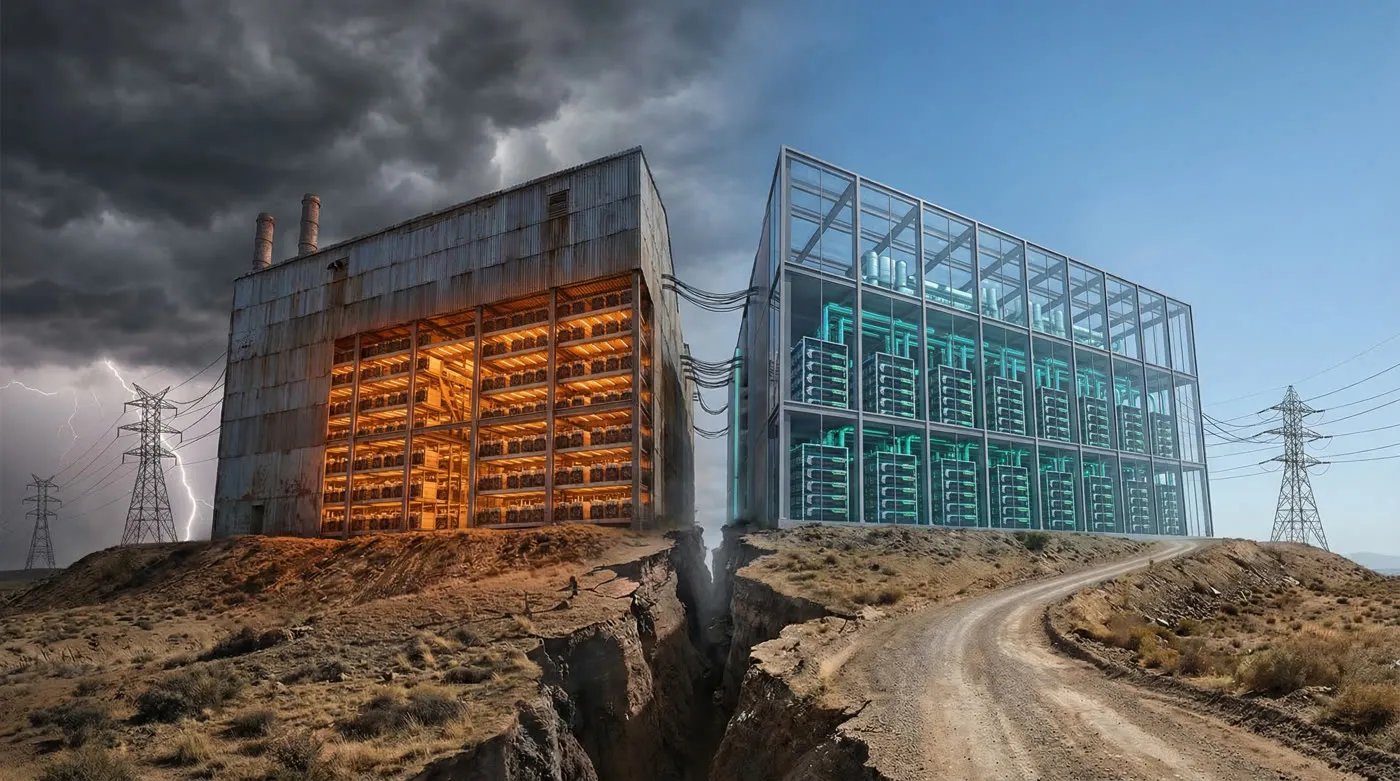
On February 19, 2026, at 02:54:35 UTC, Bitcoin’s mining difficulty spiked 14.73% to 144.4 trillion. That’s the largest absolute increase in the network’s 17-year history, and the biggest percentage jump since China banned mining in 2021.
What makes this remarkable isn’t just the size. It’s what came before: ten days earlier, difficulty had plummeted 11.16% following severe winter storms that knocked major U.S. mining operations offline. The whipsaw from record drop to record spike happened in less than two weeks.
This is Bitcoin’s protocol doing what it’s designed to do. When hashrate drops, difficulty adjusts downward to maintain the 10-minute block target. When hashrate surges back, difficulty corrects upward. The network absorbed a severe weather disruption and self-healed automatically.
But the human layer didn’t fare as well. February 2026 marked one of the most brutal capitulation events in mining history, complete with bankruptcies, strategic pivots, and a governance fight that’s still simmering.
The storm and the squeeze
Late January storms hit Texas and Georgia hard. Grid operators issued curtailment orders. Foundry USA’s hashrate collapsed from nearly 400 EH/s to around 198 EH/s. Public miners like Marathon, Riot, and CleanSpark scaled back or shut down entirely.
At block height 935,424 on February 8, difficulty dropped 11.16% to 125.86 trillion. Network hashrate had plummeted from peaks near 1.1 ZH/s in October 2025 to roughly 826 EH/s. Average block times climbed to 12.4 minutes.
Then the storms passed. Power returned. Miners reconnected fast. Hashrate surged back past 1 ZH/s, blocks started arriving faster than target, and the protocol auto-corrected with that historic 14.73% upward adjustment.
The speed of the rebound reveals how industrialized Bitcoin mining has become. These aren’t hobbyists in garages anymore. They’re massive data centers with professional operations teams who can bring capacity back online in days, not months.
It also reveals something darker: many of these miners are running at a loss and doing it anyway. As of late February, Bitcoin traded around $68,000 while production costs ranged between $77,000 and $87,000 depending on methodology. That’s not sustainable.
Who didn’t survive
NFN8 Group filed for Chapter 11 bankruptcy on February 2, 2026. A fire at their Crystal City, Texas facility had cut mining capacity in half, and low Bitcoin prices finished the job. The company sought a court-supervised asset sale.
The bigger failure came from Russia. BitRiver entered bankruptcy proceedings on January 27 following unpaid debts exceeding 700 million rubles (about $9.2 million). At its peak, BitRiver operated 15 data centers with over 175,000 rigs and 533 MW of capacity. On February 2, founder Igor Runets was placed under house arrest on tax evasion charges.
The collapse had been brewing since 2022, when BitRiver became the first crypto mining company ever sanctioned by the U.S. Treasury following Russia’s invasion of Ukraine.
Several smaller operations closed quietly around the same period. The Hash Ribbon indicator had been signaling capitulation since late 2025, marking one of the longest miner capitulation periods on record.
The AI exodus
Here’s where it gets interesting. While some miners failed, others pivoted. Hard.
Bitfarms announced in November 2025 that it would wind down Bitcoin mining operations over 2026-2027 and transition to GPU-as-a-Service offerings. CEO Ben Gagnon was blunt: “We are no longer a Bitcoin company.”
The company is retrofitting its 18 MW Washington State mining farm to support Nvidia GB300 GPUs with liquid cooling, backed by a $128 million deal. They reported that converting just this one site “could potentially produce more net operating income than we have ever generated with Bitcoin mining.”
Bitfarms reduced its Bitcoin treasury from 3,301 BTC at peak to 1,827 BTC as of early March 2026, selling to fund the AI buildout.
Riot Platforms began repurposing portions of its two-gigawatt power portfolio for AI and HPC hosting. Core Scientific announced plans to sell the bulk of its BTC holdings to fund AI infrastructure. Bitdeer sold its entire treasury (over 1,100 BTC) to fund a $325 million AI buildout with Nvidia.
The economics are stark. AI training and inference workloads need the same infrastructure Bitcoin mining uses, but AI hosting revenue currently exceeds mining revenue per megawatt. CleanSpark executives stated in early 2026 that Bitcoin mining investment “doesn’t make a lot of sense” at current hashprice versus AI returns.
This creates a ceiling effect on future Bitcoin hashrate growth. Computing capacity that moves to AI doesn’t return unless Bitcoin price rises enough to make mining more profitable than AI hosting. Some hashrate lost during this cycle may never come back.
Paradoxically, that could be bullish for remaining miners. Less hashrate competition means slower difficulty growth and better margins at any given BTC price.
The governance fight nobody asked for
On March 2, 2026, Ocean mining pool mined the first block signaling support for BIP-110, a proposed soft fork that would temporarily restrict arbitrary non-monetary data in Bitcoin transactions for approximately one year.
The proposal targets what proponents call “spam” uses of block space, including large inscriptions and OP_RETURN payloads. They argue unchecked data threatens Bitcoin’s role as sound monetary infrastructure.
The community is deeply divided. Blockstream CEO Adam Back warned that consensus-level intervention could harm Bitcoin’s credibility and create chain split risk. Developer Greg Maxwell alleged that Ocean ghostwrote the proposal under a false identity (a claim Ocean’s CTO Luke Dashjr denied).
Adding fuel to the fire, developer Martin Habovštiak inscribed a 66 KB image in a single Bitcoin transaction on March 6, demonstrating that large data payloads can be encoded even without the mechanisms BIP-110 targets.
As of early March 2026, miner signaling for BIP-110 remains minimal. Ocean is largely alone. Inscription fee revenue is down to below $10,000 per day from nearly $10 million at the 2023 peak, which raises the question: if inscription activity is already down 99.9%, what’s the actual threat?
What this means
February 2026 wasn’t just a difficulty adjustment. It was industrial consolidation disguised as a strategic pivot.
The AI narrative gives struggling miners a face-saving exit from an unprofitable business. Some will genuinely transition to profitable AI hosting. Others are using “strategic repositioning” as cover for financial distress.
In 2-3 years, we might look back and see February 2026 as the month Bitcoin mining bifurcated into two industries: pure-play Bitcoin miners (small, efficient, long-term holders) and opportunistic power arbitrageurs (large, flexible, treasury-light).
The BIP-110 debate feels like a distraction. The real structural change is the AI pivot and what it means for network security. If hashrate growth is capped by AI optionality, does that make Bitcoin more vulnerable to state-level attacks, or less vulnerable because remaining miners are more committed?
I lean toward the latter. Skin in the game beats raw hashrate. But it’s an open question, and February 2026 is where we started finding out.
Sources: Bitcoin Mining in 2026: A Month That Changed Everything, Bitcoin Difficulty Record Signals BTC Price 2026. Data as of March 10, 2026.