How Bitcoin's Difficulty Adjustment Prevents Mining Death Spirals (Explained by the Recent 7.76% Drop)
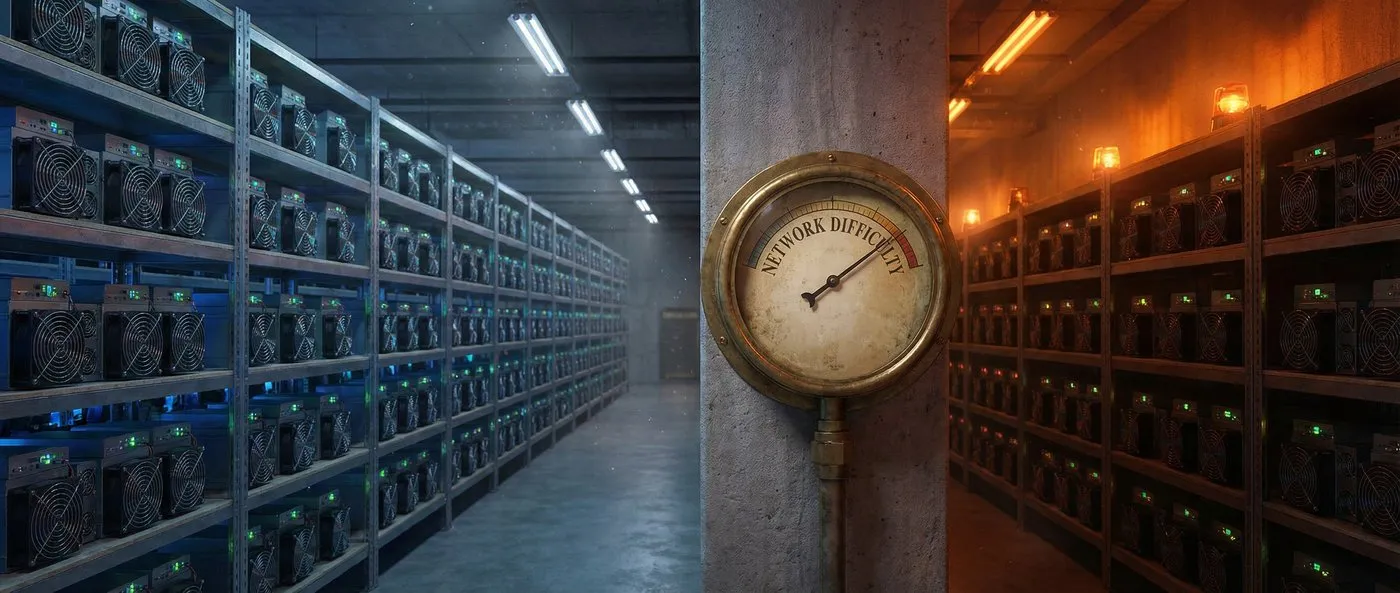
On March 21, 2026, Bitcoin’s mining difficulty dropped by 7.76% at block height 941,472, falling to 133.79 trillion. This wasn’t a crisis. It was Bitcoin’s immune system working exactly as designed.
When thousands of miners shut down because mining became unprofitable, Bitcoin didn’t grind to a halt. Instead, the network automatically adjusted to make block production easier for the miners who remained. This self-correcting mechanism is one of Satoshi Nakamoto’s most underrated design choices, and it’s the reason Bitcoin has survived every major shock thrown at it over the past 15 years.
Here’s how it works, and why it matters.
What is difficulty, and why does it adjust?
Bitcoin mining is a computational guessing game. Miners repeatedly hash block data until they find a hash that’s below a specific target number. The lower that target, the harder it is to find a valid hash. “Difficulty” is just a way to express how low that target is.
Every 2,016 blocks (roughly two weeks), Bitcoin recalculates the difficulty based on how long those 2,016 blocks actually took to mine. The formula is simple:
New Difficulty = Old Difficulty × (Actual Time / Expected Time)
Expected Time = 2,016 blocks × 10 minutes = 20,160 minutes
If the last 2,016 blocks came faster than 10 minutes on average, difficulty increases. If they came slower, difficulty decreases. The goal is to keep average block time at 10 minutes regardless of how much computing power is pointed at the network.
This adjustment has a hard limit: difficulty can only change by a maximum factor of 4 in either direction per epoch. This prevents wild swings if hashrate changes abruptly.
Why 2,016 blocks (two weeks)?
The two-week window is a carefully chosen balance. Too frequent, and miners could game the system by manipulating timestamps. Too infrequent, and the network would be slow to respond to major hashrate changes.
According to Bitcoin Wiki, the 2,016-block sample size provides enough data to measure actual hashrate trends versus random variance, while the two-week cycle is short enough to respond when miners leave or join en masse.
Satoshi never explicitly documented why he chose this exact duration, but it’s proven robust through everything Bitcoin has faced: regulatory crackdowns, price crashes, and hardware revolutions.
What caused the March 2026 drop?
Multiple pressures drove miners offline in early 2026:
Energy economics: Hashprice fell to around $30 per petahash per second per day, a five-year low. At typical electricity costs, many older mining rigs became unprofitable.
Iran energy crisis: Iran’s hashrate share fell below 5% as political instability and internet blackouts disrupted operations. CoinDesk reported that hashrate dropped roughly 8% in the lead-up to the adjustment, partly due to energy price spikes tied to the conflict.
AI competition: In Texas and other major mining hubs, AI data centers began outbidding miners for grid capacity, forcing some operations to curtail or relocate.
The result: approximately 80 exahashes per second (EH/s) of computing power left the network. Bitcoin’s estimated hashrate fell from around 1,038 EH/s to 958 EH/s.
Historical proof: Bitcoin survives catastrophic hashrate drops
This isn’t the first time Bitcoin’s hashrate has cratered. The difficulty adjustment has been tested repeatedly, and it’s passed every time.
China mining ban (July 2021)
When China banned crypto mining in mid-2021, roughly 50% of Bitcoin’s hashrate disappeared almost overnight. Chinese miners had controlled the majority of global mining capacity.
Difficulty adjustments in the following months ranged from 12.6% to 27.9%. Block times temporarily stretched beyond 10 minutes, but the network continued functioning. By September 2021, miners had relocated globally, and Bitcoin kept ticking.
Winter Storm Fern (February 2026)
Just weeks before the March 2026 drop, difficulty fell 11.16% in early February, the largest single negative adjustment since the China ban. Winter Storm Fern caused widespread curtailments across US power grids, and hashrate dropped 12% in the worst drawdown since 2021.
Once again, Bitcoin adapted.
Post-halving capitulation (2024-2025)
After Bitcoin’s April 2024 halving cut miner rewards from 6.25 BTC to 3.125 BTC per block, global hashrate dropped approximately 20% over three months as inefficient miners shut down. Multiple negative difficulty adjustments followed, giving surviving miners breathing room.
The pattern repeats: miners leave, difficulty drops, remaining miners become profitable again.
Why the death spiral never happens
The “mining death spiral” is a doomer scenario that goes like this:
- Bitcoin price crashes → miners become unprofitable → miners shut down
- Hashrate plummets → blocks take forever → network unusable
- Slow blocks → price crashes further
- Repeat until Bitcoin dies
It sounds plausible. It’s never happened. Here’s why:
Automatic stabilization: Mining cost is largely a function of difficulty. When miners leave, difficulty drops. This makes remaining miners profitable again, creating a natural floor. As CoinShares Research notes, as long as someone keeps mining (even hobbyists), the network survives.
No minimum hashrate required: Bitcoin doesn’t need a specific hashrate to function. Even if hashrate fell to 1% of current levels, blocks would still be found. Difficulty would adjust to match whatever hashrate remains. Security scales with hashrate, but functionality doesn’t require a minimum.
Economic incentives self-balance: When difficulty drops, profitability per hash increases. This attracts miners back (or keeps marginal miners online). When difficulty rises, marginal miners drop off. The system finds equilibrium without human intervention.
The 4x limit prevents extreme scenarios: Even if 75% of miners disappeared instantly, difficulty could only drop 75% per epoch. Multiple epochs can handle even catastrophic hashrate loss without destabilizing the network.
Bitcoin has survived 50%+ hashrate crashes, multiple bear markets, and geopolitical disruptions. In every case, the difficulty adjustment prevented catastrophic failure.
How this compares to other blockchains
Bitcoin’s difficulty adjustment is simple and battle-tested. Other chains have struggled with poorly designed alternatives:
Bitcoin Cash (BCH): Initially added an “Emergency Difficulty Adjustment” that adjusted difficulty if 6 blocks took longer than 12 hours. This created gaming opportunities where miners could turn on and off to manipulate difficulty. BCH later switched to a different algorithm.
Ethereum (pre-merge): Used a per-block difficulty adjustment (faster response than Bitcoin) but implemented a “difficulty bomb” to force the transition to Proof of Stake. Post-merge, Ethereum doesn’t use mining difficulty at all.
Smaller PoW chains: Many low-hashrate chains are vulnerable to 51% attacks because renting enough hashpower to attack them is cheap. Bitcoin’s massive hashrate combined with difficulty adjustment makes attacks prohibitively expensive, even during hashrate crashes.
Bitcoin’s approach is minimalist: just timestamps and division. But the implications are profound.
Why this matters for Bitcoin’s long-term survival
Every four years, Bitcoin’s block subsidy cuts in half. By around 2140, the subsidy will approach zero. Without the difficulty adjustment, this would be catastrophic: halving events would cut miner revenue in half, miners would leave, blocks would slow to a crawl, and the network would become unusable.
With the difficulty adjustment:
- Halving → miner revenue drops → some miners leave → difficulty drops → remaining miners profitable again
- Transaction fees gradually replace block subsidy as the primary revenue source
- Network continues functioning regardless of subsidy level
The difficulty adjustment is what allows Bitcoin’s fixed supply schedule to work. Without it, Bitcoin would have died at the first halving in 2012.
Current mining economics
At today’s hashprice of around $30 per PH/s per day, mining margins are razor-thin. Here’s the math for a single Antminer S21 (200 TH/s, 3,500W):
- Daily revenue: $30 × 0.2 PH/s = $6
- Daily electricity (at $0.10/kWh): 3.5 kW × 24h × $0.10 = $8.40
- Net: -$2.40/day
This explains why the 7.76% difficulty drop occurred. Unprofitable miners shut down. The adjustment makes remaining miners more profitable because they compete with fewer others for the same block rewards.
Luxor forward market pricing suggests hashprice will average $29.50 per PH/s/day through August 2026. The market expects continued pressure on miners.
What this means for users
When hashrate drops, block times may temporarily exceed 10 minutes. Once difficulty adjusts (within two weeks), block times return to the 10-minute target. Transaction confirmation times remain predictable over the medium term.
Bitcoin’s security remains high even during significant hashrate drops. At 958 EH/s, Bitcoin is still the most secure Proof-of-Work blockchain by far. A 51% attack would require controlling more than 479 EH/s, which would cost tens of billions of dollars in hardware alone, plus millions per day in electricity.
The difficulty adjustment is Bitcoin’s insurance policy against existential risk. It’s automated into the protocol. No governance debates, no emergency hard forks needed.
It just works.
Sources
- Bitcoin.com - Bitcoin Mining Difficulty Drops 7.76%
- The Block - Bitcoin mining difficulty drops 7.8%
- PANews - Bitcoin mining difficulty decreased by 7.76%
- Bitcoin Wiki - Difficulty
- Learn Me a Bitcoin - Difficulty
- Bitcoin Stack Exchange - Why 2 weeks?
- Forbes - Diving Into Difficulty
- TradingView - China ban difficulty drops
- CNBC - Mining difficulty drops after China hashrate collapse
- The Block - 11% drop February 2026
- CoinDesk - Hashrate drops 12%
- Photomadic - Miner Capitulation
- CoinDesk - Bitcoin hash rate tumbling
- AMBCrypto - Iran’s crisis threat to mining
- CoinShares Research - Why Miners Keep Mining
- Investopedia - Cryptocurrency Difficulty
- Rocketr - Death Spiral vs BCH
- MEXC - Luxor forward market
Data as of March 23, 2026.