Bitcoin's Circular Economy Paradox: Lightning Capacity Hits Record Highs While Merchant Adoption Stalls
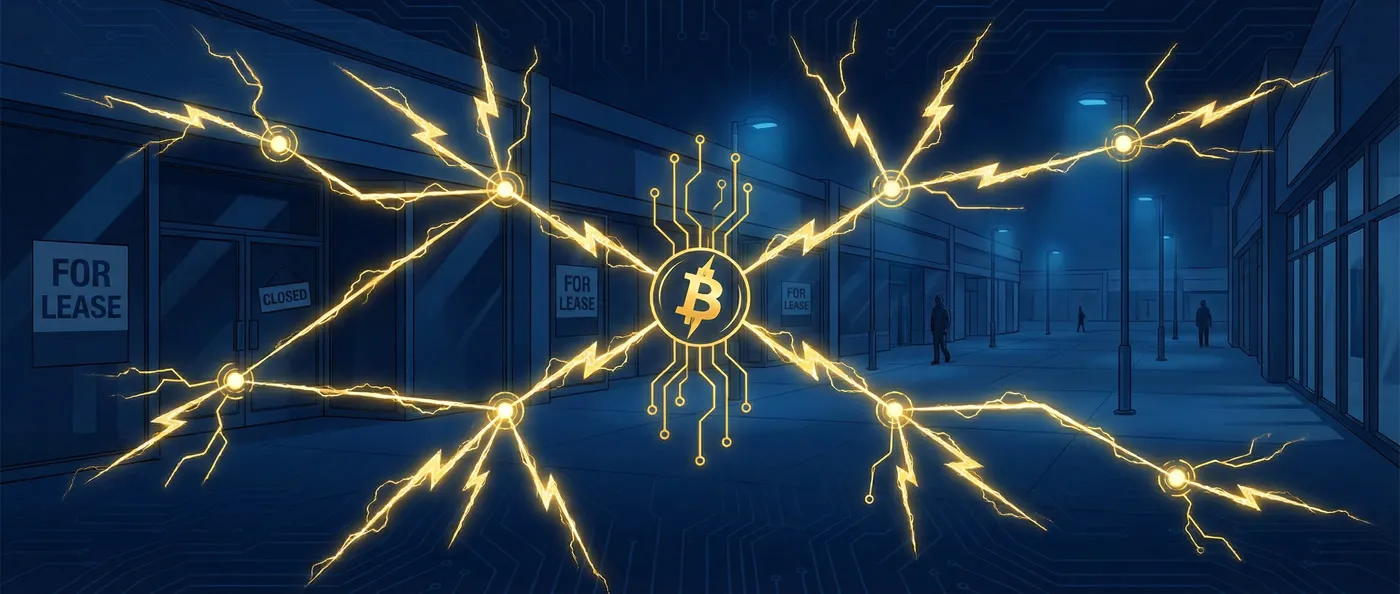
The Lightning Network just crossed $1 billion in capacity. Payment processors like BTCPay Server, OpenNode, and Strike make merchant integration simple. The infrastructure is ready. The tech works.
So why is nobody buying coffee with Bitcoin?
February 2026 brought a milestone that should have Bitcoin advocates celebrating: Lightning Network capacity surpassed $1 billion, with monthly transaction volume hitting $1.17 billion across 5.2 million transactions. Those are impressive numbers. But look closer and you’ll find an uncomfortable truth. The circular economy vision, where you earn Bitcoin, spend Bitcoin, and never touch fiat, remains stubbornly out of reach. Not because the technology failed, but because the economics work against it.
The numbers look great (on the surface)
Lightning’s growth story reads like a success:
- Capacity: 5,606-5,637 BTC (roughly $1.1 billion USD) locked in public channels
- Volume: $1.17 billion processed in November 2025 alone
- Network size: ~16,000 nodes running ~52,700 active channels
- Year-over-year growth: 266% volume increase from 2024 to 2025
The infrastructure expanded. Transaction success rates hit 99%+ on optimized setups. Major exchanges like Kraken, Bitfinex, and Binance integrated Lightning deposits and withdrawals. On paper, Lightning delivered everything it promised: instant settlement, negligible fees, and global reach.
But here’s the thing. When you dig into what’s actually driving that volume, the circular economy narrative falls apart.
The dominant use case: institutional flows
The average Lightning transaction size in November 2025 was $223. That’s not someone buying coffee or paying for lunch. That’s not micropayments. The dominant use case is institutional transfers, not retail spending.
River Financial’s analysis makes it clear: the primary driver is “moving larger sums between exchanges rather than everyday small purchases.” The $1.17 billion monthly volume breaks down like this:
- Exchange transfers between platforms
- Cross-border remittances where speed and low fees matter
- Embedded fintech apps like Cash App and Strike enabling deposits/withdrawals
- Subscription services for recurring digital goods
- Gaming and messaging micropayments that peaked in 2023 but didn’t sustain
Notice what’s missing? The coffee shop. The grocery store. The gas station. Retail merchant adoption, the heart of a circular economy, sits at a stubborn 15% of Bitcoin payments. That number has been growing, but slowly. Much slower than the infrastructure investment would suggest.
Even in El Salvador, Bitcoin’s highest-profile experiment, the gap is glaring. Data from 2024-2025 shows that 60-70% of businesses technically accept Bitcoin, but only 15-20% see regular crypto transactions. The infrastructure exists. Merchants can take payments. Customers just aren’t spending.
The root cause: Nakamoto-Gresham’s law
This is fundamentally an economic problem, not a technology failure.
Gresham’s Law states that “bad money drives out good money.” When two currencies circulate together, people spend the depreciating one and hoard the appreciating one. It’s rational self-interest. You don’t spend the asset that’s going up in value if you have an alternative that’s losing purchasing power.
Bitcoin Magazine formalized this in January 2025 as Nakamoto-Gresham’s Law: “Bitcoin drives out fiat as a store of value. Fiat drives out Bitcoin as a medium of exchange. In layman’s terms, it’s rational to spend fiat and HODL Bitcoin.”
This is the core of the paradox. As long as Bitcoin appreciates against fiat currencies, rational actors will save in Bitcoin and spend in fiat. The circular economy vision requires people to spend Bitcoin for everyday purchases, but every Bitcoin spent is Bitcoin you no longer own. Nobody wants to be the next Laszlo Hanyecz, who famously paid 10,000 BTC for two pizzas in 2010. At today’s prices, that’s over a billion dollars worth of pizza.
The HODL culture, Bitcoin’s greatest strength as a store of value, is also its biggest barrier to widespread use as a medium of exchange.
What’s actually blocking merchant adoption?
Even merchants who want to integrate Lightning face real barriers:
Technical complexity
Running a well-connected Lightning node requires technical skills and capital. You need to manage private keys, configure nodes, maintain channel liquidity, and handle ongoing operational overhead. The Bitcoin Manual’s analysis from August 2025 puts it plainly: “Setting up Bitcoin payment systems has historically required substantial technical knowledge. Merchants needed to understand blockchain technology, manage private keys, configure Lightning Network nodes, and navigate complex wallet setups, barriers that deterred many businesses from adopting.”
Volatility concerns
Even with instant Lightning settlement, merchants receive Bitcoin, a volatile asset. Businesses need stable revenue for accounting, payroll, and inventory. Holding Bitcoin on the balance sheet is a risk most small businesses can’t afford.
Integration challenges
Existing point-of-sale systems and accounting software weren’t built for crypto. Integration is possible, but it’s friction. Training staff adds more overhead.
Lack of customer demand
If customers aren’t asking to pay with Bitcoin, why bother integrating? This creates a chicken-and-egg problem. Merchants won’t integrate until customers demand it. Customers won’t demand it if merchants don’t accept it.
El Salvador: the cautionary tale
El Salvador was supposed to prove the circular economy concept at national scale. In September 2021, Bitcoin became legal tender. The government pushed the Chivo wallet. Merchants were required to accept it.
But by early 2025, under IMF pressure, the government reversed the policy. An amendment to the Bitcoin law passed in February 2025, and Chivo began winding down. The national experiment largely failed because the fundamental economic incentives were wrong. Infrastructure was mandated top-down, but actual usage never materialized.
Bitcoin Beach in El Zonte, a small coastal town with around 500 families and 120 businesses, continues as a local circular economy. It works in tight-knit communities with strong network effects. But it didn’t scale nationally. The lesson: circular economies are the exception, not the rule.
The pragmatic pivots: stablecoins and fiat rails
The Bitcoin community is responding to this paradox with practical solutions.
Stablecoins on Lightning
In January 2025, Tether announced USDT integration on Bitcoin and Lightning via Taproot Assets. This is potentially game-changing.
Taproot Assets, developed by Lightning Labs, allows stablecoins to be minted on Bitcoin and sent via Lightning. Users can hold and send dollar-denominated value with Lightning’s speed and low fees. Bitcoin remains the backbone, but the payment medium is stable.
Lightning Labs described it in June 2025 as making “Lightning a decentralized FX layer for stablecoins on Bitcoin. With larger, more reliable transactions, we’re one step closer to trillions of dollars flowing on Lightning.”
By the end of 2025, over 70% of Taproot Assets flows were stablecoins. This separates the store of value function (Bitcoin) from the medium of exchange function (stablecoins). Merchants can accept stable-value payments. Users can participate in Lightning commerce without spending their appreciating Bitcoin stack.
This isn’t a compromise. It’s pragmatic design.
Fiat-to-Lightning rails
Services like Strike let users pay Lightning invoices with fiat. Your bank account is debited in dollars. The merchant receives Bitcoin (or fiat, if they prefer). You preserve your Bitcoin holdings.
Bitcoin Magazine explained it in January 2025: “Download the Strike app and get in the circular economy game without touching your stack. The Strike app is a fiat app that pays Bitcoin invoices, so it also solves a lot of other complaints you get from HODLers about not wanting to spend Bitcoin.”
This sidesteps Nakamoto-Gresham’s Law entirely. You participate in Lightning-based commerce without sacrificing your store of value.
Custodial solutions
Many Bitcoiners expected Lightning to be “just as sovereign, decentralized, and accessible as running a full Bitcoin node.” But the reality is different.
Bitcoin Magazine noted in August 2025: “Setting up and maintaining a well-connected Lightning node involves technical skills and capital requirements that most users aren’t prepared to manage. This isn’t a failure. It’s simply a reflection of Lightning’s design. As a result of these barriers, many users have turned to custodial solutions to access Lightning’s benefits.”
Cash App, Strike, and exchange-integrated Lightning wallets dominate actual usage. These solutions sacrifice self-custody for ease of use. For mass adoption, that trade-off may be necessary.
Where Lightning is actually working
Despite the retail merchant struggle, Lightning has found product-market fit in specific verticals:
Exchange transfers
Major exchanges integrated Lightning deposits and withdrawals. On some platforms, 15% of Bitcoin withdrawals happen via Lightning. Users save 80%+ on fees compared to on-chain transactions. Withdrawal times drop from 10-30 minutes to seconds.
Cross-border remittances
African fintech companies are using Lightning for low-cost remittances to unbanked populations. Enterprise pilots show 50%+ cost savings compared to traditional wire services.
Micropayments and tipping
Nostr users sent 3.6 million “zaps” (Lightning tips) in six months. Social media micropayments and content monetization are showing real traction.
Subscription services
Recurring payments for digital goods work well on Lightning. Automated, low-fee subscription rails are a natural fit.
Embedded wallets
Cash App has 54.3 million users and 3.6 million merchants. Lightning operates as invisible infrastructure inside fintech apps. Users don’t necessarily know they’re using Lightning. They just experience instant, cheap payments.
The two-layer future
Bitcoin may not need to be both store of value and medium of exchange. It can excel at the first while enabling the second through different mechanisms.
The base layer, on-chain Bitcoin, serves as the settlement layer and store of value. Lightning serves as the payment rails, potentially for stablecoins more than for Bitcoin itself. This isn’t a failure of the original vision. It’s an evolution based on real-world economic incentives.
Circular economies like Bitcoin Beach prove the concept works in tight-knit communities. But at global scale, Nakamoto-Gresham’s Law may be permanent. People will spend depreciating currency and save appreciating currency. That’s not a bug. That’s human nature.
The question isn’t whether Lightning failed. It’s whether we can accept what it actually became: a high-speed, low-cost payment infrastructure that may serve as stablecoin rails more than Bitcoin spending rails. The paradox may not resolve. It may just shift shape.
And maybe that’s okay.
Sources
Bitcoin Magazine: “Lightning Is Misunderstood”, Bitcoin Magazine: “Bitcoin’s Lightning Network Passes $1 Billion In Monthly Volume”, Bitcoin Magazine: “Four Lies About The Bitcoin Circular Economy”, Bitcoin Magazine: “Lightning Labs Releases Taproot Assets V0.6”, Bitcoin Magazine: “What Is Nakamoto-Gresham’s Law”, Bitcoin Visuals: Lightning Network Capacity, BBC Travel: “The Salvadoran beach town that became a Bitcoin testbed”, Binance Square: “Bitcoin Lightning Network amid future challenges and opportunities”, CoinDesk: “Tether Brings Its $140B USDT Stablecoin to Bitcoin and Lightning Networks”, CoinDesk: “Bitcoin Beach’s Pioneering Circular Economy”, CoinLaw: “Bitcoin Lightning Network Usage Statistics 2026”, Cointelegraph: “Bitcoin Lightning Network is growing, but 3 major challenges remain”, D-Central Technologies: “Bitcoin, Gresham’s Law, and the Evolution of Currency Behavior”, Forbes: “Tether To Introduce USDT To Bitcoin And The Lightning Network”, Forbes: “This Bitcoin Circular Economy Project From El Salvador Goes Global”, ForkLog: “Back to Bitcoin: how Taproot Assets brings USDT to the Lightning Network”, Lightning Labs: Taproot Assets v0.6 Announcement, Lightning Labs: Taproot Assets v0.7 Announcement, River Financial: Lightning Network Volume Analysis, Securities.io: “Lightning Network in 2025: Stablecoins, Taproot, Growth”, Tether: “Tether Brings USDt to Bitcoin’s Lightning Network”, The Bitcoin Manual: SamRock Protocol Analysis, Wikipedia: “Bitcoin in El Salvador”. Data/status as of February 28, 2026.