Coinbase Denies Lobbying Against Bitcoin Tax Relief as Lightning Data Shows $1B+ Monthly Use
Jack Dorsey doesn’t usually pick public fights with other Bitcoin CEOs. But on March 11, he made an exception.
Responding to allegations that Coinbase is lobbying Capitol Hill to exclude Bitcoin from proposed tax relief for small cryptocurrency payments, the Block CEO publicly called out Coinbase’s Brian Armstrong on X: “Hope this is true for de minimis as well. @brian_armstrong?”
The question was pointed. Dorsey’s company has bet heavily on Bitcoin payments through Cash App and Square’s Lightning Network integration. A stablecoin-only tax exemption would kneecap that strategy while handing a structural advantage to Coinbase’s stablecoin business.
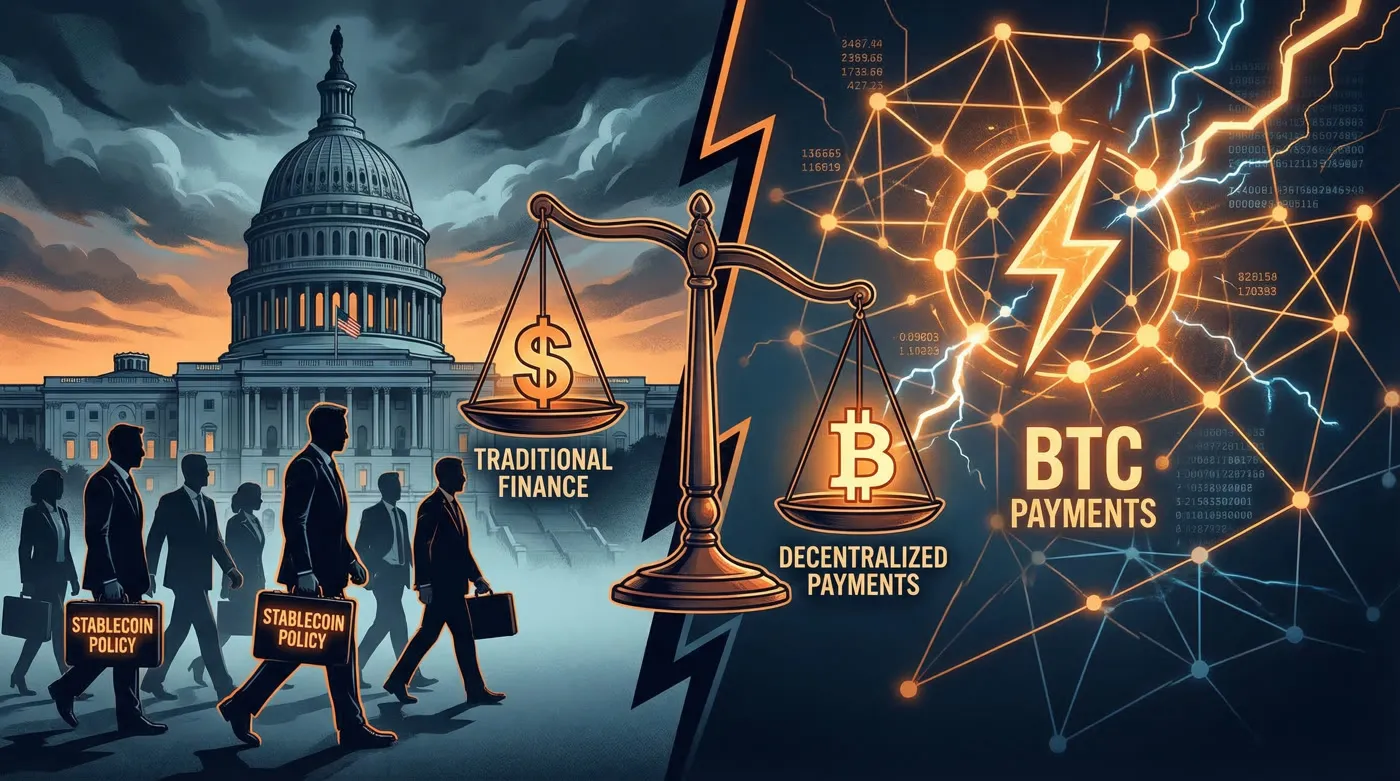
Armstrong and Coinbase’s chief policy officer both denied the allegations categorically, calling them “totally false” and “a total lie.” But the controversy points to a real policy battle playing out on Capitol Hill, one that could determine whether Bitcoin ever becomes practical for everyday payments in the United States.
And the data suggests it already is: the Lightning Network processed $1.17 billion in November 2025 alone, directly contradicting claims that “no one is using Bitcoin as money.”
The allegations and denials
The firestorm started with a post from Bitcoin podcaster Marty Bent, who claimed Coinbase representatives were telling lawmakers that tax relief for Bitcoin payments would be “a handout that will be DOA” (dead on arrival). According to Bent, Coinbase was arguing that such an exemption was unnecessary because “no one is using bitcoin as money.”
Bent later said he had “three different sources” backing the claim, though no documentation has surfaced.
Faryar Shirzad, Coinbase’s chief policy officer, responded bluntly: “This is a total lie @MartyBent. We have never and will never lobby against Bitcoin. Ever.”
Armstrong echoed the denial when Dorsey pressed him directly.
But here’s the thing: the policy shift Bent described is real, even if the actors behind it remain murky. Conner Brown, managing director of the Bitcoin Policy Institute, confirmed on the same day that “over the past three months there’s been a strong shift on the Hill to limiting the de minimis exemption to stablecoins only.”
Someone is driving that shift. Whether it’s Coinbase, banking interests, stablecoin issuers, or a coalition of all three, the outcome is the same: Bitcoin is being left out.
Why this matters: the tax problem
Under current U.S. law, Bitcoin is classified as property, not currency. That means every single Bitcoin transaction triggers a capital gains calculation, no matter how small.
Buy a $5 coffee with Bitcoin? You need to:
- Determine the cost basis of the Bitcoin you spent
- Calculate the gain or loss on that specific portion of your holdings
- Report it to the IRS
- Pay capital gains tax on any appreciation
It’s absurd. And it makes Bitcoin functionally unusable for everyday purchases.
The proposed fix is a “de minimis” exemption, similar to how the IRS treats minor foreign currency exchanges. Transactions below a certain threshold would be exempt from capital gains taxes and reporting requirements.
Senator Cynthia Lummis introduced a standalone bill in July 2025 with a $300 per-transaction threshold and a $5,000 annual cap. It would apply to Bitcoin and other digital assets used for payments, not just stablecoins.
The bill went nowhere.
Meanwhile, a competing framework tied to the PARITY Act surfaced in December 2025, proposing a $200 threshold but limiting the exemption to “regulated payment stablecoins” only. No Bitcoin. No decentralized tokens. Just dollar-backed stablecoins compliant with the GENIUS Act, the federal stablecoin regulatory framework signed into law in July 2025.
That’s the version gaining traction on Capitol Hill.
The data: $1.17 billion says otherwise
If no one is using Bitcoin as money, someone forgot to tell the Lightning Network.
River Financial reported that the Lightning Network processed $1.17 billion in transaction volume across 5.22 million transactions in November 2025 alone. That’s an all-time high for the network, achieved during a year when Bitcoin’s price mostly stagnated.
The average transaction size was $223, up from $118 the previous year. That’s not micropayments for coffee, but it’s not “no one using Bitcoin as money” either. It’s exchanges, services, and real payments moving real value.
Sam Wouters, River’s director of marketing, put it plainly: “This approach allows us to debunk misconceptions that Lightning adoption isn’t happening.”
Cash App, owned by Dorsey’s Block, now handles one in four outbound Lightning transactions, according to a June 2025 report. Block’s Lightning node generates actual yield (9.7% reported) routing payments. In November 2025, Block launched its “Bitcoin is Everyday Money” campaign, explicitly calling for de minimis tax exemption while rolling out tools that let Square merchants accept Bitcoin payments with zero fees through 2027.
The infrastructure is being built. The volume is growing. The use case is real.
But if the tax code treats Bitcoin payments as taxable property transactions while giving stablecoins a free pass, Bitcoin loses before the race even starts.
The business interests: Coinbase vs. Block
This isn’t just about ideology. It’s about money.
Coinbase earns substantial revenue from stablecoin activity, particularly USDC, which it co-issues with Circle. In Q3 2025, stablecoin-related revenue hit $355 million, representing nearly half of all subscription and services revenue. The average USDC held in Coinbase products reached $17.8 billion in Q4 2025, an all-time high.
USDC’s market cap hit $74 billion in Q3 2025. Analysts project stablecoin circulation could triple to $1 trillion by 2026. Bloomberg estimates that Coinbase’s income from USDC could increase 2x to 7x if stablecoin adoption continues to rise.
A stablecoin-only de minimis exemption removes tax friction from stablecoin payments while leaving Bitcoin payments fully taxable. That’s a structural advantage for Coinbase’s payments infrastructure.
Block, by contrast, has built its strategy around Bitcoin payments. Cash App has 59 million monthly active users. Square has integrated Lightning payments into point-of-sale terminals. Block’s business model benefits directly from Bitcoin payment adoption.
A Bitcoin-inclusive de minimis exemption helps Block. A stablecoin-only exemption helps Coinbase.
Whether or not Coinbase is actively lobbying against Bitcoin’s inclusion, the company has clear financial incentives to favor stablecoin-focused policy. And in a zero-sum legislative environment, staying silent on Bitcoin while prioritizing stablecoins achieves much the same outcome as active opposition.
What’s at stake: digital gold or actual money?
The deeper question here is: what should Bitcoin be?
A stablecoin-only tax exemption effectively answers that question by saying Bitcoin is an investment asset, not a medium of exchange. It’s digital gold: something you hold, not something you spend.
Stablecoins, by contrast, get payment treatment. They’re the “safe, regulated” option, backed by U.S. dollars and issued by federally-compliant entities. They’re also centralized, censorable, and dependent on traditional financial infrastructure.
Bitcoin is none of those things. It’s decentralized, permissionless, and censorship-resistant. Those are features to Bitcoiners, but they’re bugs to many policymakers.
The Bitcoin Policy Institute has been pressing lawmakers to broaden the exemption beyond stablecoins, warning that stablecoin-only relief would be “a strategic blunder” for U.S. competitiveness. Over the past three months, BPI has met with 19 congressional offices, proposing a value-based exemption potentially as high as $600 per transaction with a $20,000 annual cap.
But the clock is ticking. BPI is targeting a window between March and August 2026 to pass meaningful legislation. After that, midterm elections consume the calendar. And Senator Lummis, Bitcoin’s most vocal champion in Congress, is set to leave the Senate in January 2027.
If Bitcoin-inclusive de minimis relief doesn’t happen in 2026, it might not happen at all.
The unanswered questions
Did Coinbase actually lobby against Bitcoin’s inclusion in tax exemptions? We don’t know. Bent has sources but no documentation. Coinbase categorically denies it. Federal lobbying disclosures lag by months, so even if it happened, it might not show up until Q2 2026 reports are filed in July.
What we do know is this:
- The policy shift toward stablecoin-only exemptions is real
- Coinbase has clear financial incentives to support stablecoin-focused policy
- Lightning Network data contradicts the claim that Bitcoin isn’t being used for payments
- The legislative window is closing fast
The fight over de minimis tax exemptions isn’t just about accounting rules. It’s about whether the U.S. tax code will treat decentralized, permissionless money the same way it treats dollar-backed tokens controlled by regulated entities.
It’s about whether Bitcoin gets to be money, or just an asset you hodl.
And right now, the stablecoins are winning.
Sources: Jack Dorsey’s public call-out on X, Brian Armstrong’s denial on X, Marty Bent’s original allegation, Faryar Shirzad’s response, Conner Brown confirms policy shift, River Financial Lightning Network data, Sam Wouters announces November 2025 milestone, Coinbase Q3 2025 investor report, Block’s Bitcoin is Everyday Money campaign, Bitcoin Policy Institute, Senator Lummis’s office, GENIUS Act signing, Bloomberg analysis of Coinbase stablecoin revenue, PARITY Act framework. Data/status as of March 2026.