The Lightning Routing Hustle: Why Most Node Operators Lose Money (And How Block Makes 9.7%)
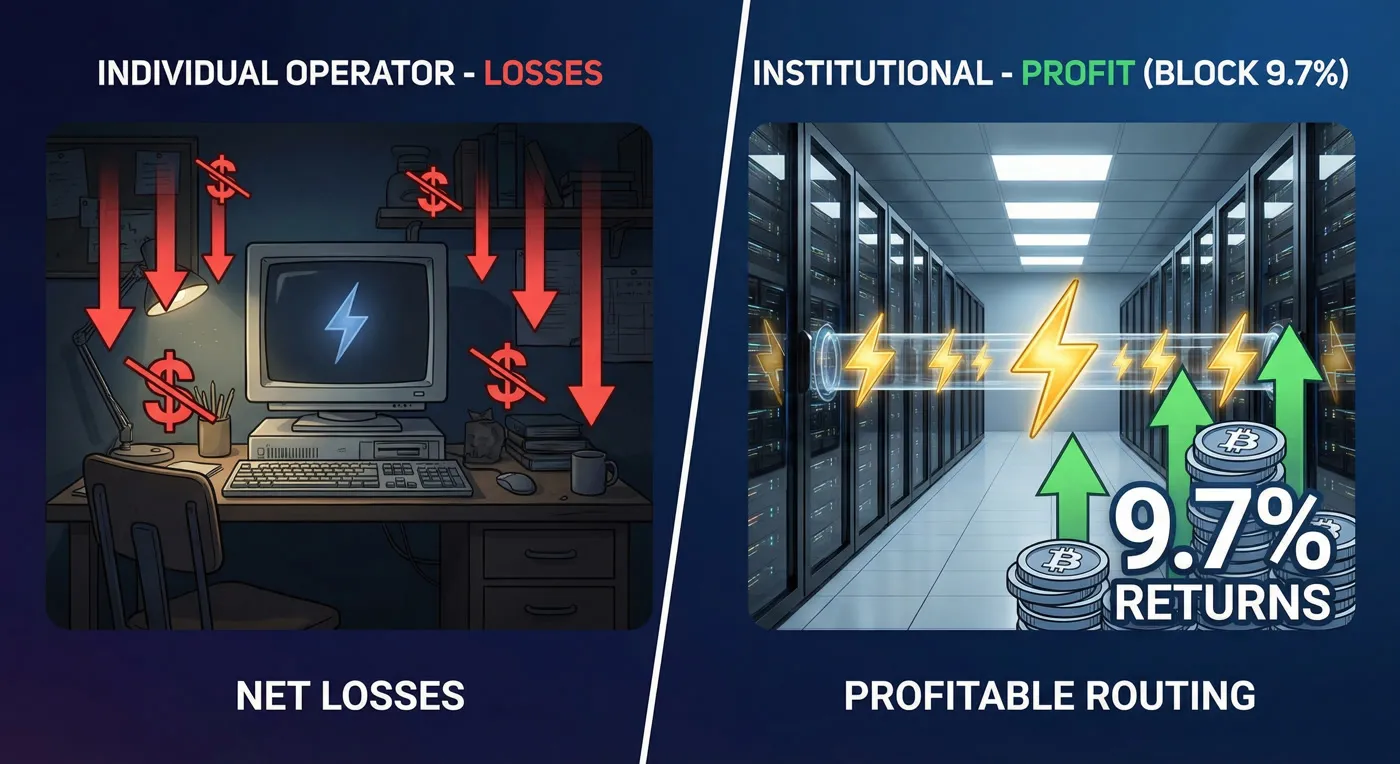
Roger Devore spent $5.97 for every $1 he earned running a Lightning routing node. For four years.
That’s a 597% cost ratio. Nearly six dollars out the door for every single dollar that came back. His node routed hundreds of payments, handled thousands of transactions, and bled money the entire time.
Then in October 2025, something changed. Devore finally turned profitable: 63% profit margin on his last 30 days of routing. He published the complete data set showing exactly how he lost money, what he changed, and why it barely matters.
Meanwhile, Block (formerly Square) casually announced at Bitcoin 2025 that their Lightning routing operation generates 9.7% annual returns on invested Bitcoin. On an estimated $10 million in deployed liquidity, that’s roughly $1 million in annual profit.
Same network. Wildly different outcomes. What’s going on?
Block’s 9.7% return: the announcement that reignited Lightning fever
On May 29, 2025, Miles Suter, Bitcoin Product Lead at Block, stood on stage at the Bitcoin 2025 conference in Las Vegas and dropped a number that got the entire Lightning community buzzing: 9.7% annual returns on Bitcoin deployed in routing operations.
This wasn’t theoretical. Block was generating what Suter called “real BTC returns from our corporate holdings…by efficiently routing real payments across Lightning” through their c= Lightning Service Provider, launched back in March 2023.
Ryan Gentry, Director of Business Development at Lightning Labs, called it “the biggest news at Bitcoin 2025.”
Here’s what we know:
- Return rate: 9.7% APR on Bitcoin liquidity
- Estimated capital deployed: ~$10 million (per Gentry)
- Estimated annual profit: ~$1 million
- Integration: One in four of Square’s outbound Bitcoin payments now processed on Lightning
The announcement landed at exactly the right moment. Lightning Network capacity was climbing toward all-time highs (hitting 5,637 BTC in December 2025). Major institutions like Binance and OKX were pouring capital into the network. The narrative was bullish.
Naturally, people started wondering: could they replicate Block’s success? Just spin up a routing node, deploy some Bitcoin, collect fees?
Roger Devore’s data answers that question pretty definitively.
The four-year money pit: what individual operators actually face
Devore ran a hobby routing node on Umbrel/LND from 2021 to October 2025. He kept meticulous records. The numbers are brutal.
Lifetime performance (four years):
- Cost ratio: 597%
- Translation: Lost $5.97 for every $1 earned
- Capital deployed: 0.46 BTC in channel liquidity
Last 90 days (mid-2025, before breakthrough):
- Transactions routed: 548
- Volume: 0.271 BTC
- Revenue: 3,815 sats (140 ppm average)
- Rebalancing costs: 1,989 sats (542 ppm average)
- On-chain costs: 1,519 sats
- Profit: 307 sats (~$0.25)
That 542 ppm rebalancing cost versus 140 ppm routing revenue tells the whole story. Devore was spending 3.87 times more on rebalancing than he earned from routing fees.
For four years straight, every payment he routed lost him money.
Last 30 days (October 2025, after optimization):
- Cost ratio: 37%
- Profit: 1,221 sats (~$10 at October 2025 prices)
- Profit margin: 63%
- Status: First sustained profitability
Ten dollars a month. After four years of losses. On 0.46 BTC deployed (roughly $46,000 at current prices).
Is Devore incompetent? No. He’s actually pretty good at this. He just ran headfirst into the fundamental economic problem that kills most individual routing operations: rebalancing costs.
The rebalancing trap: why earning fees means losing money
Rebalancing is the hidden killer in Lightning economics. Most routing guides bury this detail or wave it away as “advanced optimization.” It’s actually the single biggest factor in whether a node makes or loses money.
Here’s the problem in plain language:
Lightning channels have balance on both sides. When you route a payment from Alice to Bob through your node, Bitcoin moves from your side of the Alice channel to your side of the Bob channel. Do this enough times in one direction, and your channels become unbalanced. Now you can’t route payments anymore because you don’t have balance on the right side.
So you rebalance: you pay fees to route Bitcoin back through other people’s nodes in a circular path, redistributing your balance. This costs money. Often a lot of money.
Devore’s experience:
- Routing revenue: 140 ppm (parts per million) on average
- Rebalancing cost: 542 ppm on average
- Net result: Lose money on every payment routed
As Devore put it: “The rebalancing of channels will be the single biggest factor in your ability to run a profitable lightning node.”
Community wisdom backs this up. From a 2021 Reddit discussion on r/lightningnetwork:
“The cost of rebalancing, when it works 1/100 tries, is so high that raising fees to offset this would be so high no one will route through you.”
Even Lightning Engineering’s official documentation is blunt about this:
“Balancing channels is time intensive and comes at a cost. It requires careful consideration and planning to be economical. For instance, you will need to make sure that rebalancing your channels does not cost more than you earned routing through…”
The math rarely works out.
Devore eventually clawed his way to profitability by extreme optimization: adjusting fee rates on his top three channels, closing expensive channels, focusing on circular rebalancing strategies, and connecting to better-balanced peers. It took four years of trial and error.
And he’s still only making $10 a month.
So how does Block make 9.7% returns on the same network?
Why Block wins: the institutional advantages no individual can replicate
Block’s 9.7% return isn’t from superior routing algorithms. It’s not from better channel management or more sophisticated fee optimization.
It’s from controlling both sides of the payment flow.
Advantage 1: natural payment balance
Block owns Cash App (millions of users sending Bitcoin) and Square (businesses receiving Bitcoin payments). When a Cash App user sends Bitcoin to a Square merchant, Block routes the payment through their own c= infrastructure.
This is a closed loop. Payments flow in both directions naturally. Channels stay balanced without expensive manual rebalancing.
Individual operators don’t have this. Their channels drain in one direction based on unpredictable network-wide payment patterns. They have to pay other nodes to rebalance. Block doesn’t.
Advantage 2: Lightning Service Provider revenue
Block doesn’t just earn routing fees. They operate c= as a Lightning Service Provider (LSP), which means they sell services on top of basic routing:
- Opening channels for new users (upfront fees)
- Providing inbound liquidity (monthly fees or one-time payments)
- API access for developers
- Zero-conf channel openings (advanced service fees)
Individual operators can’t offer these services at any meaningful scale. Block can bundle routing + LSP services into a profitable business model.
Advantage 3: economies of scale
Block deploys an estimated $10 million in Lightning liquidity. Individual operators typically deploy $500 to $50,000.
Why does scale matter?
- Larger channels can handle more payments before becoming unbalanced
- More capital allows diversification across many channels, reducing rebalancing frequency
- Better negotiating position for strategic channel partnerships with exchanges and merchants
Advantage 4: strategic positioning
Block has direct channel connections to major exchanges (Binance, OKX) and major payment destinations (Square merchants, Cash App users). They sit at the center of payment flows.
Individual operators compete for scraps on the periphery.
As a 2025 enterprise routing guide notes:
“Where a node is positioned in the Lightning Network matters. Strategic placement can lower costs and improve payment success rates.”
Block bought their position by building Cash App and Square. Individual operators can’t.
The centralization question: is Lightning becoming an institutional game?
The gap between Block’s 9.7% and Devore’s $10/month raises an uncomfortable question: can Lightning routing only work at institutional scale?
The evidence is mixed, but leaning toward “yes.”
Signs pointing toward institutional consolidation:
-
Network node count is declining. Lightning peaked at 20,700 nodes in early 2022. As of March 2026, there are roughly 14,940 nodes. Meanwhile, network capacity hit all-time highs in December 2025 at 5,637 BTC.
Translation: fewer operators controlling more capital. Classic consolidation.
-
Capital requirements are prohibitive. Devore deployed 0.46 BTC and made $10/month after four years of optimization. That’s a 0.026% monthly return on capital. At that rate, you’d need 100+ BTC deployed to make minimum wage.
-
Rebalancing economics favor integrated platforms. Operators who control both sender and receiver eliminate the single largest cost. Individual operators can’t replicate this.
-
Institutional influx is accelerating. Binance, OKX, and Tether all significantly increased Lightning deployments in late 2025. As Voltage observed: “It’s not just one company that’s putting more Bitcoin into the Lightning Network; it’s across the board.”
But there are counterpoints:
-
Devore proved individual profitability is possible. It’s marginal and takes years, but it’s not impossible.
-
Non-profit motivations matter. Plenty of operators run nodes for privacy, network support, ideological reasons, or learning. Profit isn’t the only metric.
-
Niche strategies may work. Specialized routing (specific geographic corridors, liquidity leasing, niche services) might carve out small profitable niches.
Devore himself is realistic about the limits:
“Am I rich from routing fees? No. Is my node a profitable business? No. Will I ever make meaningful income from routing? Probably not at this scale. But I proved something important: a small Lightning node operated by one person on commodity hardware CAN be profitable with the right optimization.”
That’s the honest assessment. Lightning routing at hobby scale is possible but barely worth it financially. At institutional scale, it’s highly profitable. The middle ground may not exist.
What this means for the Lightning Network
Lightning was supposed to decentralize Bitcoin payments. The reality is that payment networks have natural economies of scale, and those economics are pushing Lightning toward consolidation.
Is this a problem? Depends on your perspective.
The optimistic view: Institutions bring capital, reliability, and professional infrastructure. Block, Binance, and OKX running well-capitalized routing nodes makes the network faster and more reliable for everyone. Individual operators who want to participate can still run nodes for non-profit reasons.
The pessimistic view: If routing only works at institutional scale, Lightning becomes another financial layer dominated by the same companies that dominate traditional payments. The decentralization promise fades.
The data suggests we’re somewhere between those poles. Institutions are winning the routing profit game, but the network still functions. Individual operators still exist. The question is whether that balance holds or tips further toward consolidation.
For now, if you’re thinking about running a Lightning routing node for profit, the numbers are clear:
Unless you control both sides of the payment flow (like Block), deploy serious capital (like the exchanges), or have extreme patience (like Devore), you’re probably going to lose money.
And if you do eventually turn profitable after four years of optimization?
Expect about $10 a month.
Sources: CoinDesk, Medium (Roger Devore), Bitcoin Magazine, Bitcoin Magazine (c= LSP), Lightning Engineering Docs, Blockstream Glossary, PayWithFlash, Amboss Stats, Bitcoin Visuals. Data/status as of March 2026.