The ASIC Efficiency Plateau: Why Bitcoin Miners Can't Hardware Their Way Out Anymore
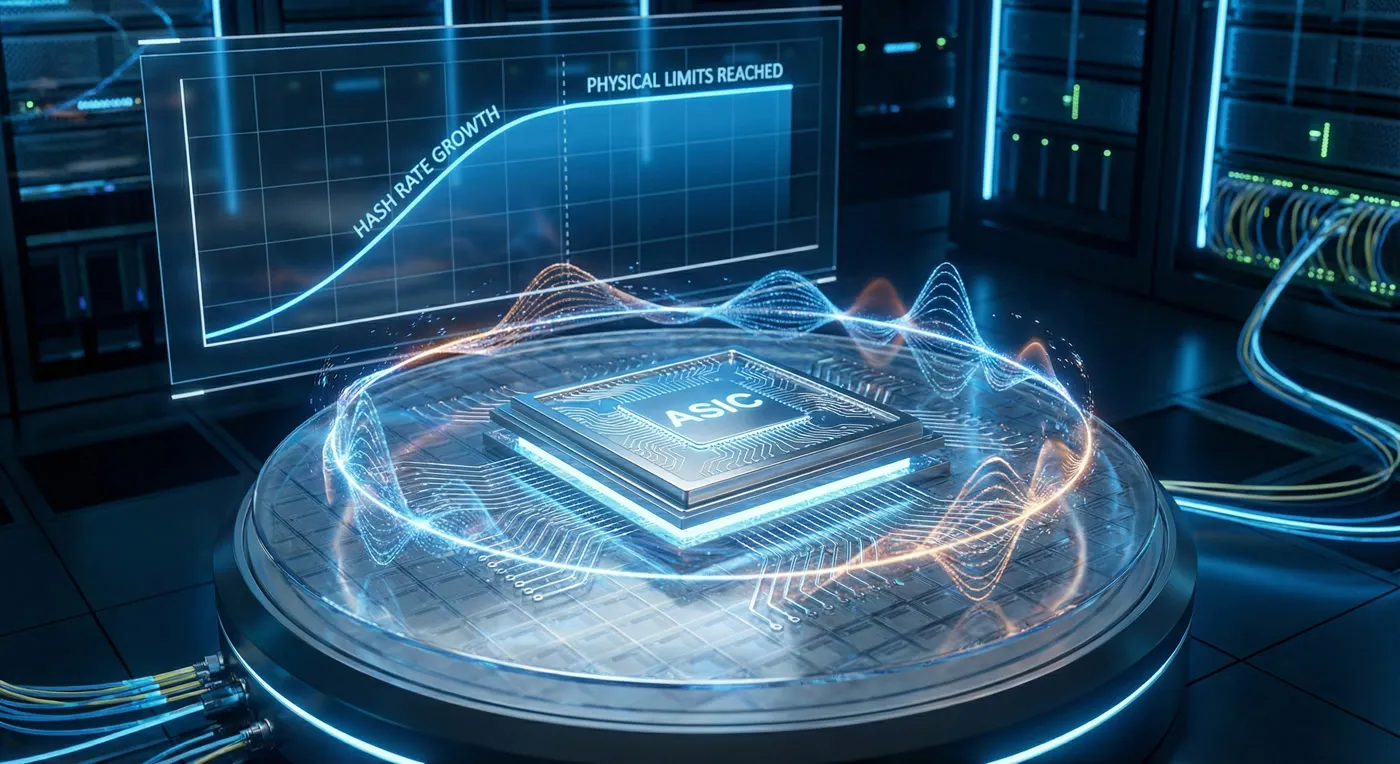
For over a decade, Bitcoin miners had a reliable playbook: buy the latest ASIC, plug it in, watch efficiency gains compound. Each hardware generation delivered 50-100% improvements in joules per terahash, effectively halving operating costs every 18-24 months. That playbook is dead.
From 2016 to 2020, mining chip efficiency improved roughly 70%. From 2020 to 2026? Just 54%. The pace has slowed to a crawl, and the cause isn’t a lack of innovation. Manufacturers have hit the physical limits of silicon-based transistors. At process nodes below 5nm, quantum effects cause energy leakage and heat problems that diminish returns from smaller features.
Meanwhile, the April 2024 halving cut block rewards to 3.125 BTC, compressing margins just as hardware improvements stalled. The result: only miners with electricity costs below $0.05-0.10/kWh and sub-20 J/TH hardware remain profitable. The game has shifted to location and scale.
The numbers tell the story
The deceleration becomes obvious when you chart it:
- Antminer S9 (2016): 100 J/TH
- Antminer S17 (2019): 40 J/TH , 60% improvement
- Antminer S19 Pro (2020): 29.55 J/TH , 26% improvement
- Antminer S19 XP (2023): 21.5 J/TH , 27% improvement
- Antminer S21 (2024): 17.75 J/TH , 17% improvement
- Antminer S21 XP (2026): 13.5 J/TH , 24% improvement
The S9 to S17 transition delivered 60% efficiency gains over three years. The S17 to S19 Pro jump was 26% in a single year. But from 2020 to 2026, the annual improvement rate dropped to around 9%. Each new generation requires exponentially more R&D and capital for diminishing returns.
Why the plateau exists
At 3-5 nanometer process nodes, transistor features approach the scale where quantum tunneling becomes significant. Electrons pass through barriers they classically shouldn’t, causing current leakage, power loss, and heat generation that offset the benefits of smaller gates.
Advanced nodes also demand extreme ultraviolet (EUV) lithography. A 3nm chip requires 25-28 EUV layers versus 14-16 for 5nm, dramatically increasing fabrication complexity and cost. Building a 3nm-capable fab costs upward of $20 billion. Only TSMC and Samsung operate at the frontier, creating a duopoly that limits supply and inflates prices.
The economics have inverted. Moore’s Law predicted density doubling and cost reductions per transistor. That second part is dead. Leading-edge nodes now cost more per transistor than their predecessors. For ASIC manufacturers like Bitmain and MicroBT, this translates directly into higher chip costs and retail prices.
A 2026 study found that 3nm chips deliver only 10-15% better performance than 5nm at 30-40% higher cost. For miners, this means longer ROI periods and higher capital requirements to maintain competitiveness.
Post-halving profitability: the new math
The April 2024 halving reduced block rewards from 6.25 BTC to 3.125 BTC, cutting miner revenue in half overnight. Combined with the efficiency plateau, this created a profitability crisis.
Assuming a BTC price around $100,000 and hashprice of $0.038/TH/day (February 2026 figures), here’s what break-even looks like:
- Antminer S21 XP (13.5 J/TH): Break-even power cost ~$0.085/kWh , profitable at $0.05/kWh ✅
- Whatsminer M66S (18.5 J/TH): Break-even ~$0.062/kWh , marginal at $0.05/kWh ✅
- Antminer S21 (17.75 J/TH): Break-even ~$0.065/kWh , marginal ✅
- Antminer S19 XP (21.5 J/TH): Break-even ~$0.053/kWh , barely viable ❌
- Antminer S19 Pro (29.55 J/TH): Break-even ~$0.038/kWh , unprofitable ❌
Public mining companies report production costs ranging from $26,000 to $77,000 per BTC. Marathon Digital operates at the low end with all-in costs around $26,000-28,000/BTC. Riot Platforms achieves industry-leading power costs of $0.025-0.03/kWh in Texas. CleanSpark reports marginal costs around $35,000/BTC at 50 EH/s operational hashrate.
Meanwhile, JPMorgan estimates the industry average production cost at $77,000/BTC as of February 2026.
The survivor profile: operators who secured long-term power contracts at $0.03-0.05/kWh before the 2024-2025 AI datacenter boom, deployed sub-18 J/TH hardware at scale, and operate 10+ megawatt facilities with immersion cooling or hydro setups. Everyone else is in managed decline or pivoting to HPC/AI infrastructure leasing.
The death of small-scale mining
In December 2025, industry revenue hit $1.21 billion, barely covering aggregate costs. Small miners without multi-megawatt facilities or sub-$0.05/kWh power began shutting down en masse.
By February 2026, Bitcoin mining difficulty dropped for the first time since 2021, signaling widespread miner capitulation. Hashrate briefly declined as machines running outdated hardware were unplugged or repurposed for AI workloads.
What killed the hobbyist? Antminer S19 models are now unprofitable above $0.05/kWh. Home miners running 1-5 machines face retail electricity rates averaging $0.10-0.15/kWh in the US and EU, rendering operations cash-flow negative unless BTC price exceeds $120,000-150,000.
Who’s left standing:
Public miners: Marathon is targeting 75 EH/s by end 2025. Riot reported a 59% mining gross margin. CleanSpark reached a 50 EH/s milestone in 2025. These firms have raised billions in equity and convertible debt to fund expansion. Marathon secured $750M, Riot $500M, CleanSpark $300M in 2025 alone.
Geographic arbitrage players: Operators in regions with stranded renewables (Iceland, Norway, Kazakhstan, parts of Texas) where electricity remains cheap due to oversupply or regulatory incentives.
Vertically integrated operators: Miners who own power generation (solar, wind, hydro, natural gas) and can produce electricity at true marginal cost.
Operational innovation becomes the frontier
With hardware improvements plateauing, miners are shifting focus to total system efficiency:
Immersion cooling
Submerging ASICs in dielectric fluids allows for higher density deployments, overclocking potential, and heat recapture for secondary uses like residential heating or greenhouses. Bitmain’s S21 Hydro (335 TH/s) uses water cooling to achieve higher performance than air-cooled models, though at higher capital cost.
AI-optimized rig management
Machine learning systems monitor real-time hashprice and electricity spot pricing, predict maintenance needs based on thermal patterns, and enable dynamic load curtailment. CleanSpark powered down 11 Tennessee sites within 10 minutes during a TVA demand response event in December 2025, demonstrating the value of flexible consumption capabilities.
Hybrid revenue models
Miners are diversifying beyond block rewards:
- HPC/AI leasing: Repurposing datacenter space and power capacity
- Demand response credits: Selling the ability to curtail load on short notice to grid operators
- Heat-as-a-service: Selling waste heat to district heating networks or industrial customers
Renewable energy integration
Stranded solar and wind power offer near-zero marginal costs, plus tax credits and subsidies in jurisdictions incentivizing green infrastructure. The caveat: intermittency requires either battery storage (expensive) or willingness to tolerate sub-100% uptime, which erodes competitiveness.
What comes next
Looking ahead to the next halving (expected April 2028), rewards will drop to 1.5625 BTC per block. At current difficulty and hashprice, models suggest miners will need BTC prices of $90,000-160,000 to sustain operations, or electricity costs below $0.03/kWh, or hardware improvements beyond current trajectories.
The hardware wildcard: carbon nanotubes. Chinese researchers have demonstrated CNT-based AI chips running 1,700x more efficiently than silicon for certain tasks. If adapted for Bitcoin mining, CNTs could theoretically push efficiencies below 5 J/TH by late 2026 or 2027. However, scaling CNT production remains a major challenge due to purity and alignment issues, and geopolitical competition in advanced chip manufacturing could delay widespread adoption.
Beyond CNTs, the industry is exploring gallium nitride and 2D materials like molybdenum disulfide. These are material science frontiers, not silicon tweaks. Breakthroughs are unpredictable. Just as ASICs displaced GPUs and FPGAs, a non-silicon technology could upend current assumptions.
The bigger picture
For ASIC manufacturers, slower refresh cycles mean fewer unit sales. If each generation offers only 15-20% improvement, miners extend hardware lifespans from 12-18 months to 24-36 months. Manufacturers must pivot to services (hosting, maintenance, financing) or explore adjacent markets like AI chips and HPC.
For miners, capital allocation shifts. Less spending on hardware CAPEX, more on infrastructure: power contracts, cooling systems, real estate. Geographic strategy becomes paramount. Site selection based on electricity cost, regulatory stability, and grid access trumps hardware specs.
For the Bitcoin network, this raises centralization risks. As small miners exit and industrial operators dominate, hashrate concentration increases. The top 5 public miners already control 25-30% of network hashrate. If mining becomes economically unviable for all but a handful of firms, the network could face increased susceptibility to regulatory capture or coordinated attacks.
Long-term network security may depend on robust transaction fee markets developing well before block subsidies approach zero (circa 2140). Right now, with fees at 12-month lows, that development feels distant.
The takeaway
Hardware still matters, but it’s no longer the trump card. The efficiency spread between top-tier and outdated equipment has narrowed. A miner running the S21 XP versus the S19 Pro sees a 2.2x efficiency advantage. Meaningful, but far smaller than the 5x+ gaps of the early 2010s.
Meanwhile, the price premium for cutting-edge ASICs has increased, extending payback periods. Operators are now choosing hardware based on total cost of ownership and compatibility with existing infrastructure rather than pure efficiency specs.
The miners who survive the next decade will be those who mastered power procurement, infrastructure optimization, and financial engineering. Not just those who bought the shiniest new chip.
Sources
- CoinGeek: Silicon limitations, new material innovations in BTC mining
- BlockEden: Bitcoin Mining in 2025: The New Reality
- PatentPC: The Future of Moore’s Law
- CoinDesk: Bitcoin mining difficulty drops by most since 2021
- Medium: The Economics of Bitcoin Mining in 2026
- ASIC Miner Value: Real-time profitability calculator
- Hashrate Index: ASIC pricing and market analysis
- Marathon Digital investor relations
- Riot Platforms investor relations
- CleanSpark investor relations
Last updated: March 1, 2026