The GENIUS Act Is Law: What America's First Stablecoin Regulation Actually Says
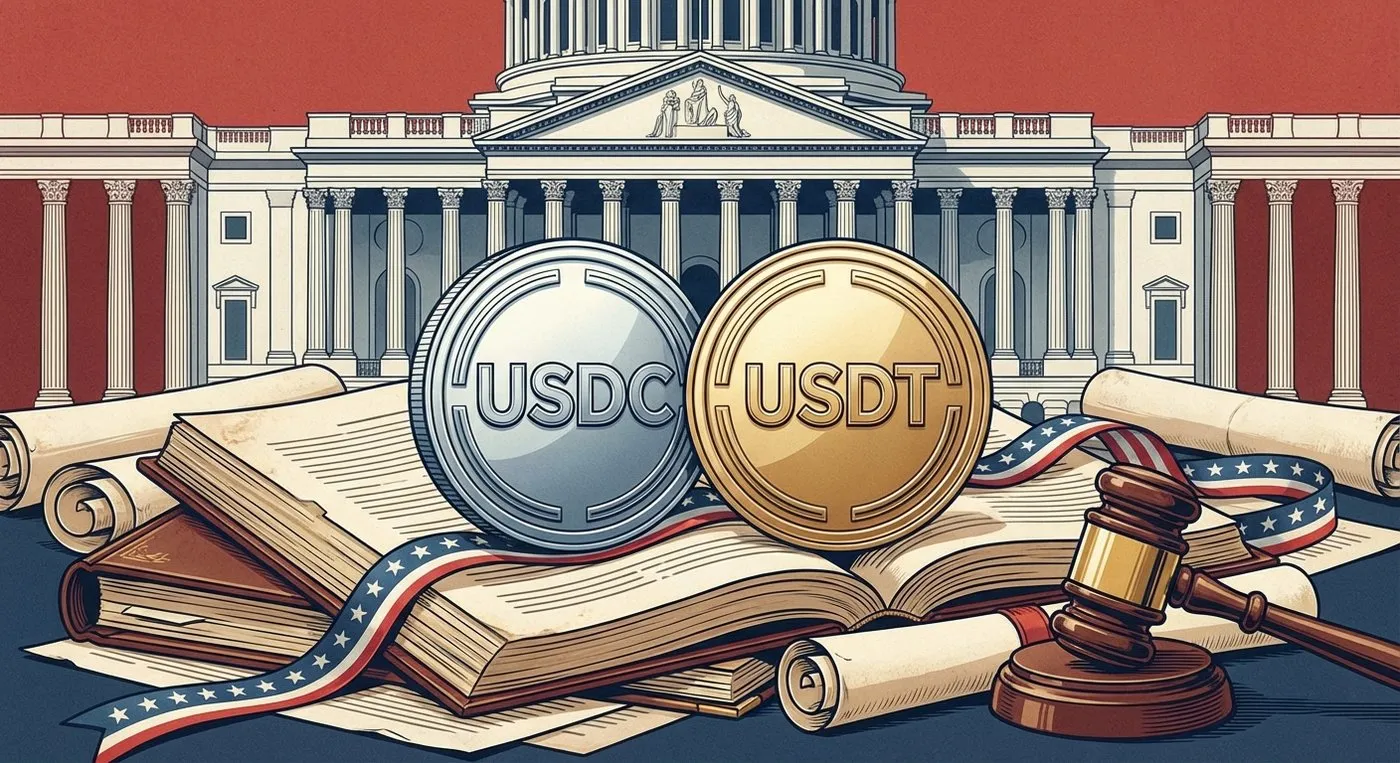
The $280 billion stablecoin market just got its first rulebook. On July 18, 2025, President Trump signed the GENIUS Act into law. Seven months later, the industry is scrambling to figure out who’s in and who’s out.
This is not a proposed bill. Not draft regulation. Enacted law. The compliance deadline is roughly 11 months away (January 18, 2027, or 120 days after final regulations, whichever comes first). After that, it will be illegal to issue or sell a payment stablecoin in the U.S. unless you’re a “permitted payment stablecoin issuer.”
The GENIUS Act (Guiding and Establishing National Innovation for U.S. Stablecoins) creates a dedicated regulatory framework for stablecoins, run by banking regulators instead of the SEC or CFTC. It mandates 1:1 reserve backing, monthly transparency reports, and bans issuers from paying yield. It gives Circle (USDC) a clear path to legitimacy. It puts Tether (USDT) in a bind.
Here’s what the law actually says and what it means for the stablecoin market.
The four core requirements
Every permitted stablecoin issuer must meet these standards:
1. Reserves must be 1:1, in approved assets
Stablecoins must be backed by identifiable reserves on at least a 1-to-1 basis. Permitted reserve assets include:
- U.S. dollars (Federal Reserve Notes, central bank deposits)
- Insured bank deposits (FDIC or NCUA)
- Treasury securities with ≤93 days remaining maturity
- Repurchase agreements backed by Treasuries (≤93 days)
- Other high-quality liquid assets as determined by the regulator
Reserves cannot be rehypothecated (lent out or pledged as collateral), except for approved repos.
This kills algorithmic stablecoins. Terra/UST had no reserves and collapsed. Under the GENIUS Act, that model is banned from the “payment stablecoin” category.
2. Monthly disclosure and attestation
Issuers must:
- Publish monthly reserve composition (how much is in cash vs. Treasuries vs. bank deposits)
- Submit to monthly examination by a registered public accounting firm
- File reports with regulators demonstrating compliance
This is transparency at a level Tether has never provided. Tether publishes quarterly attestations, not monthly audits. Its reserves have historically included commercial paper, secured loans, and “other investments” that don’t meet the GENIUS Act standard.
Circle already does monthly attestations with Grant Thornton. Circle wins on this requirement.
3. Published redemption policy
Issuers must publish a clear redemption policy that states:
- Redemption procedures (conspicuous and clear)
- All associated fees
- Reasonable timelines for redemption
This matters during market stress. When Silicon Valley Bank collapsed in March 2023, USDC briefly de-pegged because Circle held $3.3 billion in deposits at SVB. Holders needed to know how and when they could redeem. The GENIUS Act mandates this be spelled out upfront.
4. No yield paid by issuers
The law explicitly prohibits issuers from paying “any form of interest or yield” to stablecoin holders.
Third-party platforms can still offer yield. Coinbase, DeFi protocols, and CeFi lenders can pay interest on stablecoins through lending or staking programs. But issuers themselves cannot pay yield.
Why? The Senate Banking Committee said payment stablecoins “are different than banking products” and should not compete with insured bank deposits. Allowing issuers to pay yield would create bank-like deposit competition without FDIC insurance.
This creates a potential problem for Circle. Circle’s “USDC Rewards” program allows Coinbase users to earn yield on USDC held in Coinbase wallets. Legal analysis from Columbia Law School argues this might violate the yield prohibition, because Coinbase is legally the holder of custodial wallet USDC, and Circle pays yield to Coinbase (who passes it to customers). That could be seen as Circle paying yield “to the holder.”
Circle may need to restructure or kill this program.
The dual-track licensing system
The GENIUS Act creates two paths to become a permitted issuer.
Federal licensing (for issuers >$10 billion)
Issuers with more than $10 billion in outstanding stablecoins fall under federal supervision. The OCC can charter federal non-bank stablecoin issuers. The Federal Reserve supervises state member banks and bank holding companies. The FDIC supervises state non-member banks. NCUA supervises credit unions.
This applies to Tether ($183.7B) and Circle ($75.1B).
Tether has a problem: the law requires permitted issuers to be “formed in the United States.” Tether is based in the British Virgin Islands. It cannot qualify for federal licensing under the GENIUS Act.
State licensing (for issuers ≤$10 billion)
Issuers with $10 billion or less can opt for state-level regulation, if the state has a “substantially similar” regulatory regime certified by the Stablecoin Certification Review Committee (SCRC), chaired by the Treasury Secretary.
31 states have enacted the Uniform Commercial Code (UCC) model law for digital assets (in whole or in part). 18 states have adopted Section 4.05, the stablecoin-specific provision. Wyoming, New York, and Texas have existing digital asset licensing frameworks that may qualify.
States that established prudential regulatory regimes before the GENIUS Act’s enactment receive presumptive approval for a waiver, unless federal regulators find by “clear and convincing evidence” that the state regime doesn’t meet standards or poses safety risks.
This opens the door for smaller, crypto-native stablecoin issuers to compete without full federal oversight.
The jurisdictional carve-out: not a security, not a commodity
One of the most significant parts of the GENIUS Act is its explicit exclusion of payment stablecoins from SEC and CFTC jurisdiction.
The law amends the Securities Act of 1933, the Securities Exchange Act of 1934, the Investment Company Act, the Investment Advisers Act, and the Commodity Exchange Act to provide that a payment stablecoin issued by a permitted issuer is:
- NOT a “security” (for purposes of SEC regulation)
- NOT a “commodity” (for purposes of CFTC regulation)
Before the GENIUS Act, the SEC argued many stablecoins could be unregistered securities (investment contracts under the Howey Test). The CFTC claimed jurisdiction over stablecoins as commodities. Issuers faced regulatory uncertainty and enforcement risk.
After the GENIUS Act, compliant stablecoins have a dedicated lane under banking regulators. No SEC registration. No CFTC commodity oversight.
Critical caveat: this only applies to permitted issuers. Non-compliant stablecoins (offshore issuers, algorithmic models, yield-bearing tokens marketed as investments) can still be deemed securities or commodities.
Who wins under the GENIUS Act
Circle (USDC)
Circle is the obvious winner.
- U.S.-domiciled (incorporated in the U.S.)
- Transparent reserve reporting (already publishes monthly attestations from Grant Thornton)
- Proactive compliance culture (licensed in 49 states as a money transmitter, regulated in Bermuda, France, Singapore, UK)
- Reserves in Treasuries and bank deposits (Circle Reserve Fund managed by BlackRock)
Circle grew 73% year-over-year in 2025, while Tether grew 36%. USDC’s market cap is now $75.12 billion, up from ~$43 billion a year ago. The GENIUS Act accelerates that trend.
Circle’s only issue is the USDC Rewards program, which may violate the yield prohibition.
U.S. banks
Banks get clear legal authority to issue stablecoins through subsidiaries. State-chartered depository institutions can engage in money transmission and custody of payment stablecoins. JPMorgan (JPM Coin) and other banks with pilot stablecoin programs now have a regulatory path to scale.
Banks have existing compliance infrastructure (AML, KYC, BSA). They can integrate stablecoins into existing product offerings without building a fintech company from scratch.
Compliant fintech issuers
New entrants get regulatory clarity. Before the GENIUS Act, stablecoin issuers faced a patchwork of state money transmitter licenses plus SEC/CFTC uncertainty. Now there’s a clear framework.
State-licensed issuers in Wyoming, New York, or Texas can enter the market without federal oversight (if they stay under $10 billion). Specialized payment stablecoin firms focusing on B2B payments or cross-border settlement have a path forward.
Who faces pressure
Tether (USDT)
Tether is in a bind.
It’s based in the British Virgin Islands. The GENIUS Act requires permitted issuers to be “formed in the United States.” Tether does not qualify.
It cannot be a permitted payment stablecoin issuer.
What happens to USDT?
- Individuals can still use USDT in the U.S. The law does not ban holding or transacting in non-compliant stablecoins.
- U.S. regulated entities (banks, brokers, exchanges with federal charters) likely cannot use USDT as core infrastructure.
- Offshore exchanges and emerging markets will continue to rely on USDT. It dominates outside the U.S.
Tether’s workaround: it launched USA₮, a U.S.-compliant stablecoin issued through a nationally chartered bank. This creates a compliant entry point for U.S. institutions while keeping USDT offshore-focused.
Whether USA₮ gains traction is the open question. USDT has network effects. Liquidity. Institutional inertia. Circle has compliance and regulatory clarity.
Tether’s market cap is down slightly (from $186.6 billion in January 2026 to $183.7 billion in February). That’s the first sustained decline in years.
Algorithmic stablecoins
The 1:1 reserve requirement excludes unbacked algorithmic models.
Terra/UST collapsed in May 2022. It had no reserves. The death spiral was inevitable. The GENIUS Act ensures that cannot happen again in the regulated U.S. market.
Algorithmic stablecoins can still exist as experimental DeFi protocols. But they cannot be marketed or used as payment stablecoins in the U.S.
Offshore issuers without U.S. partnerships
Stablecoin issuers domiciled outside the U.S. (European or Asian fintech projects, stablecoins pegged to foreign currencies) have three options:
- Partner with a U.S.-regulated entity (e.g., license their brand to a U.S. bank subsidiary)
- Establish a U.S. subsidiary and obtain federal or state licensing
- Exit the U.S. market and focus on non-U.S. jurisdictions
The 11-month clock
Where we are now (February 2026):
- 7 months post-signing
- 5 months until regulation deadline (July 18, 2026)
- 11 months until effective date (January 18, 2027, or 120 days after final regulations, whichever comes first)
Federal banking agencies (OCC, Fed, FDIC, NCUA) are drafting implementing regulations. The FDIC’s comment period on approval requirements for bank-subsidiary stablecoin issuers closed on February 17, 2026. Final rules are expected by mid-2026.
What happens on the effective date:
- It becomes unlawful to issue or sell a payment stablecoin in the U.S. unless you are a permitted issuer
- Existing issuers must be licensed (federal or state) or cease U.S. operations
- Exchanges, brokers, and financial institutions can only list or custody stablecoins issued by permitted issuers
The law does not explicitly provide a grace period, but regulators are expected to use enforcement discretion for issuers demonstrating good-faith compliance efforts.
Open questions
Will Circle kill USDC Rewards?
If the Columbia Law analysis is correct and Circle’s yield-sharing with Coinbase violates the issuer yield prohibition, Circle faces a choice: restructure the program (maybe Coinbase pays yield directly without Circle involvement) or kill it.
Killing it hurts competitiveness. DeFi protocols and CeFi lenders can still offer yield on USDC. But if Circle can’t pay yield through custodial wallet partnerships, it loses a marketing advantage.
Can Tether’s USA₮ compete with USDC?
Tether launched USA₮ to maintain institutional access in the U.S. But USDT has network effects. Liquidity. Global dominance.
Will institutions switch to USA₮ (a compliant but new product) or switch to USDC (an established compliant product with better transparency)? I don’t know. But Circle has the easier path.
Will states compete to attract stablecoin issuers?
If states can offer “substantially similar” but more lenient regimes (faster approvals, lower fees, less invasive oversight), we could see regulatory competition. Wyoming and Texas already compete for crypto-native companies.
The SCRC has the authority to reject state regimes that don’t meet standards. But states that approved stablecoin issuers before the GENIUS Act get presumptive approval. That creates an opening.
The end of the Wild West
The GENIUS Act passed the Senate 68-30 and the House 308-122. Bipartisan support. Trump signed it in July 2025. The regulations are being written. The deadline is real.
This is the end of the Wild West for stablecoins in the U.S. The law is pro-innovation but pro-regulation. It legitimizes stablecoins while demanding transparency and oversight.
Circle is the clear winner. Tether faces a strategic crossroads. Algorithmic models are out. Banks are in.
Eleven months from now, the stablecoin market will look very different.
Sources
- White House: Fact Sheet on GENIUS Act (July 18, 2025)
- Congress.gov: S.1582 Full Text
- Congressional Research Service: GENIUS Act Overview
- Senate Banking Committee: Myth vs. Fact Sheet
- Wikipedia: GENIUS Act
- Federal Register: FDIC Proposed Rule (Dec 19, 2025)
- Federal Register: GENIUS Act Implementation Notice (Sept 19, 2025)
- Latham & Watkins: GENIUS Act Analysis (July 18, 2025)
- Gibson Dunn: A New Era of Stablecoin Regulation (Nov 14, 2025)
- Morgan Lewis: Breakdown of the Landmark Law (July 17, 2025)
- Greenberg Traurig: Regulatory Framework Analysis (July 2025)
- Georgetown Law Journal: Reserve Standards Analysis
- Columbia Law Blue Sky Blog: Circle, Coinbase, and the Prohibition on Interest (Dec 11, 2025)
- Oxford Law Blog: Regulatory Bifurcation (Nov 10, 2025)
- CSBS: GENIUS Act Implementation Comment Letter
- Richmond Fed: Stablecoins and the GENIUS Act (Nov 14, 2025)
- State Street Global Advisors: GENIUS Act Explained
- CoinDesk: Circle’s USDC Outpaces Tether’s USDT Growth (Jan 6, 2026)
- GNCrypto News: Tether’s USDT Market Cap Hits Biggest Monthly Drop (Feb 20, 2026)
- CoinDesk Opinion: Tether and Circle’s Dominance Is Being Put to the Test (Oct 11, 2025)
- Unchained Crypto: GENIUS Act Passes: Winners and Losers (July 22, 2025)
- CCN: Why USA₮ and USDC Are GENIUS Act-Compliant (Feb 2026)