Ethereum's Adoption Paradox: Why Layer 2 Growth Isn't Lifting ETH Price
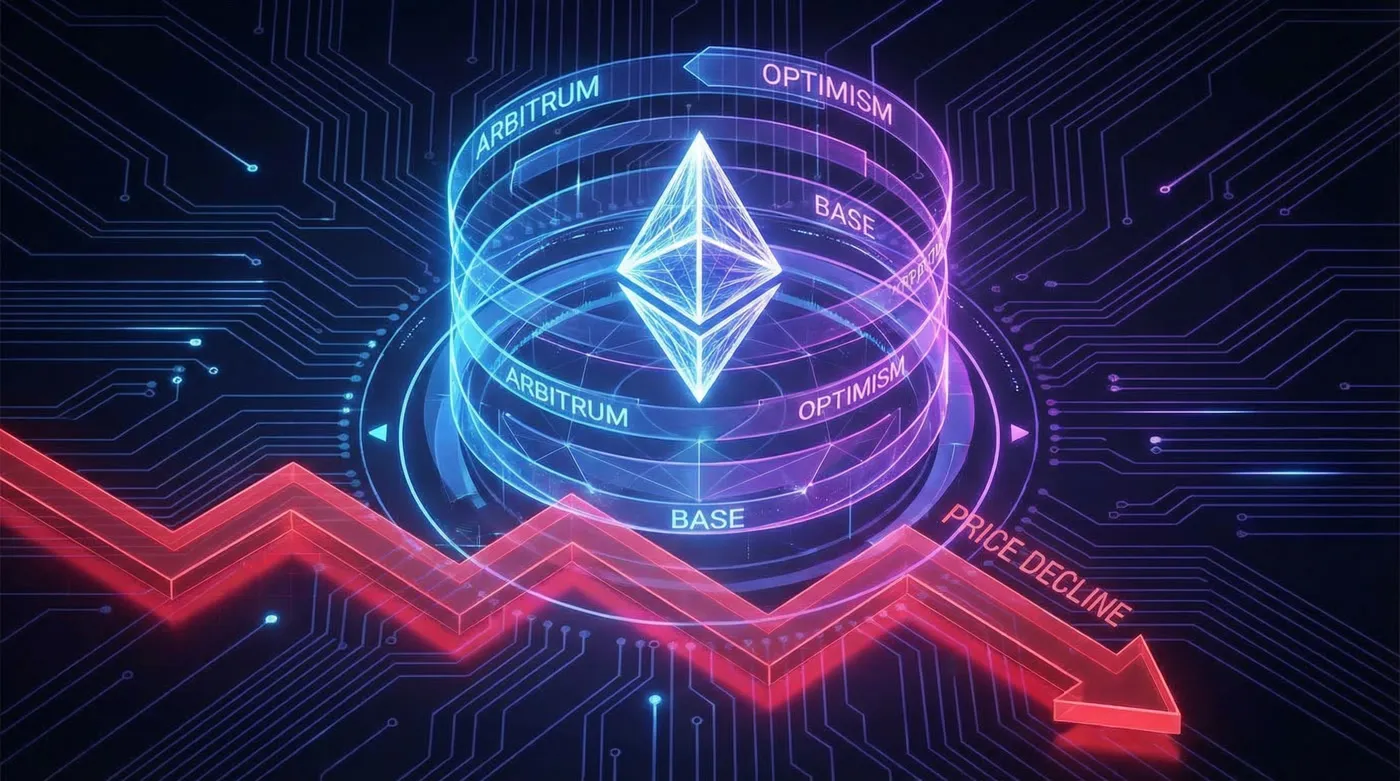
Ethereum is experiencing something strange: network usage is hitting all-time highs while ETH price has plummeted over 50% from its recent cycle high.
As of March 14, 2026, ETH trades at $2,091, down from a peak of $4,946 in August 2025. Smart contract calls are at record levels. Daily active addresses keep climbing. Layer 2 networks are processing millions of transactions per day.
And yet, CryptoQuant analyst Julio Moreno warns this disconnect could signal further downside. Potentially to $1,500 by late 2026 if capital flows don’t reverse.
The culprit? Ethereum’s own scaling solution.
How layer 2s break the fee economics
Layer 2 networks like Arbitrum, Optimism, and Base process transactions off Ethereum’s mainnet, then post compressed batches of data back to Layer 1 for security. Think of it as bundling hundreds of transactions into a single package that gets settled on mainnet.
This design drastically reduces the computational load on Ethereum’s base layer. And that’s where the paradox emerges.
Ethereum’s EIP-1559 upgrade (August 2021) introduced a fee-burning mechanism: every transaction burns a portion of ETH, removing it from circulation permanently. The equation was simple: high network activity → high fees → more ETH burned → deflationary pressure.
But Layer 2s break that equation.
When activity migrates to L2s, mainnet gas demand plummets. The numbers are stark:
- Mainnet gas fees: 0.43–0.50 gwei (down 93% year-over-year)
- L2 transaction fees: $0.001–0.01
- L2 market share: 60–70% of all Ethereum transaction volume
Coinpaprika reports that a simple ETH transfer on mainnet costs $0–0.33 in early 2026, compared to $3–5 during peak DeFi/NFT mania in 2021–2022.
A recent arXiv paper analyzing Ethereum’s fee dynamics found that a 10 percentage point increase in L2 adoption lowers median mainnet base fees by roughly 13%. After the Dencun upgrade (March 2024) introduced “blob space” for cheaper L2 data posting, the effect intensified.
The burn rate collapsed
Ethereum’s supply dynamics hinge on a simple formula:
Net ETH Supply Change = New Issuance (staking rewards) − Burned Fees
When mainnet activity was high (2021–2022), fees often outpaced issuance, making ETH deflationary. After the Merge to Proof-of-Stake (September 2022), Ethereum briefly achieved net deflation.
But with L2s siphoning activity, the burn rate collapsed. As of February 2026, Ethereum has a 0.23% annual inflation rate. In 2025, 1.2 million ETH was burned, down from peak burn periods.
Lower fees mean less deflationary pressure. And in a market driven by supply and demand, that’s a headwind for price.
The revenue cannibalization problem
From an investor perspective, the issue runs deeper than supply dynamics. It’s about value capture.
Investing.com describes the dilemma: “Ethereum processes enormous economic volume while collecting a smaller slice of revenue per transaction.”
Layer 2s capture most transaction fees through their sequencers (the entities that batch and order transactions). Ethereum mainnet gets:
- Data availability fees (posting batches to mainnet)
- Settlement security (finalizing L2 state on L1)
But these are far cheaper than executing every transaction on mainnet. EIP-4844’s blob space reduced L2 data posting costs by around 60%.
The result: Ethereum’s mainnet revenue collapsed even as total ecosystem activity soared.
Three L2s (Arbitrum, Optimism, and Base) process nearly 90% of all Layer 2 transactions. They’ve become the new execution layer, while Ethereum mainnet is relegated to settlement.
Capital flows vs. network activity
CryptoQuant’s Moreno pinpoints the core issue: ETH price dynamics are driven primarily by capital flows, not network activity growth.
Key indicators signaling trouble:
- One-year change in realized capitalization turned negative (capital is exiting ETH)
- Exchange inflows remain elevated relative to Bitcoin (more selling pressure)
- Daily active addresses at all-time highs (usage decoupled from investment demand)
Moreno notes that smart contract calls hit record levels in early 2026, driven by DeFi, stablecoins, and L2 infrastructure. Yet ETH underperformed Bitcoin throughout this period.
The implication: utility doesn’t automatically translate to value accrual. Ethereum can be wildly useful without rewarding ETH holders.
The $1,500 scenario
CryptoQuant’s bearish scenario hinges on two conditions persisting:
- Continued capital outflows from Ethereum
- Elevated exchange inflows (selling pressure stays high)
If these trends hold through Q3/Q4 2026, Moreno projects ETH could test $1,500, a roughly 28% drop from current levels.
To reverse the trend, Ethereum needs capital inflows to resume and exchange inflows to decline. Notably, centralized exchange reserves sit at 16 million ETH, a historic low. This suggests much of the potential selling pressure has already been absorbed, but doesn’t guarantee a floor.
The bull case: settlement layer thesis
Not everyone sees doom. The long-term bull argument reframes Ethereum as global financial infrastructure, not a transaction processor.
Key pillars:
- Stablecoin dominance: Ethereum hosts the majority of global stablecoin liquidity (USDT, USDC, DAI). Stablecoin settlement volume continues to grow.
- Tokenization momentum: Major institutions are building blockchain-based settlement systems on Ethereum. Real-world assets and securities increasingly settle on L1.
- ETF inflows: Spot Ethereum ETFs hold tens of billions in assets. Despite price weakness, institutional participation remains strong.
- Staking lockup: Tens of millions of ETH are staked, removing supply from circulation. Validators continue entering the network, signaling long-term confidence.
- Data availability fees at scale: If L2 volumes keep exploding, even low per-unit fees for blob space could become a meaningful revenue stream by 2027–2028.
Investing.com argues that Ethereum’s appeal lies in its role as “foundational financial infrastructure,” where revenue-per-transaction matters less than total economic throughput.
Scaling trade-offs aren’t new
This paradox isn’t unique to crypto. Traditional payment networks face similar dynamics:
- Visa/Mastercard: High volume, low per-transaction margins
- Cloud computing: Prices trend toward zero as capacity scales
- Telecom: More bandwidth, lower prices
Ethereum chose the “fat protocol, thin applications” path, betting that security and decentralization at the base layer would create a moat, even if most economic activity moved up the stack.
The question is whether settlement security alone justifies Ethereum’s valuation when users rarely touch mainnet directly.
What it means for users
For the average Ethereum user, the paradox is mostly good news:
- Transaction costs have plummeted (swapping tokens on Arbitrum costs around $0.01 vs. $3–5 on mainnet)
- Applications are usable again (gaming, social apps, and micropayments are viable on L2s)
- Security is maintained (L2s inherit Ethereum’s security guarantees)
For ETH holders, it’s more complicated. The asset’s role has shifted from transactional currency to settlement collateral and staking yield instrument.
The innovator’s dilemma
Ethereum succeeded at its technical goal: scalable, cheap transactions. But it created a new problem in the process. Value doesn’t naturally flow to the base layer when most economic activity happens elsewhere.
Whether the settlement layer thesis holds depends on one question: can Ethereum capture enough value from being the foundation of global crypto finance to justify its current price, even if users never pay mainnet gas fees?
We’ll have an answer by late 2026.
Sources
CryptoBasic - CryptoQuant Warns Ethereum Price Could Fall to $1,500 Despite Record Network Growth, Investing.com - Ethereum’s Layer 2 Paradox: Lower Fees, Bigger Questions for ETH Valuation, CoinPaprika - Ethereum gas fees in 2026: how to cut costs with layer 2 and timing, arXiv - Layer-2 Adoption and Ethereum Mainnet Congestion: Regime-Aware Causal Evidence Across London, the Merge, and Dencun, Zipmex - Ethereum Burn Address Explained: How ETH Burning Creates Deflation in 2026, PayRam - Arbitrum vs. Optimism vs. Base: The Best Layer 2 for Crypto Payments. Data/status as of March 14, 2026.