The Most Elegant Crypto Architectures You've Never Heard Of
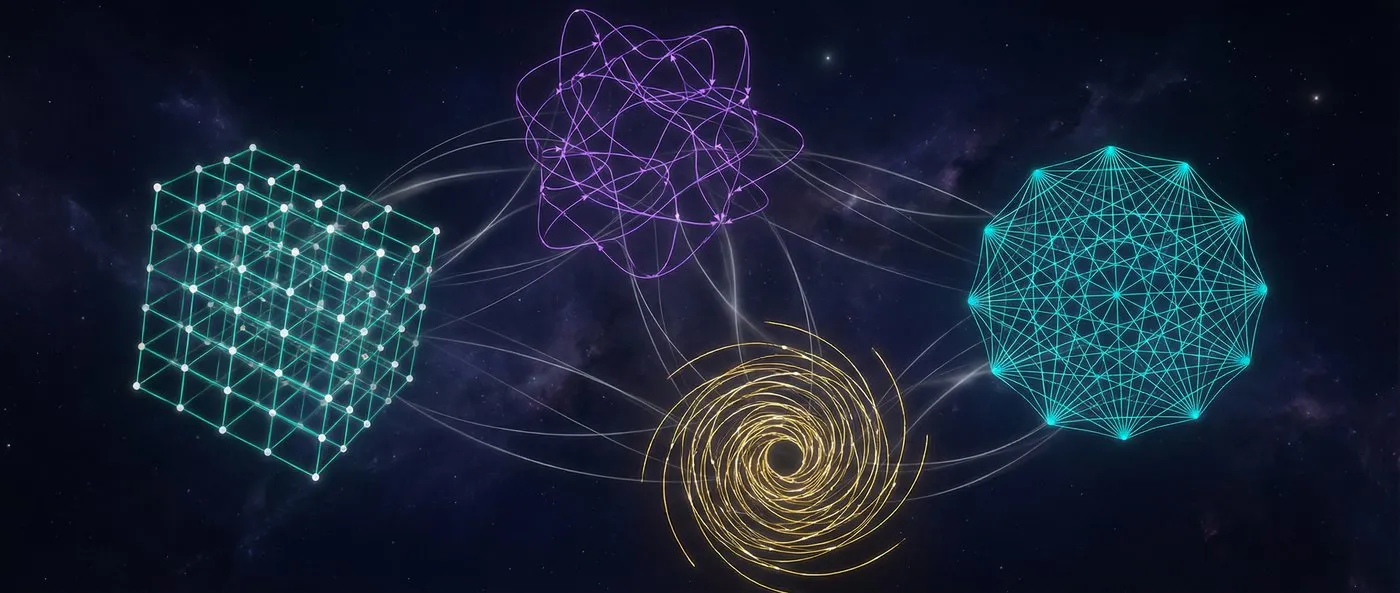
Crypto’s most interesting innovations aren’t the ones with the biggest market caps. Some of the most elegant distributed systems ever built are hiding in plain sight.
NANO eliminated fees and miners with a block-lattice DAG. IOTA’s Tangle scales better as more transactions arrive. Hedera’s hashgraph achieves Byzantine consensus without traditional blocks. Algorand delivers instant finality via VRFs. Kaspa runs parallel blocks without orphans. Stellar pioneered Federated Byzantine Agreement.
These aren’t vaporware. They’re live, working networks solving real computer science problems in ways that are genuinely clever. None of them rank in crypto’s top 10 by market cap. Some have fallen from prominence. Others launched strong but stagnated.
I’m not here to pitch you on undervalued gems. This is a technical appreciation. If you care about what’s actually possible with distributed ledgers, these projects are worth understanding.
NANO: Block-lattice eliminates the global ledger bottleneck
NANO uses a block-lattice data structure where every account has its own blockchain. Unlike Bitcoin’s global blockchain or Ethereum’s single state machine, NANO’s ledger is a lattice of individual account-chains that interact asynchronously.
Instead of one block containing many transactions, each NANO transaction requires two blocks: a send block published by the sender to their account-chain, and a receive block published by the receiver to theirs.
Alice wants to send 10 NANO to Bob? Alice publishes a send block (reduces her balance by 10). Bob publishes a receive block (increases his balance by 10). Transaction complete. Sender and receiver don’t need to be online simultaneously. Each account updates its own chain independently. No waiting for global block confirmation.
The result: a Directed Acyclic Graph where account-chains connect via send/receive blocks. No single global ledger to sync. Nodes only track the account-chains they care about. The total ledger is currently around 7.5 GB for 14+ million transactions.
Double-spend prevention: Open Representative Voting (ORV). Every account can delegate its balance as voting weight to a Representative node. When conflicting transactions occur (Alice tries to spend the same 10 NANO twice), Representatives vote. Once votes reach quorum (more than 50% of online voting weight), the transaction is cemented and irreversible. No staking required. Votes change automatically as NANO moves around.
Anti-spam mechanism: Tiny Proof-of-Work requirement on send blocks. The PoW is minimal (runs on mobile devices) and only required on send, not receive. Acts as a rate limit without transaction fees.
What it enables: feeless transactions, sub-second finality, energy efficiency (no mining, minimal PoW for anti-spam only), horizontal scaling (more accounts means more parallel chains).
The technical elegance: NANO solves blockchain’s fundamental bottleneck by parallelizing at the account level. It eliminates miner extractable value because no miners exist. Asynchronous operation means no synchronization overhead. Voting happens only on conflicts, not every transaction.
Status: Live since 2015 (originally RaiBlocks, rebranded in 2018). Market cap rank outside the top 100.
IOTA: The Tangle scales as activity increases
IOTA uses a Directed Acyclic Graph called the Tangle instead of a blockchain. To send a transaction, you must validate 2 prior transactions. No miners, no blocks, no fees.
The innovation: users secure the network by participating. Your transaction only confirms if you help confirm others. More transactions means more validators. The network gets faster as activity increases. That’s the opposite of blockchain congestion.
Think of it this way. Blockchain is a single train track (one transaction at a time). The Tangle is a highway network (many parallel paths).
The Coordinator controversy: Early IOTA used a Coordinator, a centralized node run by the IOTA Foundation that issued milestone transactions to prevent double-spends and ensure consensus. This was criticized as training wheels and a centralization risk.
Status as of 2026: Coordinator removed in IOTA 2.0. The IOTA 2.0 testnet has been running for months without the Coordinator. Nakamoto Consensus mechanism introduced. Mana anti-spam system replaces lightweight PoW. Full decentralization achieved.
What it enables: feeless transactions, scalability that increases with network activity, IoT optimization (lightweight enough for resource-constrained devices), micropayments (ideal for machine-to-machine economy).
The technical elegance: eliminates miners entirely. No MEV (no miners to front-run). Scales better with activity, which is counter-intuitive compared to blockchain. Designed for a future where IoT devices, machine payments, and microtransactions are the norm.
Status: Live since 2016. Coordinator removed. Focus on IoT, RWA tokenization, enterprise use cases. Market cap rank #82 (Feb 2026).
Hedera: Virtual voting via gossip about gossip
Hedera doesn’t use a blockchain. It uses a hashgraph, a fundamentally different data structure. Instead of blocks linking to a single predecessor, hashgraph uses “gossip about gossip” to build a complete history graph.
Nodes share not just transactions but metadata about who they heard from and when.
How it works:
-
Gossip protocol: Nodes randomly select peers and share all transactions they know. One gossip session shares everything new.
-
Gossip about gossip: When Node A gossips to Node B, it includes transactions plus who Node A previously gossiped with (parent hashes). This creates events (records of “Node A gossiped to Node B at time T”). Events form a Directed Acyclic Graph: the hashgraph.
-
Virtual voting: Nodes don’t actually vote. They calculate what everyone would vote for based on gossip history. By examining who gossiped with whom and when, each node deterministically computes consensus. No voting messages sent over network equals massive efficiency gain.
Hedera achieves asynchronous Byzantine Fault Tolerance (aBFT). Tolerates up to ⅓ malicious nodes. No leader election (no single point of failure). Mathematically proven fairness and security (Leemon Baird’s academic papers).
What it enables: 3-5 second finality, high throughput (10,000+ TPS claimed), fair ordering (timestamp consensus prevents front-running), energy efficiency (no mining, minimal computation).
The technical elegance: virtual voting eliminates voting message overhead. Gossip protocol is inherently efficient (exponential spread). No wasted work (every event counts, unlike Bitcoin orphans). Provably secure (academic papers, not just whitepaper claims).
Governance controversy: Hedera Governing Council is 39 large corporations (Google, IBM, Boeing, Deutsche Telekom, etc.). Council members run consensus nodes. Decentralization purists criticize this as “permissioned” despite open read/write access. Counterargument: enterprise governance provides stability. The network itself is public (anyone can use it). Council term limits rotate membership.
Status: Live since 2019. 39-member rotating council. Focus on enterprise applications, sustainability tracking, tokenization. Market cap rank #30 (Feb 2026).
Algorand: Instant finality via verifiable random functions
Algorand uses Pure Proof-of-Stake with Verifiable Random Functions (VRFs) to achieve instant finality. Designed by Silvio Micali, a Turing Award winner, MIT professor, and inventor of zero-knowledge proofs.
The innovation: random, cryptographically verifiable leader selection via private lottery.
How it works:
Every round, a block proposer and committee are selected via VRF. Each node runs VRF locally using their private key. VRF output determines if the node is selected (provably random, cannot be manipulated). If selected, the node proposes a block and broadcasts a VRF proof. Others can verify the selection was legitimate.
Why VRFs matter: no one knows who will propose the next block until they do (prevents targeted attacks). Selection is cryptographically provable (can’t cheat). No centralized randomness source needed.
The selected committee votes on the proposed block. Quorum required: more than ⅔ of stake. Instant finality. Once a block is confirmed, it’s irreversible (no forks). Secure against less than ⅓ adversarial stake.
What it enables: instant finality (no waiting for confirmations, no forks), fast blocks (3-4 second finality), no slashing (can’t lose funds for going offline), participation rewards (self-custody staking, no delegation required), carbon negative (energy-efficient PoS).
The technical elegance: VRFs are mathematically beautiful. Provable randomness without trusted setup. Instant finality solves the biggest UX problem in crypto (waiting for confirmations). No slashing lowers the barrier to participation (contrast with Ethereum). State proofs enable cross-chain verification without oracles.
Challenges: Large supply held by Foundation. Periodic selling created “supply overhang” perception. Price performance lagged despite technical sophistication. Less hype-driven than competitors (Solana, Avalanche). Academic/technical focus didn’t translate to retail enthusiasm.
Status: Live since 2019. Founder: Silvio Micali (Turing Award, MIT). Consensus: Pure Proof-of-Stake + VRF. Finality: 3-4 seconds, instant and irreversible. DeFi ecosystem: Folks Finance, Pact, Algofi. Market cap rank #56 (Feb 2026).
Kaspa: Parallel blocks with no orphans
Kaspa uses a blockDAG (Directed Acyclic Graph of blocks) instead of a blockchain. Miners can produce blocks in parallel, and all valid blocks get included. None are orphaned.
The innovation: Bitcoin’s security model plus parallel block production.
The problem with Bitcoin: Only the longest chain survives. Parallel blocks (“orphans”) are discarded. That means wasted work and limited throughput.
Kaspa’s solution (GHOSTDAG protocol): Miners produce blocks as fast as possible (~1 block/second). All blocks reference multiple parent blocks (form DAG). GHOSTDAG algorithm orders blocks into a linear sequence. All valid work counts toward security (no orphans).
The security argument: Bitcoin’s security/throughput tradeoff says faster blocks means more orphans, which weakens security. Slower blocks means fewer orphans but low throughput. Kaspa’s breakthrough: faster blocks means MORE security (all blocks count). No orphans means no wasted work. Parallel production means high throughput.
Academic foundation: Yonatan Sompolinsky is a postdoctoral researcher at Harvard University. He co-authored the original GHOST protocol in 2013. The GHOST paper was cited in Ethereum’s whitepaper. 10+ years of DAG consensus research.
What it enables: high throughput (1 block/second vs. Bitcoin’s 10 minutes), fast confirmations (seconds instead of minutes), fair to miners (all valid work counts), decentralized PoW (no compromises on decentralization).
The technical elegance: solves Bitcoin’s security/throughput tradeoff elegantly. No orphaned blocks means efficient use of computational work. Research-backed (PHANTOM/GHOSTDAG papers). Maintains Bitcoin’s security model while dramatically improving throughput.
Current limitations: Kaspa currently doesn’t have smart contracts. A planned hardfork in May 2026 will add native assets, zero-knowledge verification, and expanded programmability.
Status: Live since 2021. Block time: 1 second. Target: 100 blocks/second (post-hardfork). Smart contracts: planned for May 2026 hardfork. Market cap rank #28 (Feb 2026).
Stellar: Open membership via Federated Byzantine Agreement
Stellar pioneered Federated Byzantine Agreement (FBA), where nodes choose their own trusted validators instead of relying on a global validator set. Designed by David Mazières, a Stanford professor.
The innovation: open membership plus Byzantine consensus without global agreement on validators.
How it works:
Every node chooses a quorum slice (a subset of other nodes it trusts). “I trust nodes A, B, and C. I need at least 2 of them to agree before I accept a transaction.”
A quorum forms when slices overlap. If many nodes include each other in their slices, the network reaches agreement without requiring everyone to use the same validator set.
FBA guarantees safety if quorums intersect. Any two quorums must share at least one honest node. Prevents network splits and conflicting history.
Comparison to traditional BFT: Traditional Byzantine Agreement (like Tendermint or HotStuff) requires a pre-agreed validator set. Closed membership (must be approved to join). Federated Byzantine Agreement has no global validator set required. Open membership (anyone can join). Each node chooses who to trust.
What it enables: fast finality (3-5 seconds), cheap transactions (fractions of a cent), built-in DEX (decentralized exchange at protocol level), asset issuance (anchors can issue real-world assets on-chain), open membership (anyone can run a validator).
The technical elegance: generalizes Byzantine agreement to open networks. No global coordination needed (everyone chooses their own trust). Safety guaranteed via quorum intersection. Purpose-built for cross-border payments and asset tokenization.
Real-world adoption: MoneyGram partnership for USDC remittances on Stellar. Circle issues USDC on Stellar. Anchors for fiat on/off ramps.
Status: Live since 2014. Founder: Jed McCaleb (Ripple co-founder), designed by David Mazières (Stanford). Consensus: Federated Byzantine Agreement (FBA). Use cases: cross-border payments, remittances, RWA tokenization. Market cap rank #18 (Feb 2026).
Why technical elegance doesn’t guarantee success
None of these projects rank in crypto’s top 10 by market cap. NANO and IOTA have fallen from former prominence. Hedera and Algorand had strong launches but stagnated. Kaspa is growing but still niche. Only Stellar maintains a top-20 presence.
Why?
Market success in crypto requires more than technical viability (all six have that). It requires network effects (developer mindshare, liquidity, users), capital/marketing (VC funding, hype cycles, influencer support), narrative fit (does it tell a compelling story retail understands?), and timing (launching into the right market conditions).
Technical superiority is necessary but not sufficient.
Project-specific challenges:
NANO: Early faucet system led to distribution controversy. No smart contracts means no DeFi, which means no yield farming, which means no retail hype. Simplicity paradox: “just fast, feeless payments” isn’t sexy enough for speculators.
IOTA: Years of Coordinator centralization criticism damaged reputation (even though now resolved). IoT adoption slower than expected. Vision was ahead of reality. Harder to build on than EVM chains. Pivot to enterprise reduces retail appeal.
Hedera: Corporate governance (39-member council) seen as antithesis of decentralization. Despite the open network, branding hurt adoption. Enterprise focus less appealing to DeFi degens.
Algorand: Foundation token selling created negative price pressure. Academic/technical focus didn’t resonate with retail. Solana and Avalanche had better marketing despite similar tech. No slashing means no drama, which ironically made it less interesting to traders.
Kaspa: Launched in 2021 (late to the game). No smart contracts until May 2026 (can’t compete with DeFi chains yet). Proof-of-Work seen as outdated by many (despite GHOSTDAG innovation).
Stellar: XRP had first-mover advantage for cross-border payments. Foundation-centric, not grassroots community-driven like Bitcoin/Ethereum. “Faster, cheaper payments” is a crowded narrative.
The broader pattern: Ethereum won because of network effects (developers, liquidity, composability). Solana and Avalanche raised massive VC funding, which funded marketing, which created hype. Narratives like “Ethereum killer” or “DeFi hub” or “NFT chain” drive capital flows. Once builders arrive, users follow.
What doesn’t win: technical elegance alone. Academic credentials (Silvio Micali’s Turing Award didn’t save Algorand). Solving real problems (NANO’s feeless payments, IOTA’s IoT vision).
The market rewards memes, not math. Dogecoin outperformed Algorand. That tells you everything.
Why this still matters
These six projects expanded the design space. NANO proved block-lattice works at scale. IOTA showed DAG consensus is viable (after Coordinator removal). Hedera demonstrated virtual voting efficiency. Algorand popularized VRFs and instant finality. Kaspa revived PoW innovation with blockDAG. Stellar pioneered FBA for open networks.
Even if they never “moon,” they’ve contributed to blockchain R&D.
Future projects will borrow these ideas. Sui and Aptos use parallel execution (inspired by block-lattice/DAG thinking). Avalanche uses DAG for consensus (IOTA influence). Many chains copied Algorand’s VRF approach.
These projects still matter because they proved alternative architectures work in production. They published research that advances the field. They demonstrated tradeoffs (like Hedera governance vs. decentralization). They provided case studies in what doesn’t guarantee adoption.
They don’t need to win market share to have been worthwhile.
If you care about what’s technically possible with distributed ledgers, these six networks are worth understanding. Not because they’ll make you rich. Because they show what happens when smart people solve hard computer science problems and the market doesn’t care.
That’s the gap between engineering excellence and market success. And it’s bigger than most people think.
Sources: NANO Documentation, IOTA Wiki, Hedera Learning, Algorand Technology, Kaspa Official, Stellar Consensus Protocol Paper (David Mazières), Forbes: Kaspa Analysis, CoinMarketCap. Data as of February 22, 2026.