Why NANO Might Be Better Than Bitcoin for AI Agent Payments (And Why You've Never Heard of It)
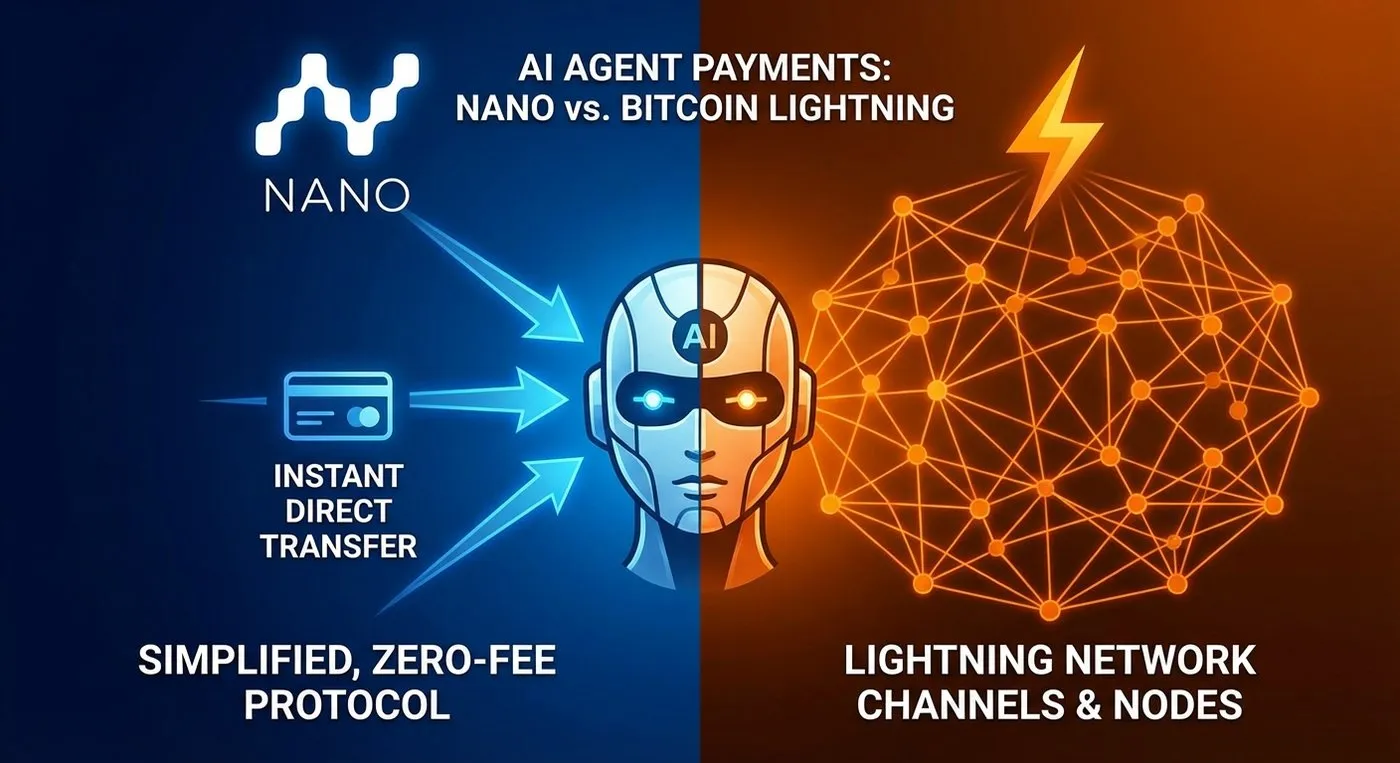
Lightning Labs just put Bitcoin into AI agents. On February 11, 2026, they released an open-source toolkit that lets AI agents run Lightning nodes, pay for APIs, and host paid endpoints. The announcement made headlines across crypto and AI media.
But here’s the thing: a $71 million cryptocurrency you’ve never heard of has been doing this since October 2024. And it’s doing it better.
NANO powers NanoGPT, a pay-per-prompt AI service with 200+ models. Zero fees. 0.2-second settlement. No channel management complexity. In November 2024, NANO accounted for 77.8% of all crypto payments on the platform by transaction count, and 51.35% by volume. Despite being ranked #293 by market cap.
This is a story about why better tech doesn’t always win, and what that means for the emerging AI agent economy.
What is NANO?
NANO launched in 2015 as RaiBlocks, rebranded in 2018. It’s built on something called a Block Lattice, which is a fancy way of saying each account has its own blockchain instead of everyone competing for space on one shared ledger.
Here’s why that matters:
- No fees. Ever. Not “near-zero” fees. Actual zero. No miners to pay, no gas markets.
- 0.2-second settlement. Average confirmation time under normal network conditions.
- No network congestion. Transactions don’t compete for block space because each account updates independently.
The supply is fixed at 133.25 million XNO. No inflation. No mining rewards. The entire supply was distributed at launch via a faucet back in 2015.
As of February 21, 2026, NANO trades around $0.54 with a market cap of ~$71.5 million. Ranked #293 on CoinMarketCap. Most people in crypto have never heard of it.
NanoGPT: The proof of concept
NanoGPT is a pay-per-prompt AI service. You don’t need an account. You don’t need KYC. You top up a balance, use prompts, withdraw unused funds anytime. Minimum deposit: $0.01. That’s only possible because there are no transaction fees.
The platform offers access to 200+ AI models: ChatGPT-4o, Claude 3.5 Sonnet, Gemini 1.5 Pro, Llama 3.1, Grok 2, Dall-E 3, Flux Pro, and more. No monthly subscriptions. You pay only for what you use.
In October 2024, NanoGPT co-founder Milan de Reede published a blog post explaining why the platform offers a 5% discount for NANO payments (versus credit cards).
Credit card costs:
- Stripe base fee: $0.30
- Variable fee: 3%
- On a $5 transaction: $0.45 in fees (9%)
- Additional costs: VAT determination (1%), currency conversion, payout fees
- Total: over 10% on small transactions
Stripe payouts: 7 to 14 days. Instant payouts available for an additional fee.
NANO:
“Nano offers an extremely simple zero fee. It’s $0, regardless of amount paid, regardless of the time of day.”
Payments are instant. No chargebacks. No fraud risk. Merchants get funds immediately instead of waiting two weeks.
The November 2024 stats
In November 2024, NanoGPT published payment statistics showing actual cryptocurrency usage on the platform:
By transaction count:
- NANO: 77.8% of all crypto payments
By volume:
- NANO: 51.35% of total crypto payment volume
This is a cryptocurrency with a $75 million market cap (at the time) competing against Bitcoin ($1.7 trillion+), Ethereum, Monero, and Bitcoin Cash. And winning.
Milan de Reede told Finbold:
“The reason we like Nano so much despite its low market cap is that it’s quite unrivaled as a medium of exchange with zero fees and instant confirmations, but also that we think it fundamentally might be the strongest possible store of value… We feel more confident about it than any other crypto.”
Lightning Labs’ AI agent toolkit
Lightning Labs’ February 2026 announcement was slick. They released a toolkit with seven composable skills that lets AI agents:
- Run Lightning nodes (with remote signer for security)
- Pay for L402-gated APIs automatically
- Host paid endpoints (sell resources to other agents)
- Manage scoped credentials (limit spending via macaroons)
- Query node state via MCP (Model Context Protocol)
The centerpiece is lnget, a command-line HTTP client that handles Lightning payments automatically. Hit an L402-gated API, get a 402 status code, lnget pays the Lightning invoice and retries the request. All transparent to the agent.
It’s impressive infrastructure. Lightning Labs raised $70+ million in VC funding. They have mature developer tooling, extensive documentation, and Bitcoin’s brand behind them. They timed their announcement perfectly during the peak of AI agent hype.
The technical comparison
Here’s the honest assessment:
Settlement:
- NANO: 0.2 seconds, instant finality
- Lightning: Sub-second when routing succeeds, but requires finding a payment path
Fees:
- NANO: $0 (always)
- Lightning: Near-zero for payments, but opening and closing channels costs on-chain Bitcoin fees
Infrastructure:
- NANO: Direct account-to-account transfers
- Lightning: Requires channels, liquidity management, rebalancing
Complexity:
- NANO: Send and receive. That’s it.
- Lightning: Channel management, liquidity balancing, routing path-finding, watchtowers
Privacy:
- NANO: Transparent public ledger
- Lightning: Better (onion routing hides payment details)
Base layer security:
- NANO: Own consensus (Open Representative Voting)
- Lightning: Bitcoin’s Proof of Work (most secure blockchain)
Ecosystem:
- NANO: Small community, limited tooling
- Lightning: Large ecosystem, mature developer tools, Bitcoin brand
NANO is technically simpler and cheaper for machine-to-machine payments. Lightning has the network effect, the ecosystem, and the timing.
Why NANO isn’t winning
1. Brand recognition
Bitcoin is a household name. Lightning Network rides that wave. NANO is ranked #293 by market cap and unknown outside crypto enthusiast circles.
2. Developer ecosystem
Lightning Labs just released a full toolkit: lnget, L402 protocol, MCP server, remote signer architecture, scoped credentials. They have extensive docs, tutorials, and support.
NANO has basic RPC APIs and integration guides. Small community. No major company backing.
3. Exchange access
Lightning is integrated into Kraken, Coinbase (via partnerships), Strike, Cash App. Institutional custodians offer Lightning services.
NANO is on Binance, Kraken, and smaller exchanges. Harder to on/off-ramp fiat. No major institutional custody.
4. Network effect
Lightning has thousands of nodes, Lightning Service Providers abstracting complexity, apps like Strike and Cash App making it accessible. Growing merchant adoption.
NANO has a small community. NanoGPT is one of the only high-profile use cases.
5. Narrative
Bitcoin’s story: sound money, separation of money and state, digital gold. Lightning as the scaling solution for Bitcoin. Ideological. Emotionally resonant.
NANO’s story: fast and free payments. Technical superiority. Less emotionally resonant.
Ideology drives adoption more than performance specs.
6. Timing
Lightning Labs announced their AI agent tools on February 11, 2026, during peak AI agent hype. OpenAI’s Codex 5.3, Anthropic’s Claude Opus 4.6, OpenClaw, Moltbook. AI agents making phone calls, deploying code, autonomously managing infrastructure.
Perfect timing to position Lightning as “the payment rail for the AI economy.”
NanoGPT launched in October 2024, 16 months earlier. Before AI agents were mainstream. Quiet launch. Little media coverage.
What this tells us about tech adoption
Better tech doesn’t always win.
VHS vs. Betamax: VHS won despite inferior video quality. Network effect, licensing strategy.
QWERTY vs. Dvorak: QWERTY keyboard layout won despite slower typing speeds. Legacy lock-in.
Bitcoin vs. faster L1s: Bitcoin remains #1 despite slower block times and higher fees. First-mover advantage, brand.
What determines adoption:
- Network effects (value increases as more users join)
- Ecosystem partnerships (integrations with major platforms)
- Developer tooling (ease of building on top)
- Narrative and branding (emotional resonance)
- Timing (being ready when the market wants the solution)
NANO has the tech. Lightning has everything else.
Could NANO still win?
Maybe. Here are the scenarios:
1. Major AI company adoption
If OpenAI, Anthropic, or Google integrated NANO for AI agent payments. Unlikely. They’d choose Bitcoin/Lightning (brand safety) or build their own.
2. Lightning’s complexity becomes a blocker
If channel management proves too difficult for developers at scale. If routing failures create poor user experience. If on-chain fees for channel opens/closes become prohibitive during high congestion.
3. Feeless payments become a hard requirement
If certain micropayment use cases require literally $0 fees. Lightning’s “near-zero” isn’t good enough.
4. Multi-rail future
Just as traditional finance has Visa, Mastercard, ACH, wire transfers. AI agents could use Lightning (Bitcoin ecosystem), NANO (feeless microtransactions), stablecoins (fiat pegs).
What NANO would need to compete:
- Major funding or company backing (Lightning Labs raised $70M+)
- Developer tooling investment (build equivalent of lnget, L402, MCP server)
- Exchange and custody partnerships
- Marketing and narrative (story that resonates beyond “faster and cheaper”)
- Killer app (NanoGPT needs to scale 10x to 100x)
Current reality: NANO is a small open-source project with a tiny community. Lightning is backed by a well-funded company riding Bitcoin’s coattails during an AI hype cycle.
The takeaway
NANO proves that feeless, instant payments for AI agents can work. NanoGPT isn’t a demo. It’s a live service with 200+ models and real usage data showing NANO dominated 77.8% of payments despite being ranked #293 by market cap.
Lightning proves that ecosystem and timing matter more than technical superiority.
For developers building AI agent payment infrastructure: NANO’s simplicity (direct transfers, no routing, no channel management) is genuinely appealing for high-frequency machine payments. But Lightning’s network effect and developer tooling make it the safer bet for most use cases.
The AI agent economy may be big enough for multiple payment rails. We might see Lightning for Bitcoin-native apps, NANO for ultra-low-cost microtransactions, and stablecoins for fiat-denominated services. Or Lightning might win everything by default because it has Bitcoin’s brand and Lightning Labs’ execution.
For now, Lightning is winning the narrative. Even if NANO has the better tech.
Sources
- Nano Documentation: Protocol Design
- Nano Developers: Block Lattice
- CoinGecko: NANO Price
- CoinMarketCap: NANO Market Data
- NanoGPT Website
- Nano.org Blog: NanoGPT – Why do we prefer payments in Nano?
- Finbold: Small-cap crypto dominates payments in this AI pay-per-use hub
- Lightning Labs Blog: The Agents Are Here and They Want to Transact
- The Block: Lightning Labs releases AI agent tools
- Bitcoin Magazine: Lightning Labs rolls out AI agent tools