El Salvador's Bitcoin experiment: four years of real data, one clear lesson
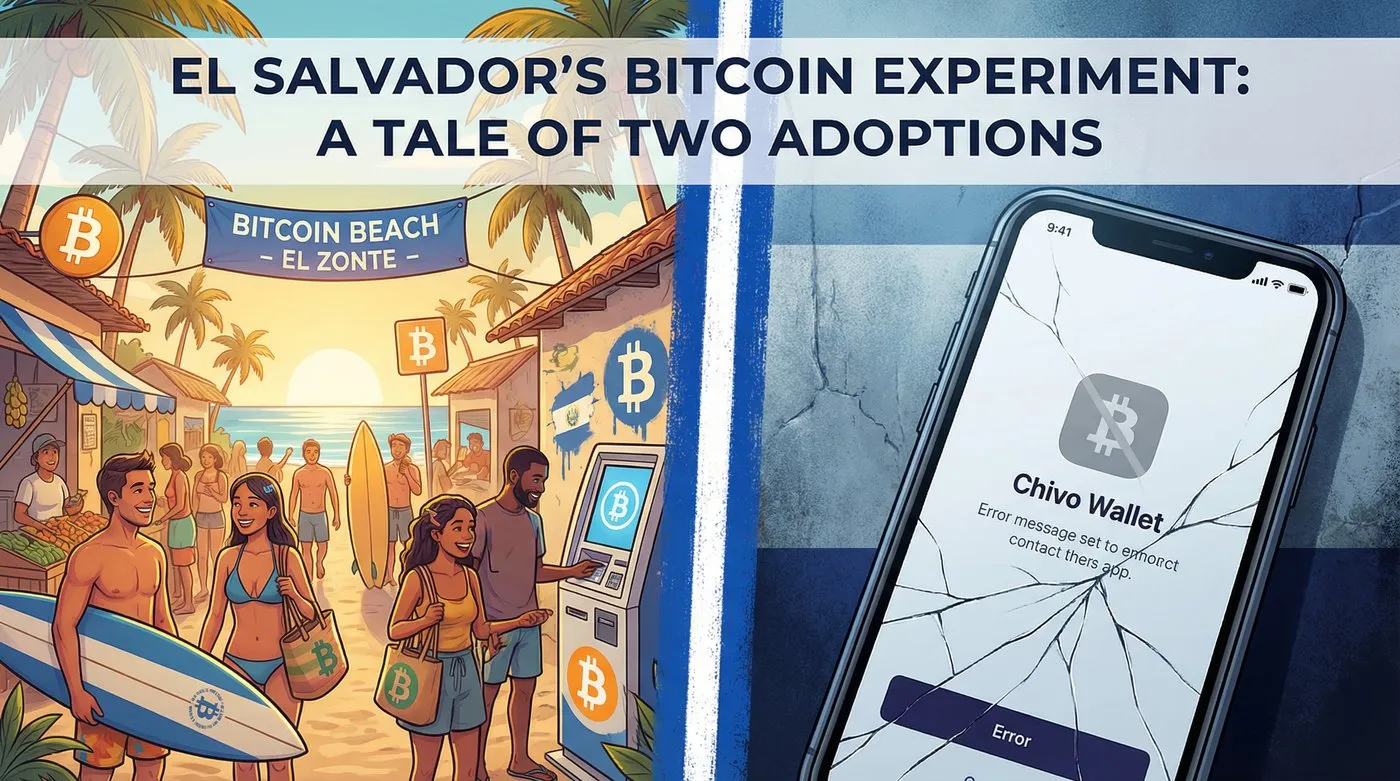
In January 2025, El Salvador’s legislature voted to strip Bitcoin of its legal tender status. The mandatory acceptance requirement that Nayib Bukele had announced at a Miami Bitcoin conference in 2021 was gone. The Chivo wallet, the state-backed app every Salvadoran adult was incentivised to download with a $30 sign-up bonus, is being sold or wound down as part of a $3.5 billion IMF loan deal.
The government still holds 7,566 BTC, currently worth around $508 million. Bukele posted “No, it’s not stopping” in March 2025 when asked about Bitcoin purchases. The Bitcoin Office continues to operate.
So is this a failure, a partial success, or something harder to categorise? The data from four years is now in. It’s worth going through carefully, because the lessons are not what either Bitcoin advocates or critics want them to be.
What the remittance data actually shows
The central promise was that Bitcoin would cut the cost of remittances. El Salvador’s diaspora, primarily in the United States, sends home roughly 23-24% of GDP. If you could route that money through Lightning instead of Western Union, millions of families would keep more of it.
It didn’t work out that way. According to the Central Reserve Bank of El Salvador, Bitcoin was used in just 1.9% of remittance payments in the first year of the law. By 2023, that figure had dropped to 1.3%, per El País reporting in September 2023. The IMF Country Report published in March 2025 put the 2024 figure at approximately 1.75%, broadly flat across three years, not a growth story. Americas Quarterly puts it at around 1%.
The core problem: on-chain Bitcoin transaction fees can exceed what Western Union charges. During periods of congestion, they often did. The cost advantage that made the pitch compelling simply wasn’t there in practice.
The $30 bonus that didn’t stick
The Chivo wallet launch is a textbook case study in the difference between incentivised adoption and genuine utility adoption.
Bukele claimed two million active users within weeks of the September 2021 launch, driven by the $30 Bitcoin sign-up bonus. But the National Bureau of Economic Research studied the actual usage data and found that 20% of people who downloaded Chivo never used their $30 bonus at all. Of those who did use the app, 61% stopped after spending it.
One of El Salvador’s largest banks reported that in the first week of Chivo, under 0.0001% of its transactions were in Bitcoin. By the end of 2021, an independent UCA survey found that only 36.3% of Salvadorans used Bitcoin at least once a month. By 2024, just 8.1% reported using it at all. The trajectory was 25.7% in 2021 to 21% in 2022 to 12% in 2023 to 8.1% in 2024.
Even when the mandate was legally in force, enforcement was minimal. The Salvadoran Chamber of Commerce found that only 14% of businesses had conducted Bitcoin transactions between September 2021 and July 2022, despite the legal requirement to accept it. Only 3% felt that being able to use Bitcoin was valuable.
The IMF showdown
The IMF warned El Salvador about Bitcoin risks as early as January 2022. Linking the concern to a then-pending $1.3 billion loan created real leverage, but the formal reckoning took three more years.
In December 2024, the IMF announced a staff-level agreement for a 40-month loan arrangement. The conditions: Bitcoin acceptance by the private sector would become voluntary; taxes would be payable only in US dollars; public sector engagement in Bitcoin activities would be “confined”; and Chivo would be sold or wound down. The IMF’s framing was measured: “The potential risks of the Bitcoin project will be diminished significantly in line with Fund policies.”
In January 2025, the legislature formally amended the Bitcoin Law. In February 2025, the amendment passed. On February 26, 2025, the IMF formally approved the arrangement: $1.4 billion from the IMF directly, with the full $3.5 billion package coming from the World Bank, the Inter-American Development Bank, and regional development banks.
As José Ignacio Hernández wrote in Americas Quarterly in March 2025: “On a de jure level, Bitcoin was legal tender in the country, but it was only rarely used.”
The one thing that actually worked
Before the Bitcoin Law, before Chivo, before Bukele’s Miami announcement, there was El Zonte.
A small beach community on El Salvador’s Pacific coast, El Zonte received an anonymous $100,000 Bitcoin donation in 2019. Instead of a top-down mandate, it built a bottom-up circular economy over two years: merchants accepting Bitcoin, community members earning and spending it, visitors arriving specifically to participate. Some businesses reported a 30% increase in revenue from cryptocurrency tourists, according to BBC reporting in June 2022.
El Zonte worked because people chose to use Bitcoin. There was no mandate, no expiring bonus to burn through, no government wallet with uncertain security. The adoption was earned.
The Bitcoin Law tried to replicate that nationwide, at gunpoint of the law, without the underlying two years of community trust-building. The NBER data shows exactly what happened: people collected the $30, spent it, and stopped.
Hernández put the lesson plainly: “Rather than trying to force Bitcoin’s use through top-down lawmaking, proponents should pursue a bottom-up strategy that would more effectively foster public confidence.”
The economic context people get wrong
El Salvador’s economy is growing. The IMF projects real GDP growth of around 4% for 2025 and 2.5% for 2026. Bukele’s supporters point to these numbers as vindication of the Bitcoin experiment.
The IMF itself attributes the rebound to “robust remittance inflows, rising investment levels, and improvements in domestic security conditions.” The security crackdown that began in March 2022 dramatically reduced gang violence and is the most widely cited cause of El Salvador’s improved investment climate and tourism. Not Bitcoin.
There is no clean way to isolate Bitcoin’s contribution to El Salvador’s economy from the concurrent security improvements. Anyone attributing the 2025 recovery primarily to the Bitcoin experiment is ignoring what the data actually says.
What still stands
El Salvador still holds 7,566 BTC. At current prices, that’s roughly $508 million on an investment that cost a fraction of that in accumulation. The paper gains are significant.
Bitcoin is still legal to use voluntarily. Private businesses can accept it. The Bitcoin Office continues operating educational programs and capital markets development. The January 2025 amendment removed the mandate; it didn’t ban Bitcoin.
The IMF deal’s transparency requirements may end up creating better conditions for genuine adoption than the mandate ever did. As the Americas Quarterly analysis noted, the deal forces accountability and anti-money laundering frameworks that the original Bitcoin Law lacked. A cleaner, more transparent regulatory environment could support the voluntary, trust-based adoption that El Zonte demonstrated is possible.
What this means for other countries
Several countries with inflation or currency instability have watched El Salvador closely. The data sends a clear message.
The remittance efficiency argument didn’t work because on-chain fees undermined the cost advantage. Mandatory acceptance can’t be enforced in a cash-heavy economy without digital infrastructure. El Salvador ranked last in Latin America on the IDB’s 2023 Broadband Development Index; Bitcoin adoption at scale requires internet access. The IMF will push back, and the IMF has real leverage over developing-country finances.
The distinction that matters most: the experiment failed at the mandated top-down rollout. It didn’t fail at voluntary community-based adoption. Those are different things. El Zonte still exists. That model still works.
Sources
- El Salvador to Shut or Sell Chivo Crypto Wallet as Part of $3.5B IMF Deal — CoinDesk, December 19, 2024
- In El Salvador, Bitcoin’s Retreat Left Valuable Lessons — Americas Quarterly, José Ignacio Hernández, March 24, 2025
- IMF softens stance as El Salvador’s Bitcoin bet coincides with economic rebound — Crypto.news, December 24, 2025
- El Salvador Advances Chivo Wallet Sale Despite Bukele’s Bitcoin Buying Pledge — Tico Times, December 24, 2025
- Bitcoin in El Salvador — Wikipedia (aggregating primary sources including UCA/IUDOP polling, NBER Working Paper 29968, Chamber of Commerce data)
- IMF Country Report No. 25/68 — IMF, March 2025 (remittance data: 1.75%)
- El Salvador government Bitcoin holdings — Bitcoin Treasuries (sourcing Bitcoin Office of El Salvador), accessed February 18, 2026
- The Economist: El Salvador’s wild crypto experiment ends in failure — The Economist, March 2, 2025
- El Salvador: Bitcoin apenas se usa para remesas — El País, September 2023 (2023 remittance figure: 1.3%)
Data and pipeline status as of February 18, 2026.